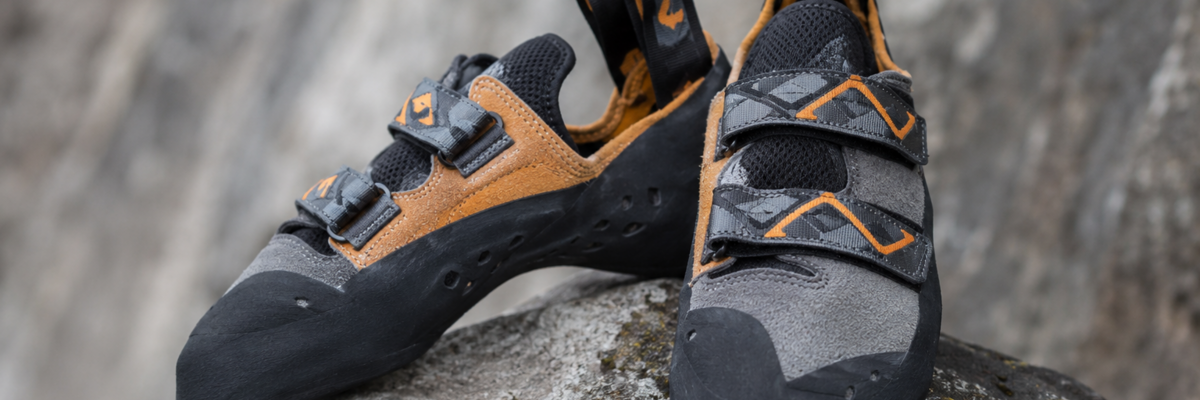
Today, climbing shoes are one of the most recognizable pieces of climbing equipment. They are easy to identify: a thin rubber sole, a tight fit, an unusual shape, and, in many modern models, a strongly downturned toe.
For someone seeing climbing shoes for the first time, they can look rather strange.
Why make footwear so small and unusual?
The answer is simple: climbing shoes are designed not for walking, but for precise footwork on rock.
Modern climbing shoes allow climbers to stand on tiny edges, work on vertical and overhanging surfaces, use friction on smooth slabs, and perform movements that would be extremely difficult in ordinary footwear.
But modern climbing shoes did not appear overnight.
Their history is almost a century of experimentation with rubber, shape, materials, and climbing technique.
And the most interesting part is that the evolution of climbing shoes and the evolution of climbing itself have constantly influenced each other.
What Are Climbing Shoes?
Climbing shoes are specialized footwear designed for rock climbing and indoor climbing.
Unlike ordinary athletic shoes, they have a thin sole made from specialized rubber that provides high friction against rock.
Their construction allows climbers to feel the surface beneath their feet as precisely as possible.
Modern climbing shoes depend on many design elements:
-
toe shape;
-
sole stiffness or softness;
-
rubber compound;
-
asymmetry;
-
downturn;
-
rand;
-
heel construction;
-
closure system;
-
last shape.
All of these factors affect how a climber can use their feet.
That is why there is no single "best" climbing shoe today.
There are climbing shoes designed for different styles of climbing, different surfaces, and different levels of experience.
But to understand why they became what they are today, we need to go back in time.
What Makes Climbing Shoes Different?
The most important component of a modern climbing shoe is rubber.
The sole of a hiking boot needs to be durable, provide protection and cushioning, and work across many different surfaces.
Climbing shoes have a different purpose.
Their main job is to provide the most precise possible contact with the rock.
That is why their soles are thin and their rubber compounds are specifically designed for grip.
This allows climbers to use techniques such as edging - standing on very small edges - and smearing - using friction on relatively smooth surfaces.
That is why an experienced climber can place a foot on an almost invisible edge and transfer a significant amount of their weight onto it.
But modern climbing shoes do more than just use the sole.
Rubber can extend around the toe, sides, and heel. This allows climbers to use different techniques, including toe and heel hooks on difficult sections.
Before Climbing Shoes: What Did Climbers Wear?
Modern rock climbing grew out of mountaineering, so the earliest footwear used for climbing was closely connected to traditional mountain boots.
During different periods, climbers used footwear with soles made from felt, rope materials, and later rubber.
An especially interesting example comes from the history of climbing in the Dolomites.
During the first half of the 20th century, some famous Italian climbers used lightweight footwear with textile uppers and relatively smooth soles.
One of them was Emilio Comici, one of the most influential climbers of the generation that developed technical climbing in the Dolomites.
Later, more rigid mountain boots with rubber soles became widespread, particularly following the introduction of Vibram soles.
They represented a major technological step forward for mountaineering.
But technical rock climbing created a different problem.
Rigid footwear protected the foot, but limited sensitivity and freedom of movement.
And this is where the real evolution of climbing shoes began.
Pierre Allain and the First Specialized Climbing Shoes
One of the key figures in this story was French climber Pierre Allain.
He experimented with footwear construction and rubber soles, trying to create shoes that would perform better specifically on rock.
The result was the famous PA boots.
Production began in 1947, and they became an important step in the transition from traditional mountaineering footwear to specialized climbing shoes.
This represented a fundamentally different approach.
Footwear was no longer designed simply to allow someone to walk through the mountains.
It was beginning to be designed around the specific demands of climbing technique.
EB - Climbing Shoes That Conquered Europe
The next important stage was the story of the French company EB.
After World War II, Edmond Bourdonneau acquired the business associated with Pierre Allain's footwear and began developing it.
One of the best-known models was the EB Super Gratton.
It became extremely popular among European climbers and helped establish a new generation of specialized climbing footwear.
But even these models were very different from what we call climbing shoes today.
They were stiffer, had different geometry, and provided much less sensitivity than modern models.
The next major leap required more than a new shape.
It required new rubber.
Sticky Rubber: The Revolution That Changed Climbing
One of the most important technological breakthroughs was the development of genuinely sticky rubber for climbing shoes.
The Spanish Boreal Fire, introduced in the early 1980s, became particularly famous.
This was a turning point.
Climbers had already experimented with different rubber compounds, but the development of specialized sticky rubber greatly expanded what climbing shoes could do.
The sole no longer simply had to be durable.
It could grip the rock.
The development of specialized rubber became one of the factors that allowed climbers to work more confidently on smooth slabs and tiny holds. Historical accounts of climbing's development connect this period with the emergence of sticky-rubber climbing shoes.
The 1980s: Climbing Shoes Become a Sporting Tool
The 1980s brought another major transformation.
Climbing increasingly separated from traditional mountaineering.
Free climbing developed, followed by sport climbing.
The philosophy of climbing itself was changing.
Previously, footwear primarily needed to protect the foot, be durable, and provide reliable support.
Now climbers demanded something different:
maximum precision and performance.
This can be clearly seen in the work of Heinz Mariacher and La Sportiva.
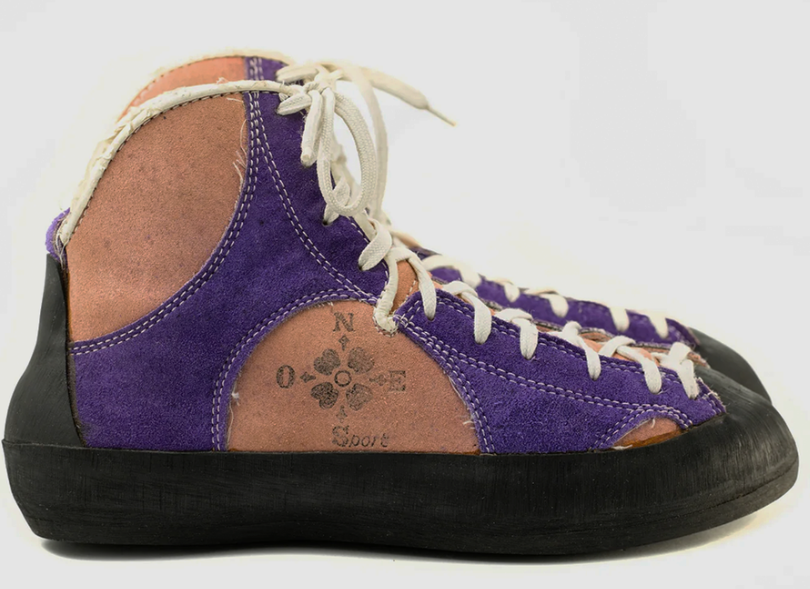
In the early 1980s, the Mariacher model appeared - a softer, more flexible shoe designed around precise footwork. Its distinctive purple-and-yellow appearance became almost a symbol of a new era in climbing.
This was no longer simply a boot for climbing.
It was a sporting tool.
Mariacher: When Everything Changed
Today it is difficult to appreciate how significant this transformation was.
Older models were generally relatively rigid.
The new generation of climbing shoes became:
-
lighter;
-
softer;
-
more flexible;
-
more precise;
-
lower-profile;
-
better adapted to the shape of the foot.
And climbing technique evolved with them.
Climbers began using more dynamic movements, placing the toe more precisely, relying on friction, and looking for new ways to interact with the rock.
La Sportiva itself describes the arrival of the Mariacher as a major turning point in the history of climbing footwear.
This is an important point.
Climbing shoes did not simply become better. They allowed climbers to climb differently.

From Rigid Shoes to Slippers
Another step in the evolution was the emergence of very soft climbing shoes without traditional lacing.
In 1984, La Sportiva introduced early slipper-style climbing shoes, which could be put on almost like a ballet slipper.
This reduced the amount of construction and placed even greater emphasis on sensitivity and foot control.
These shoes were particularly well suited to the emerging style of climbing, where precise control of every movement was becoming increasingly important.
The 1990s: The Modern Climbing Shoe Takes Shape
During the 1990s, development accelerated.
Manufacturers experimented with last shapes, asymmetry, rand construction, downturn, and heel design.
Climbing shoes became increasingly specialized.
It was no longer enough to simply make a "good shoe for climbing."
The question became:
For what kind of climbing?
For slabs?
For vertical walls?
For overhangs?
For cracks?
For bouldering?
For long routes?
For competitions?
This is where the enormous diversity of modern climbing shoes began to emerge.
What Types of Climbing Shoes Exist Today?
Modern climbing shoes can broadly be divided into several categories.
Neutral Climbing Shoes
These have a shape that keeps the foot relatively close to its natural position.
They are generally more comfortable and well suited for:
-
beginners;
-
long climbing sessions;
-
multipitch routes;
-
longer climbs;
-
training.
For a first pair, they are often a very sensible choice.
Moderately Aggressive Climbing Shoes
These shoes introduce more noticeable asymmetry and a slight downward curve toward the toe.
They aim to combine two things:
precision + the ability to stay in the shoes for longer periods.
This makes them one of the most versatile categories for experienced climbers.
Aggressive Climbing Shoes
Here the shape becomes significantly more downturned.
The toe points downward and the foot takes a more tensioned position.
These shoes are primarily designed for difficult routes, overhangs, bouldering, and situations where maximum efficiency on small holds is required.
But increased performance usually comes at the cost of comfort.

Laces, Velcro or Slippers?
Another major area of development is the closure system.
Laces
They allow very precise adjustment.
They are especially useful when it is important to adapt the shoe closely to the shape of the foot.
Velcro
Quick to put on and take off.
This is particularly convenient for bouldering or training sessions, when climbers frequently remove their shoes between attempts.
Slippers
Minimal construction and maximum connection with the foot.
But there is no universal winner.
Modern climbing shoes are so diverse that the closure system has become part of the overall design philosophy of each model.
Why Are Modern Climbing Shoes So Uncomfortable?
This is probably the first question someone asks when they see a pair of performance climbing shoes.
Why are they so small?
And why would a climber put their foot into something that looks several sizes too small?
The answer is precision.
The foot should not move around inside the shoe.
When the foot is held firmly in place, the climber can control the position of the toe much more precisely.
But it is important to distinguish between a close fit and pain.
A climbing shoe does not necessarily need to be so small that wearing it becomes unbearable.
Modern fitting is much more nuanced: size and shape depend on the model, the shape of the foot, the climber's experience, and the intended use.
The rule "smaller is always better" is an oversimplification.
Climbing Shoes for Indoor Climbing, Bouldering and Rock
The diversity of modern climbing shoes becomes especially clear when comparing different disciplines.
Bouldering
Soft and aggressive models are often preferred because they perform well on small holds and during dynamic movements.
Sport Climbing
The goal is usually a balance between precision, sensitivity, and the ability to remain in the shoes throughout the route.
Traditional Climbing
Different properties may become important, particularly when the route involves crack climbing.
Multipitch Climbing
Comfort becomes much more important.
When you need to spend hours on a vertical route, an excessively aggressive climbing shoe can become a serious problem.
Indoor Climbing
Many climbers keep a separate pair for training, which is one reason why owning several pairs of climbing shoes has become common.
Climbing Shoes as a Symbol of Climbing
Throughout their history, climbing shoes have become more than just a piece of equipment.
They have become a symbol of climbing itself.
For a mountaineer, that symbol might be an ice axe.
For a sport climber, it might be a carabiner, rope, or climbing shoe.
That is why the shape of a climbing shoe has long existed beyond the world of practical equipment.
For us, it became the inspiration for a piece of jewelry - the Silver Climbing Shoe Pendant.
It is a small stylized climbing shoe that turns a piece of climbing equipment into a symbol of a passion for rock, climbing, and mountains.
How to Choose Your First Climbing Shoes?
If someone is just starting to climb, the temptation to buy the most aggressive model possible is understandable.
But it is not always a good idea.
For a first pair, what matters more is:
-
proper fit;
-
compatibility with the shape of your foot;
-
minimal unwanted movement;
-
sufficient comfort;
-
suitability for your style of climbing;
-
the ability to learn good footwork.
Your first climbing shoes should help you learn to use your feet, rather than make you think only about when you can take them off.
As your experience grows, your needs change.
It then becomes perfectly natural to have different pairs for indoor climbing, bouldering, outdoor rock climbing, multipitch routes, or difficult sport climbing.
How Have Climbing Shoes Changed Over the Last Century?
If we look at the entire history at once, the evolution looks something like this:
Mountaineering boots
↓
Lightweight footwear with smooth soles
↓
PA and EB
↓
Specialized rubber compounds
↓
Sticky rubber
↓
Soft and flexible climbing shoes
↓
Asymmetry and aggressive downturn
↓
Specialized shoes for different disciplines
↓
Modern high-performance climbing shoes
And this is not simply the history of footwear development.
Climbing itself changed together with climbing shoes.
As footwear became more precise, climbers began using smaller holds.
As rubber improved, smoother surfaces became accessible.
As shoes became softer, new ways of using the foot emerged.
The evolution of climbing shoes opened up new possibilities for humans on rock.

The Olympics and a New Era for Climbing Shoes
Perhaps the story of climbing shoes is far from over.
Sport climbing made its Olympic debut at Tokyo 2020. At those Games, athletes competed in a combined format that included speed climbing, bouldering, and lead climbing.
At Paris 2024, the format changed: speed became a separate discipline, while bouldering and lead climbing were combined into a separate event.
This is an important moment in the history of climbing.
The sport is no longer developing only around traditional climbing on natural rock. It now has a huge international competitive stage where hundredths of a second, precision, strength, balance, and the ability to execute extremely difficult technical movements all matter.
And this could become a new driver in the evolution of climbing shoes.
Manufacturers already create footwear for specific climbing styles. The growth of professional competition may push specialization even further.
Perhaps in ten or twenty years, today's climbing shoes will look as primitive to us as the first PA shoes or the rigid models of the mid-20th century look today.
The history of climbing shoes is still being written.
And it is entirely possible that the next major revolution in climbing footwear has already begun.
You might also like
What to Gift a Rock Climber: 20 Thoughtful Gift Ideas They'll Actually Use
The Climbing Carabiner: The Story of One of the Most Important Inventions in Mountaineering
Mount Everest: History, First Ascents, Routes and Modern Mountaineering