In 1924, George Mallory and Andrew “Sandy” Irvine set out for the summit of Mount Everest. They were seen high on the mountain’s Northeast Ridge, moving upward toward the summit. Then clouds covered the mountain, and the two climbers were never seen alive again.
Twenty-nine years later, Edmund Hillary and Tenzing Norgay made the first confirmed ascent of Everest.
But what if Mallory and Irvine had already reached the summit?
That question has remained one of the greatest mysteries in mountaineering history for more than a century.
In 1999, George Mallory’s body was discovered high on Everest. In 2024, an expedition found a boot and human remains believed to belong to Sandy Irvine.
But one crucial object is still missing.
The Kodak camera that Irvine may have been carrying.
If it is ever found and the film has survived, the photographs could potentially change our understanding of the first ascent of the world’s highest mountain.
Everest in 1924
At the beginning of the 1920s, Mount Everest remained one of the greatest challenges in mountaineering.
The first British reconnaissance expedition reached the mountain in 1921. A second British expedition followed in 1922 and made much more ambitious attempts to reach the summit.
That expedition achieved remarkable altitudes for the time. George Finch and Geoffrey Bruce reached approximately 8,321 metres using supplemental oxygen.
But the expedition also ended in tragedy. An avalanche on the North Col killed seven Sherpa climbers.
In 1924, the British returned to Everest.
Among the climbers was George Mallory, who had already taken part in the 1921 and 1922 expeditions.
This time, however, he had a new climbing partner.
George Mallory and Sandy Irvine
George Mallory
George Mallory was one of the best-known British mountaineers of his generation.
He had already participated in the 1921 and 1922 Everest expeditions and had extensive experience on the mountain's northern side.
The 1924 expedition was his third attempt to reach the summit.
Mallory's determination was extraordinary. In a letter to his wife, he described the expedition in terms that revealed just how deeply the mountain had affected him.
For Mallory, Everest was no longer simply an unexplored peak.
It had become a personal challenge.
Sandy Irvine
Andrew Comyn Irvine, known as Sandy, was very different from Mallory.
He was only 22 years old in 1924 and was the youngest member of the expedition.
Irvine studied at Oxford, was a talented rower and was exceptionally fit.
But his physical strength was not his only advantage.
He was also highly skilled with machinery and technical equipment.
This was particularly important because the expedition relied on supplemental oxygen systems. Irvine worked on improving the equipment and making it lighter and more reliable.
His practical skills made him a valuable climbing partner for Mallory.


June 8, 1924: The Final Attempt
On June 8, Mallory and Irvine set out toward the summit.
They were climbing via Everest's Northeast Ridge and were using supplemental oxygen.
Earlier that day, conditions were relatively favourable.
Lower on the mountain, expedition member Noel Odell was watching the summit ridge.
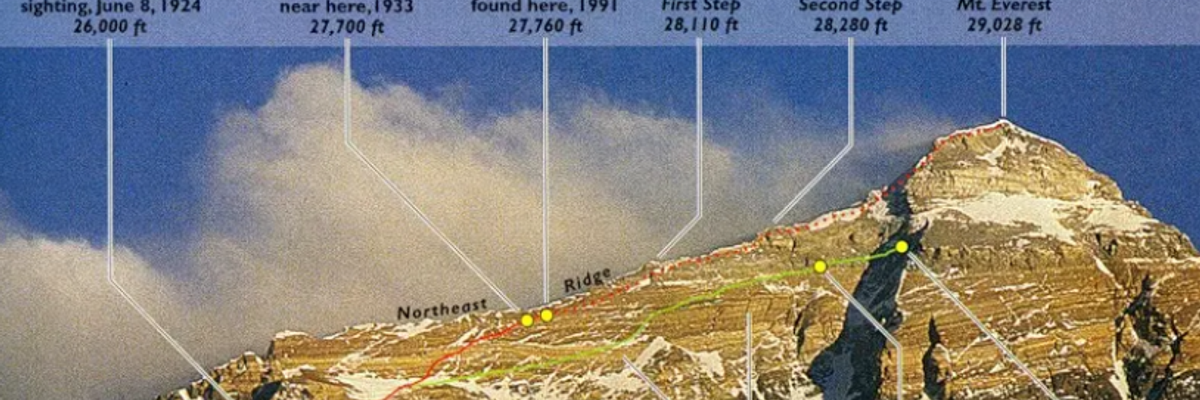
At approximately 12:50 p.m., the clouds briefly cleared.
Odell saw two tiny figures high on the ridge.
According to his account, they appeared to be moving upward near one of the major rock steps on the route.
It was the last time Mallory and Irvine were seen alive.
The clouds closed over the mountain again.
They never returned.
Where Exactly Did Odell See Them?
This remains one of the most debated details of the story.
Odell described seeing the climbers near one of the major rock features of the Northeast Ridge.
One particularly important possibility is the Second Step, one of the most difficult technical obstacles on the route.
If Mallory and Irvine were actually near the Second Step at the time Odell saw them, they were already extremely high on Everest.
But there is an important qualification.
There is no definitive proof that Odell was looking at the Second Step.
Historical interpretations of his account have varied, and modern researchers have continued to examine the terrain and his original descriptions.
This uncertainty is important because the exact location of the two climbers could tell us how close they were to the summit.
Did Mallory and Irvine Reach the Summit?
This is the central mystery.
We know that they were moving upward.
We know they were extremely high on the mountain.
But we do not know what happened after the clouds hid them from Odell.
There are two fundamental possibilities.
They died during the ascent
Mallory and Irvine may have been unable to overcome the difficult upper sections of the route.
They could have fallen, suffered equipment failure or succumbed to the extreme conditions at altitude.
They reached the summit and died on the descent
This is the possibility that has fascinated mountaineers for generations.
If Mallory and Irvine reached the summit, they could have become the first people to stand on Everest - almost three decades before Hillary and Tenzing.
But there is no direct evidence proving this.
That is why the question remains open.
The Most Important Clue: The Camera
This is where the story becomes a genuine mountaineering mystery.
Irvine is believed to have been carrying a small folding Vest Pocket Kodak camera.
It was a compact camera that could be carried during an expedition.
And if the camera remained somewhere on Everest, there could potentially be film inside it.
Film containing photographs.
The importance of the camera is obvious.
A photograph from the summit could potentially provide evidence.
If the film contained a photograph taken from the summit of Everest on June 8, 1924, it could fundamentally change the history of the mountain's first ascent.
Why Might Irvine Have Been Carrying the Camera?
There are indications that Irvine may have been carrying the camera during the final attempt.
He had experience with photography, and the camera was never found with Mallory.
When Mallory's body was discovered in 1999, the camera was not among his belongings.
This has contributed to the theory that Irvine may have been carrying it during their final climb.
But this is still not proven with absolute certainty.
There is no surviving document or eyewitness account that conclusively establishes who was carrying the camera at the moment they left for the summit.
What Happened to Mallory?
After Mallory and Irvine disappeared, searches were carried out, but Everest kept their secret for decades.
In 1933, an ice axe believed to have belonged to Irvine was discovered high on the mountain.
But neither climber was found.
For decades, researchers could only speculate about where they had died.
Then, in 1999, everything changed.
1999: Mallory Is Found
In 1999, an expedition specifically searching for Mallory and Irvine located a body high on Everest.
At first, the researchers thought they might have found Irvine.
But personal belongings and identification details eventually established that the body was George Mallory.
The discovery was one of the most important archaeological finds in mountaineering history.
After 75 years, one of the most famous missing climbers in history had finally been found.
But the most important question remained unanswered.
What Was Found on Mallory?
Mallory's body provided researchers with a number of clues.
Among the personal effects were various items of clothing and equipment.
One particularly intriguing detail concerned a photograph.
Mallory had intended to carry a photograph of his wife, Ruth, to the summit and leave it there if he succeeded.
The photograph was not found among his possessions.
This has sometimes been cited as evidence that Mallory may have reached the summit.
But it is not proof.
The photograph could have been lost or removed in other circumstances.
It is simply another unresolved detail in the story.
What About Irvine?
After Mallory was found, the search for Irvine became even more important.
Researchers had several clues, including the 1933 ice axe and information about the terrain on the Northeast Ridge.
Over the following decades, there were various reports and searches, but none produced a definitive result.
Then came 2024.
2024: A Discovery After One Hundred Years
In September 2024, a National Geographic team led by climber and photographer Jimmy Chin was working on the Tibetan side of Everest.
On the Central Rongbuk Glacier, the team spotted an old climbing boot emerging from the ice.
Inside it was part of a human foot and a sock.
The sock carried a stitched name:
A.C. IRVINE.
The discovery provided extremely strong evidence that the remains belonged to Sandy Irvine.
A century after his disappearance, researchers finally had physical evidence of where Irvine had ended his journey.
But there was one problem.
The camera was not there.
We Found Irvine - But Not the Camera
This is perhaps the most remarkable part of the entire story.
For decades, researchers searched for Irvine partly because he was believed to have been carrying the camera.
In 1999, they found Mallory.
In 2024, they found evidence strongly pointing to Irvine.
But the object that might answer the central question is still missing.
The camera has not been found.
And that means the mystery remains.
What Could Have Been on the Film?
This may be the most fascinating question of all.
If the camera survived somewhere on Everest, the film could potentially contain photographs from the expedition.
But could photographic film really survive almost a century on Everest?
The answer is complicated.
The film may have been exposed to:
-
extremely low temperatures;
-
moisture;
-
ice;
-
mechanical damage;
-
chemical deterioration;
-
decades of environmental stress.
However, specialists have long considered the possibility that even very old photographic film might retain usable information under certain circumstances.
If the camera were found, the film would require extremely careful preservation and analysis.
What Photograph Does Everyone Want to Find?
Imagine that tomorrow someone discovers an old Kodak camera on Everest.
Inside is the original film.
And the film can be developed.
Among the images is a photograph showing Mallory or Irvine standing on the summit of Everest.
That would be one of the most important photographs in the history of mountaineering.
It could potentially prove that humans reached the summit in 1924.
Twenty-nine years before Hillary and Tenzing.
But even then, researchers would need to establish:
-
who took the photograph;
-
when it was taken;
-
where it was taken;
-
whether the location was actually the summit;
-
whether the photograph fits the known route and conditions of the expedition.
The camera could provide an extraordinary answer, but even then the evidence would need to be carefully examined.
What Supports the Theory That They Reached the Summit?
There are several arguments that keep the possibility alive.
Mallory was an experienced mountaineer.
Irvine was exceptionally fit and technically skilled.
They were using supplemental oxygen.
Odell saw them very high on the ridge and believed they were moving upward.
And most importantly, we simply do not know what happened after that final sighting.
They may have continued climbing.
But the word may is crucial.
None of these facts proves that they reached the summit.
What Argues Against It?
There are also serious arguments against the theory.
The upper section of Everest was extremely difficult.
The equipment available in 1924 was primitive compared with modern mountaineering technology.
The oxygen systems were heavy and relatively unreliable.
Time was becoming a critical factor.
And after reaching the summit, the climbers would still have had to descend safely.
Most importantly:
there is still no direct evidence that Mallory or Irvine reached the summit.
There is no summit photograph.
No eyewitness account.
No written record.
No piece of equipment that conclusively proves they stood on the summit.
For this reason, the first confirmed ascent of Everest remains the climb by Edmund Hillary and Tenzing Norgay on May 29, 1953.
Why Does the Story Still Fascinate Mountaineers?
Because this is not simply the story of two climbers who died on a mountain.
It is the story of a final moment that nobody witnessed completely.
We know where Mallory and Irvine began their final climb.
We know approximately where they were last seen.
We know they never returned.
We found Mallory.
A century later, we found compelling evidence of Irvine's remains.
But the crucial part of their journey remains hidden.
Somewhere between their last known position and the unknown circumstances of their deaths lies a story we still cannot reconstruct.
And somewhere on Everest, perhaps, there may still be a small Kodak camera containing the evidence.
Mallory and Irvine: What Do We Know Today?
As of 2026, we can say with confidence that:
-
George Mallory and Andrew “Sandy” Irvine set out toward the summit of Everest on June 8, 1924.
-
Noel Odell saw them high on the Northeast Ridge for the last time.
-
They died on Everest, although the exact circumstances of their deaths remain unknown.
-
Mallory's body was discovered in 1999.
-
A boot, sock and human remains discovered in 2024 provide strong evidence that the remains belonged to Sandy Irvine.
-
The Kodak camera that Irvine may have been carrying has never been found.
-
There is no confirmed evidence that Mallory and Irvine reached the summit.
-
Edmund Hillary and Tenzing Norgay remain the first climbers with a confirmed ascent of Everest, on May 29, 1953.
The Camera That Could Change History
Perhaps the greatest mystery of Everest is finally close to being solved.
Or perhaps it is not.
We know much more today than researchers did only a few decades ago.
Mallory has been found.
Evidence pointing to Irvine has been found.
The route has been studied.
Their equipment has been examined.
Historical accounts have been reconsidered.
But the most important piece of evidence is still missing.
The camera.
If it is ever found and the film has survived a century on Everest, a few tiny photographs could change one of the most famous chapters in the history of mountaineering.
That is why the story of Mallory and Irvine remains alive more than one hundred years after that June day in 1924.
And perhaps, somewhere high on Everest, the answer to a question that has fascinated climbers for generations is still waiting to be found: Who was really first to stand on the summit of Everest?
Beyond the Limits: How Reinhold Messner Accomplished the First Solo Ascent of Everest Without Oxygen
Mount Everest: History, First Ascents, Routes and Modern Mountaineering
The Climbing Carabiner: The Story of One of the Most Important Inventions in Mountaineering
Ama Dablam - The Most Beautiful Mountain in the Himalayas
Everest Base Camp Trek - One of the Greatest Adventures on Earth