Sports tourism is much more than simply traveling with a backpack. It is a whole system of trips, training, tourist clubs, competitions, routes of different difficulty levels, and a distinctive culture that has developed in Ukraine over many decades.
For some people, sports tourism begins with a weekend hike. For others, it starts with a multi-day ski route, a river trip through rapids, a mountain pass crossing, or competitions on artificial terrain. For many people, it once began with a tourist group where they learned how to pitch a tent, read a map, tie knots, use a compass, and prepare for a real expedition.
Sports tourism in Ukraine has a particularly interesting history. Its roots can be traced back to pre-Soviet mountaineering clubs, after which it experienced enormous growth during the Soviet period and then adapted to a completely different reality after 1991.
Today, tourist clubs continue to operate, hikes and competitions are held, tourist training schools are active, and the Federation of Sport Tourism of Ukraine continues to develop official sports disciplines.
But to understand modern sports tourism, it is worth going back about a century and a half.
From the First Mountain Clubs to Sports Tourism
The history of organized tourism in Ukrainian lands began long before the Soviet period.
One important date was 1890. That was the year the Crimean Mountain Club was founded in Odesa. It was later renamed the Crimean-Caucasian Mountain Club.
The organization was involved in much more than travel. Its members studied mountains, conducted local-history research, organized excursions, and promoted organized tourism. Crimea became one of its most important areas of activity.
Interestingly, organized educational and research trips to Crimea existed even before the club was founded. In 1876, Professor Alexander Golovkinsky organized an educational and scientific trip to Crimea for 25 students.
At this stage, tourism was not yet an organized sport in the modern sense. People traveled, studied nature, conducted research, and explored new regions. But an important thing was already taking shape - a community of people for whom mountains and travel became a distinct passion.
The development of mountaineering followed a parallel path. You can read more about it in our article on the history of mountaineering.

Sports Tourism in the Soviet Union
During the Soviet period, this culture grew on a completely different scale.
Tourist sections and clubs were established at educational institutions, factories, sports organizations, and other institutions. Hiking became an organized form of activity, while tourist training developed into a structured system.
People traveled on foot, skied, went down rivers, cycled, and practiced mountain and caving tourism.
A system of route difficulty categories gradually emerged, together with requirements for participant experience, sports ranks, competitions, and various forms of technical training.
A tourist club during this period was not simply a place where people met before a trip.
It was a place to learn.
To train.
To choose equipment.
To plan routes.
To discuss previous expeditions.
And to pass knowledge from experienced tourists to beginners.
"Globus" at KPI
One of the best-known examples is the "Globus" tourist club at Kyiv Polytechnic Institute.
The tourist section at KPI began to take shape in 1951-1952. In 1963, the "Globus" tourist club was formally established on its basis.
Over the following decades, the club became an important center of sports tourism. Its members took part in mountain, hiking, ski, and cycling trips, completed difficult routes, trained beginners, and competed in sporting events.
In 1964, KPI tourists established a camp in the Baksan Gorge in the Caucasus. From 1967 to 1991, the club also had a permanent base in the Makharskoye Gorge. Thousands of tourists from the club traveled through the Caucasus, Pamirs, Carpathians, and Crimea.
After the collapse of the Soviet Union, part of this infrastructure was lost, but the club itself continued to exist. Today, "Globus" still organizes trips, training sessions, and competitions in tourism techniques, orienteering, and survival.
Crimea, Balaklava, the Caucasus and the Carpathians
When discussing the geography of Soviet-era sports tourism, Crimea occupied a special place.
Mountains, canyons, caves, cliffs, the sea, and a huge variety of routes made the peninsula an exceptionally diverse training ground for tourists.
Balaklava and the southern coast of Crimea were also part of this tourist geography. Interest in Crimea among organized travelers, of course, had appeared long before the Soviet period, beginning with the Crimean-Caucasian Mountain Club.
For more difficult expeditions, tourists traveled to the Caucasus, Altai, the Pamirs, Siberia, and other mountainous regions.
The Carpathians, meanwhile, remained one of the most important regions for Ukrainian tourists. They provided an opportunity to organize training trips, test equipment, practice navigation, and gradually gain experience before attempting more demanding routes.
This gradual progression was an important part of the system.
It was not simply about "going into the mountains." The idea was to first learn how to complete easier trips, develop technical skills, gain experience, and only then move on to more difficult routes.
"Beskid" - Skis of Ukrainian Sports Tourism
Equipment itself represents a separate chapter in the history of sports tourism.
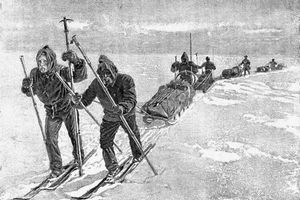
For several generations of tourists, the name "Beskid" became almost synonymous with ski tourism.
The Mukachevo ski factory produced Beskid skis, which were used alongside models such as "Tysa," "Kross," "Karpaty," and others.
Touring models with metal edges were particularly interesting. They were designed for longer journeys and more demanding winter routes.
These skis were not meant for spending a few hours on a prepared ski slope.
The skis were transportation.
A tourist would use them to travel through forests, plateaus, and mountains, carry equipment, camp in winter conditions, and remain self-sufficient for many days.
That is why the history of Beskid skis is inseparable from the history of Soviet sports tourism. We explore this subject in more detail in our article about the history of ski touring and expeditions.

Tourist Clubs - The Heart of Sports Tourism
A whole culture gradually developed around tourist clubs.
A club was a place where you could find hiking partners, get advice about equipment, learn navigation, practice rope techniques, or simply listen to stories from people who had already completed dozens of routes.
Among Ukrainian clubs with long histories are Kyiv's "Globus" at KPI, the "Universytet" tourist club, and Odesa's "Romantyk" at Odesa Polytechnic University.
"Romantyk" brought together enthusiasts of many different disciplines, from hiking and mountain tourism to water, cycling, and caving.
The "Universytet" club is still active today. Its pre-trip training program covers equipment, navigation, rope techniques, sports hiking rules, and route categories.
This is one of the most important characteristics of sports tourism: knowledge does not disappear with the person who acquired it. It is passed from experienced tourists to beginners.
Children's and Youth Tourism
Another important part of the system has always been children's tourism groups.
For many future tourists, everything began at school.
A short hike, a compass, a map, the first tent, tourist knots, navigation, a campfire.
Later came competitions, orienteering, technical stages, and more difficult routes.
Children's tourism served an important purpose. It was not simply a way for children to spend time outdoors. It also developed independence, teamwork, and basic skills for staying safe in the natural environment.
For many people, it was the first step toward adult sports tourism.
What Types of Sports Tourism Are There?
Sports tourism has never been a single discipline.
Its defining characteristic is precisely its diversity.
Hiking Tourism
Hiking is one of the most accessible forms of sports tourism.
A group travels on foot, carries its equipment, organizes camps, and overcomes natural obstacles.
A simple hike can be accessible even to beginners. A difficult route, however, requires serious physical preparation, navigation skills, proper camp organization, and the ability to deal with technical obstacles.
That is why hiking tourism is often the first step into the world of sports tourism.
Mountain Tourism
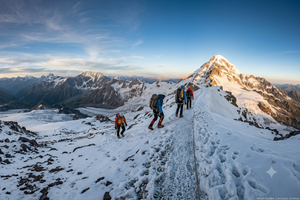
Here, mountains, passes, altitude, cliffs, snow, glaciers, and other natural obstacles become the main challenges.
Mountain tourism overlaps closely with mountaineering and rock climbing, but they are not the same thing.
In mountaineering, the main objective may be reaching a particular summit. In sports tourism, the route itself and the combination of obstacles along it are extremely important.
A mountain tourist may cross several passes during one trip, overcome technically difficult terrain, and travel long distances while remaining largely self-sufficient.

Ski Tourism
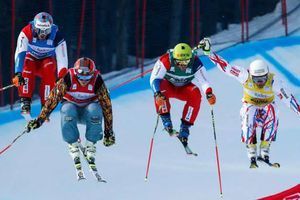
Ski tourism means multi-day winter journeys on skis.
It is much more demanding than an ordinary summer hike.
Cold.
Snow.
Short daylight hours.
Winter camping.
The need to constantly monitor the condition of participants and equipment.
Sometimes a single winter day can require considerably more preparation from a group than a similar summer route.
Water Tourism
Water tourism moves the route from land onto rivers.
Kayaks, canoes, catamarans, rafts, and other watercraft can be used to complete river routes.
On an easy river, this may be a multi-day journey with scenic campsites. On a more difficult one, it can involve rapids, fast currents, and technical sections.
Myhiya on the Southern Buh River is one of the best-known locations in Ukrainian water tourism.
The Integral rapid became a well-known training and competition site for water tourists. Here, the natural shape of the river effectively becomes a sports course.
Cycling Tourism
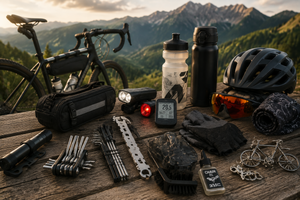
A bicycle allows travelers to cover much greater distances, but it also introduces its own challenges.
Road conditions, terrain, elevation gain, weather, water supplies, bicycle maintenance, and self-sufficiency all become important.
Cycling tourism can be a relaxed multi-day journey or a demanding sporting route.
A whole culture has developed around bicycles, encompassing both sport and travel. We explore this broader world in our article about bicycles and cycling.
Caving Tourism
Caving tourism takes the traveler underground.
Caves have their own specific challenges: darkness, narrow passages, vertical sections, water, difficult navigation, and the need for specialized equipment.
In some cases, cave exploration requires technical skills that are similar to those used in mountain tourism.

Auto-Moto Tourism
In this discipline, routes are completed by cars or motorcycles.
The sporting element can include navigation, difficult terrain, technical stages, and teamwork.
It is an especially interesting discipline for people who want to combine travel, technology, and competition.
Combined Tourism
Some routes cannot be placed neatly into a single category.
A group may travel part of the route on foot, part on skis or bicycles, and cross certain sections of water using boats.
Such routes combine skills from several disciplines and require participants to have a particularly broad range of abilities.
Modern sports tourism in Ukraine reflects this diversity, with official competitions covering hiking, mountain, ski, water, cycling, auto-moto, combined, and other disciplines.
Difficulty Categories in Sports Hiking
One of the most interesting characteristics of sports tourism is its system of route classification.
It is not enough to say, "We completed a difficult route."
Routes have specific difficulty categories, determined by factors such as the type and number of obstacles, distance, duration, altitude, technical difficulty, and other characteristics.
The criteria differ depending on the type of tourism.
For example, a mountain expedition may be evaluated according to passes, altitude, and technical sections. In water tourism, the nature and difficulty of rapids are important. In ski tourism, winter conditions and the characteristics of the route play a major role.
In general, sports hiking routes are classified from Category I to Category VI.
The principle of gradual progression is extremely important.
A tourist should not immediately attempt the most difficult route. First come basic skills, easier trips, teamwork, and experience. Only then does a participant move toward more demanding routes.
That is why tourist clubs and training schools remain such an important part of the system.
Sports Tourism Competitions
Sports tourism is not limited to expeditions.
Another major component is competition in tourist techniques.
Here, participants do not simply complete a multi-day route. They have to demonstrate specific technical skills.
River crossings.
Rope work.
Ascents and descents.
Navigation.
Slope crossings.
Rescue techniques.
Work with tourist equipment.
Such competitions make it possible to test a team's technical preparation much more quickly than during a multi-day expedition.
And this leads to one of the most interesting characteristics of modern sports tourism.

Competitions Can Even Take Place Indoors
Tourist competitions do not always require real mountains.
Many technical stages can be recreated artificially.
Rope structures, climbing walls, crossings, artificial terrain, and other elements make it possible to organize competitions indoors.
This has an important practical advantage.
Athletes do not have to wait for summer or travel to the Carpathians. Technical skills can be practiced throughout the year.
In Ukraine, indoor competitions have become a real part of the sports tourism system. This means modern sports tourism can exist in very different environments: in mountains, on rivers, in forests, on specially designed courses, and even inside sports halls.
Tourist Gatherings - A Culture of Their Own
If competitions represent the sporting side of tourist life, a tourist gathering is something more.
A gathering can bring together teams from different clubs.
During the day, there are competitions.
Then come contests, team presentations, and socializing.
In the evening, there are campfires, songs, conversations, and stories about expeditions.
A tourist gathering is a place where several generations of tourists can meet.
Older participants tell stories about routes that almost nobody travels today.
Younger participants show new equipment and modern technologies.
Someone looks for a team for their next expedition.
Someone else simply comes to meet old friends.
This is where it becomes especially clear that sports tourism is not just sport.
It is also a subculture.
It has its own language, jokes, traditions, songs, symbols, and even its own attitude toward equipment.
To an outsider, an old backpack may simply be an old backpack.
To a tourist, it may be an object connected to a particular expedition, a particular year, and a particular story.
What Is Happening to Sports Tourism in Ukraine Today?
After the collapse of the Soviet Union, the old system of tourist clubs, bases, and routes changed dramatically.
Part of the infrastructure was lost.
Some traditional routes became inaccessible.
Clubs had to adapt to new conditions.
But sports tourism itself did not disappear.
Tourist clubs are still active in Ukraine, while sports expeditions, competitions, and training programs continue to take place.
The Federation of Sport Tourism of Ukraine maintains a system of official competitions, sports rankings, and qualifications.
Modern calendars include hiking, mountain, water, cycling, ski, auto-moto, combined, and other disciplines.
It is also important that sports tourism continues to evolve in new formats. In 2026, the federation expanded its competition program and continued developing new disciplines, while Ukrainian tourist clubs remained active despite the very different conditions of the modern era.
The equipment has changed.
GPS navigation and digital maps have appeared.
Modern membrane fabrics, lightweight tents, and new communication systems have transformed the way people prepare for expeditions.
But the basic logic has remained almost unchanged.
There is a route.
There is a team.
There are natural obstacles.
And there is a need to prepare for them.
Sports Tourism as a Way of Life
Perhaps this is what makes sports tourism different from an ordinary tourist trip.
A conventional journey often begins with a question:
"Where should we go?"
A sports tourist thinks somewhat differently:
"What do I want to complete, what do I need to learn, and how are we going to prepare?"
And from this comes the entire culture.
Tourist clubs.
Training schools.
Route categories.
Equipment.
Competitions.
Gatherings.
Songs around the campfire.
Stories about expeditions passed from one generation to another.
Even clothing can become part of this culture.
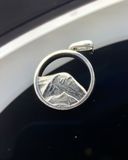
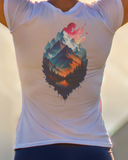
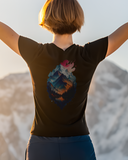
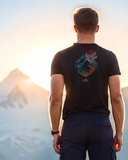
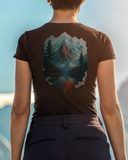
A T-shirt with a mountain motif, a club emblem, or a symbol of a favorite discipline can be more than just clothing. It can remind someone of places, people, and routes that have become part of their life.
That is the idea behind Travel Jewelry T-shirts.
They are designed for people who feel connected to mountains, travel, active recreation, and the culture of exploration itself.
From the Crimean-Caucasian Club to Modern Competitions
Over more than a century, sports tourism in Ukraine has changed enormously.
From the first organized excursions and mountain clubs.
To the huge Soviet system of tourist sections.
From expeditions in Crimea, the Carpathians, and the Caucasus.
To modern routes and competitions.
From heavy Beskid skis and paper maps.
To lightweight equipment, GPS, and satellite navigation.
From tourist sections at universities and institutes.
To modern clubs, training schools, and children's groups.
But the most important thing has remained unchanged.
People still form teams.
They still plan routes.
They still argue about what to put in the backpack.
They still learn how to pitch a tent in the rain.
They still cross rapids, passes, forests, and winter plateaus.
And they still sit around the campfire after an expedition and tell each other how it all happened.
That is why sports tourism is more than just another sport.
It is a way to travel, learn, challenge yourself, and find people with whom you want to go farther.
And perhaps that is exactly why this culture has survived changing eras, systems, equipment, and technologies - and continues to exist in Ukraine today.
World Tourism Day: History, Meaning and the Culture of Travel
Bikepacking: From Bicycle Travel to Modern Cycling Expeditions
The History of Mountaineering: From the First Ascents to Speed Records
UIAA: History, Activities, Standards, Grading Systems and Its Role in Modern Mountaineering
Ski Travel: The History of Ski Touring, Ski Expeditions and Winter Journeys
The Highest Mountains in Ukraine: Hoverla, Brebeneskul, Pip Ivan and Other Peaks
Four-Leaf Clover - The Symbol of Luck That Became Part of Culture
The Best Gift Ideas for Cyclists
Edelweiss: The Legendary Mountain Flower That Never Fades from Memory
Gift Ideas for a Skier: Practical and Meaningful Presents for Winter Enthusiasts