Ski mountaineering is where two different cultures meet: mountaineering and skiing.
Here, skis are no longer simply a way to travel through winter mountains. They become part of the ascent, a tool for crossing large snow-covered areas and, ultimately, a way to descend routes that once seemed almost impossible to ski.
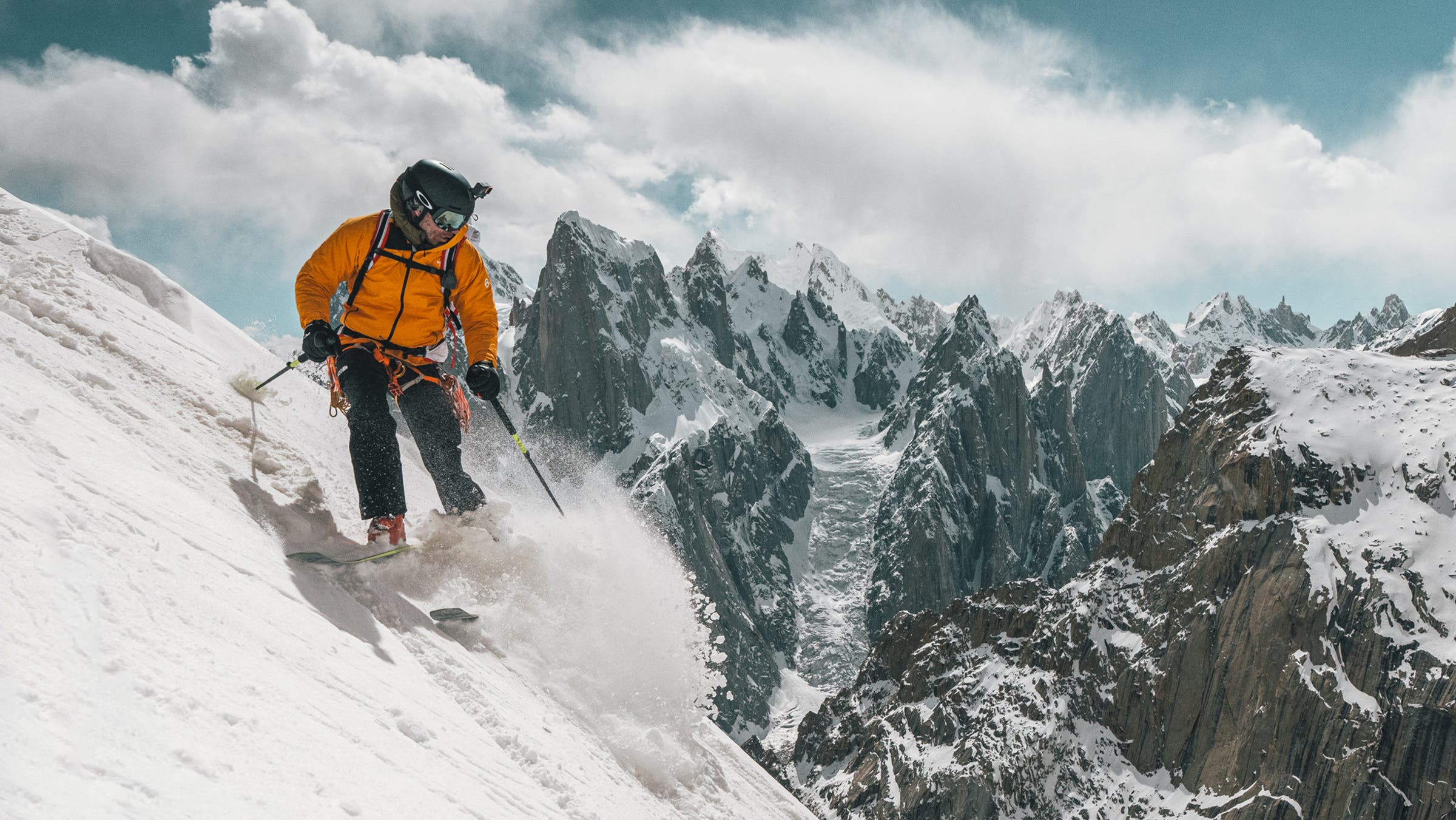
Sometimes an athlete spends most of the route on skis. Sometimes the skis have to be carried on a backpack, with crampons and mountaineering equipment taking their place on steeper terrain. And sometimes an entire high-altitude ascent is made simply to reach the point where a spectacular ski descent can begin.
This combination has made ski mountaineering one of the most demanding disciplines in modern mountain sports.
Ski Mountaineering, Ski Alpinism and Other Names
You may encounter several closely related terms:
-
ski mountaineering;
-
ski alpinism;
-
ski mountaineering and ski alpinism;
-
ski mountaineering as a form of ski alpinism.
There is no need to treat these as four completely separate disciplines.
Ski mountaineering is the most widely used English term today. Ski alpinism is also used, particularly when discussing technical mountain routes and demanding ski descents.
In Ukrainian, the closest terms are скі-альпінізм and лижний альпінізм.
In broad terms, all of these describe the combination of mountaineering and skiing, where skis are used as part of a mountain route and may play an important role in the descent.
The key difference from ordinary ski touring is not simply altitude or steepness. A ski mountaineering route can require genuine mountaineering skills.
When Skiing Meets Mountaineering
A typical ski tour may pass through snowy plateaus, valleys, forests and relatively moderate mountain slopes.
A ski mountaineering route can change completely within a few hundred metres.
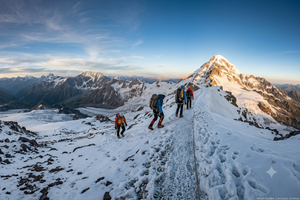
The athlete may start on skis.
Then the terrain becomes too steep, so the skis are attached to the backpack.
Crampons, an ice axe, a rope or other mountaineering equipment may be needed.
After a difficult section, the skier may put the skis back on again.
This is one of the defining characteristics of ski mountaineering - constantly adapting the way you move to the terrain.
That is also why there is no universal equipment list for ski mountaineering. Every mountain and every route is different.
Even ski poles may no longer be the best tool on steep terrain. An ice axe can be used instead as a point of support on steep snow or ice, while more technical terrain may require specialised mountaineering tools.
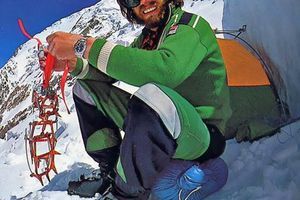
Crampons can be used with compatible ski boots, while skis can be carried on a mountaineering pack.
Everything is adapted to the mountain.
From Ski Touring to Ski Mountaineering
Historically, there was no sharp boundary between ski touring and ski mountaineering.
People first used skis simply as a practical way to travel through winter mountains.
Then routes became longer and more difficult.
Eventually, skis became part of mountaineering expeditions - initially as a practical means of transportation and later as a way of returning from the mountain.
A new idea gradually emerged:
a mountain could be not only something to climb, but also a route to ski down.
This changed the way climbers looked at mountains.
A slope was no longer considered only in terms of how to climb it. It could also be studied as a potential descent line.
What Makes Ski Mountaineering So Difficult?
The difficulty of a ski mountaineering route cannot be described by a single number.
Altitude alone does not determine how difficult a route will be.
Important factors include:
-
slope angle;
-
exposure;
-
snow and ice conditions;
-
avalanche danger;
-
rock sections;
-
crevasses;
-
narrow couloirs;
-
route length;
-
the possibility of retreat;
-
altitude and lack of oxygen;
-
the need to switch between skiing and mountaineering techniques.
Exposure is particularly important.
On an ordinary ski slope, a fall might mean sliding a few metres.
On a highly exposed mountain route, the same mistake can mean hundreds of metres of uncontrolled descent.
That is why ski mountaineering requires much more than advanced skiing skills.
You need to be able to read the mountain like a mountaineer.
Big Mountains Open Up to Skiers
During the 20th century, increasingly difficult ski descents began appearing on major Alpine peaks.
Skiers started looking for steeper and more technical routes.
The next logical step was to take this approach beyond the Alps - to the Caucasus, the Andes, the Himalayas and the Karakoram.
There, a ski descent could become a full expedition.
Several days or even weeks of acclimatisation, preparation and climbing might be required for a descent that itself could take only a few hours.
This was where the culture of the first descent became particularly important.
The goal was no longer simply to reach the summit.
The challenge was to find a descent line, evaluate it, wait for the right conditions and ski it for the first time.
First Descents - When a Mountain Becomes a Route
In ski mountaineering, the concept of a first descent has a special meaning.
It may refer to:
-
the first ski descent from a summit;
-
the first complete descent from the summit to base camp;
-
the first descent of a particular route;
-
the first descent of a particular face or couloir;
-
the first ski descent following an ascent by a mountaineering route.
That is why the history of major ski descents needs to be examined carefully.
Someone may have been the first to ski from the upper part of a mountain, without completing the entire descent.
Another athlete may later have made the first complete descent from the summit to base camp.
These are two different achievements.
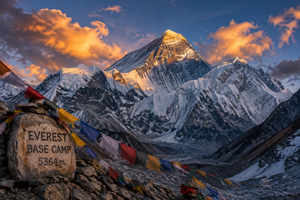
Skiing Mount Everest
One of the most famous moments in ski mountaineering history came with Slovenian mountaineer and skier Davo Karničar.
On 7 October 2000, he reached the summit of Mount Everest and began his descent on skis.
Karničar became the first person to complete a full ski descent from the summit of Everest to base camp.
The vertical descent was approximately 3,500 metres.
The route included very different types of terrain - high-altitude slopes around the South Summit, areas near the South Col, steep sections and the Khumbu Icefall.
A detailed account of the descent was published by the American Alpine Club, while the record is also documented by Guinness World Records.
Interestingly, Karničar spent considerably longer climbing the mountain than skiing down it.
This illustrates one of the great paradoxes of high-altitude ski mountaineering:
you can spend weeks reaching the point from which the most important part of the descent takes only a few hours.
K2 - One of the Hardest Ski Descents in History
If Everest is the world's highest mountain, K2 has a very different reputation.
It is regarded as one of the most technically demanding of the world's highest peaks.
On 22 July 2018, Polish mountaineer Andrzej Bargiel reached the summit of K2 at 8,611 metres.
He then completed the first full ski descent from the summit of K2.
His route was not simply a straight line down.
Bargiel combined different sections and routes, navigating complex high-altitude terrain and glacier systems.
According to the American Alpine Club, he descended approximately 3,400 vertical metres from the summit to the Godwin-Austen Glacier.
K2 became another example of how the words "ski descent" can hide an enormous amount of mountaineering work.
The descent itself was a mountain route that had to be studied, evaluated and prepared.
Eight-Thousanders and the Culture of Big-Mountain Descents
After Everest and other major peaks, ski mountaineers increasingly turned their attention to the world's fourteen 8,000-metre peaks.
Important ski descents have taken place on mountains including Everest, Cho Oyu, Shishapangma, Manaslu, Broad Peak, Annapurna and K2.
Every mountain has its own complicated history.
For example, Polish ski mountaineer Andrzej Bargiel completed the first full ski descent of Broad Peak in 2015.
On Shishapangma, he also completed a major ski descent after climbing the mountain.
These achievements show how gradually the culture of ski descents from the world's highest mountains developed.
At first, athletes had to demonstrate that skis could be used safely at extreme altitude.
Later, projects increasingly focused not simply on descending a mountain, but on finding the most difficult and interesting line.
Snowboarding Comes to the Big Mountains
This story becomes even more interesting when snowboarding enters the picture.
The culture of big-mountain descents has never belonged exclusively to skiers.
Snowboarders also began applying mountaineering techniques and big-mountain riding to high-altitude terrain.
Depending on the context, you may encounter terms such as snowboard mountaineering, snowboard alpinism and big-mountain snowboarding.
The basic idea remains similar:
an ascent + a demanding mountain route + a snowboard descent.
One of the most famous examples is French snowboarder and mountaineer Marco Siffredi.
On 23 May 2001, he reached the summit of Everest and completed the first full snowboard descent from the summit through the Norton Couloir to Advanced Base Camp.
The American Alpine Club documented the descent in detail.
It was an important moment not only in snowboarding history.
It demonstrated that the same basic philosophy behind ski mountaineering could also be applied to a snowboard.
Marco Siffredi and the Limits of Possibility
Siffredi's story had a tragic continuation.
In 2002, he returned to Everest intending to snowboard down the Hornbein Couloir - a significantly more difficult route.
After reaching the summit, he began his descent.
He was never seen again.
The story became one of the most famous and tragic examples of the extremely fine line between expeditionary sport, the pursuit of a first descent and mortal risk.
It also demonstrates one of the fundamental realities of big-mountain descents:
a mountain does not become less dangerous simply because you have reached the summit.
Sometimes the most difficult part of the route begins after the summit.
Why Not Every Big Mountain Is Suitable for Skiing
At first glance, it might seem that the ideal ski mountaineering mountain would simply be a very high mountain covered in snow.
In reality, it is much more complicated.
A ski descent requires suitable terrain, enough snow and acceptable conditions.
Rock barriers, sections of bare ice, open crevasses or unstable snow can make a descent impossible.
That is why the highest mountains in the world are not necessarily the most interesting mountains for skiers.
Conversely, a much lower mountain can have an extraordinarily difficult and exposed ski line.
In ski mountaineering, altitude is only one factor.
Ski Mountaineering Is About Constant Transitions
Perhaps the best way to understand the discipline is through the way movement changes during a route.
A skier can begin the day on skis.
Then take them off and attach them to a backpack.
Switch to crampons.
Use an ice axe instead of a ski pole.
Use a rope on a technical section.
Reach the summit.
Put the skis back on.
And begin the descent.
Ski mountaineering is therefore not simply about "extreme skiing."
It is about combining different mountain skills within one route.
Modern Ski Mountaineering
Modern equipment has made these projects more efficient.
Skis, bindings, boots and other equipment have become lighter.
Navigation, communications, weather forecasting and avalanche assessment have improved enormously.
But technology has not changed the fundamental principle.
The mountain still has to be climbed.
You still need to understand the terrain.
You still have to evaluate the conditions.
And you still have to make decisions.
Sometimes the best decision is to turn around before reaching the summit or to abandon a planned descent.
That is why modern ski mountaineering remains not only a sporting discipline, but also a culture of responsible decision-making in the mountains.
From First Descents to Your Own Route
Today, ski mountaineering can take many forms.
For some, it means a demanding route in the Alps.
For others, a winter expedition into high mountains.
For others, an expedition in the Himalayas.
And for the strongest athletes, it may mean searching for a first descent on a major mountain.
But there is a common idea connecting all of them.
It is not simply about skiing down a mountain.
It is about finding your own route through the mountain.
That is why the culture of the first descent remains so compelling.
It combines the exploratory spirit of mountaineering, the technique of skiing and the desire to see a mountain in a completely different way.
Skis as a Symbol of Mountain Adventure
In everyday life, skis may simply be sporting equipment.
For a ski tourer, they are a way to travel through winter mountains.
For an expedition, they can be transportation.
For a ski mountaineer, they can become part of a route that begins far below the summit and ends far beyond the boundaries of an ordinary ski resort.
That is why the Skis pendant from Travel Jewelry can have different meanings for different people.
For one person, it may be a reminder of winter trips.
For another, a symbol of ski touring.
For someone else, a reminder of mountains, expeditions and challenging descents.
A small silhouette of a ski can represent a much larger story - the story of people who go into the mountains not for a prepared piste, but for the route itself.
Ski Mountaineering - Where Ordinary Skiing Ends
The history of ski mountaineering is a story of gradually expanding boundaries.
First, skis helped people travel through winter landscapes.
Then they became part of ski touring and mountain travel.
Eventually, they became part of mountaineering.
And finally, skiers and snowboarders began descending peaks that had previously required long and difficult climbs simply to reach the summit.
Everest, K2 and the other eight-thousanders demonstrated just how far this idea could go.
But perhaps the most fascinating part of ski mountaineering is not the altitude.
It is the possibility of experiencing an entire mountain.
To climb it, negotiate its difficult sections, find a descent line and return on your own skis or snowboard.
That combination of mountaineering, freedom and movement is what gives ski mountaineering its unique spirit.
Gift Ideas for a Skier: Practical and Meaningful Presents for Winter Enthusiasts
What to Gift a Snowboarder: Practical and Meaningful Gift Ideas for Winter Adventure Lovers
The History of Skis: Evolution, Types, Technology and Skiing in Sport
Ski Travel: The History of Ski Touring, Ski Expeditions and Winter Journeys