Mountains have their own rules. Some of them are dictated by nature itself: weather, terrain, altitude, snow, rock and the limited possibilities for outside help. But there are other rules - principles created by people to make time in the mountains safer, more respectful and more responsible.
One of the best-known documents to formulate such principles is the Tyrol Declaration on Best Practice in Mountain Sports.
It was adopted in 2002 in Innsbruck during a conference dedicated to the future of mountain sports. The document became an important ethical reference point for mountaineers, climbers, mountain guides and everyone who spends time in the mountains.
You can read the original document in the UIAA archive of the Tyrol Declaration.
More than two decades later, the UIAA developed a new document, the Declaration on Hiking, Climbing and Mountaineering.
The new declaration reflects how much the world of mountain activities has changed - from the growth of sport climbing and trekking to climate change and increasing pressure on popular mountain areas.
For Travel Jewelry, this is a natural continuation of our article about the UIAA. If the previous article answered the question "What is the UIAA?", this one is about something different: how people should behave in the mountains and why it matters.
What Is the Tyrol Declaration?
The Tyrol Declaration is a document about ethics in mountain sports.
It should not be understood as a law or a set of legally binding regulations. It is better understood as a framework of values and principles developed by the international mountain community.
Its central idea is simple: mountain sports are not only about technique, equipment and achievements. They are also about responsibility toward partners, other people, nature and future generations.
The declaration contains ten fundamental principles.
1. Individual Responsibility
Mountains always involve a certain degree of risk. Even a well-prepared person cannot completely control weather, terrain, rockfall or other natural factors.
Everyone going into the mountains therefore has to accept responsibility for their own decisions.
This means understanding your abilities, assessing risks, preparing properly and not shifting the consequences of your decisions onto others.
Freedom in the mountains begins with responsibility for yourself.
2. Team Spirit
Mountaineering and many other mountain activities are not only about individual achievements.
People in a team depend on each other. Sometimes plans have to change, personal ambitions have to be put aside, or decisions have to be made according to the abilities of the entire group.
Team spirit means supporting your partners and remembering that safety and mutual trust are more important than the ambitions of one individual.
3. The Mountain and Climbing Community
There is a particular culture of mutual respect in the mountains.
Experienced climbers help newcomers. People share knowledge, route information and experience.
The mountain community is not built only around sport. It is also connected by a shared attitude toward mountains and toward the people who spend time in them.
Knowledge, experience and a culture of mutual assistance should therefore be passed on.
4. Visiting Foreign Countries
Mountains do not stop at national borders.
Mountaineers and travelers often visit other countries to climb new peaks, explore new routes or experience different cultures.
The Tyrol Declaration emphasizes respect for local laws, traditions, cultures and people.
A visitor remains a visitor in the mountains. What is considered normal in one country may not necessarily be acceptable in another.
5. Responsibilities of Mountain Guides and Other Leaders
Anyone who leads others into the mountains carries particular responsibility.
A mountain guide, instructor or group leader must consider not only their own abilities but also those of the people they are leading.
This includes choosing routes, assessing conditions, managing risks and making decisions in difficult situations.
Leadership in the mountains is not about always being the person at the front. It is about accepting responsibility for people who trust you.
6. Emergencies, Dying and Death
Mountains can become places of emergencies, injuries and even death.
The Tyrol Declaration emphasizes the importance of helping people who are in danger whenever this can be done without creating an unacceptable risk to the rescuer.
This is one of the fundamental principles of mountain culture.
In the mountains, someone else's emergency can very quickly become a shared problem.
7. Access and Conservation
The opportunity to hike, climb and explore natural areas should not be taken for granted.
Mountain environments need protection.
This means respecting access regulations, avoiding unnecessary damage to vegetation and infrastructure, leaving no waste behind and minimizing our impact on the natural environment.
The right to enjoy the mountains is closely connected with the responsibility to protect them.
8. Style
For the mountain community, the result is not the only thing that matters. How that result was achieved matters too.
Different climbing styles and approaches to routes carry different ethical implications.
It is therefore important to describe honestly how an ascent or route was completed and not create a misleading impression of an achievement.
In the mountains, honesty about style is part of respect for others.
9. First Ascents
A first ascent or first completion of a route has a special significance.
It is therefore important to respect the work of those who establish new routes, accurately describe the circumstances of a first ascent and avoid taking credit for someone else's achievement.
First ascents are not simply another item on a list of achievements. They become part of the shared history of mountaineering.
10. Sponsorship, Advertising and Public Relations
Mountain sports have long existed beyond the mountain community itself.
Climbers, mountaineers, athletes and expeditions attract the attention of media, sponsors and a wider audience.
This creates an additional responsibility: mountain activities should be presented honestly, dangerous behavior should not be unnecessarily romanticized, and communication should not create a misleading impression of the real risks involved.
Commercial communication should not undermine the values of mountain sports.
What Has Changed Since 2002?
The world of mountain activities has changed considerably since the Tyrol Declaration was adopted.
Sport climbing became an Olympic discipline. Indoor climbing developed into a major industry. Trekking and mountain tourism became accessible to a much wider audience.
Social media transformed mountain achievements into part of everyday visual culture.
At the same time, the popularity of certain destinations created new problems: overcrowded trails and routes, waste, erosion, pressure on local infrastructure and conflicts between visitors and local communities.
Another issue has become impossible to ignore - climate change.
Glaciers are retreating, seasons are changing, and routes that remained relatively stable for decades can now be affected by rapidly changing conditions.
The mountain community therefore needs principles that reflect the realities of the present day.
The Declaration on Hiking, Climbing and Mountaineering
In 2024, the UIAA General Assembly approved a new Declaration on Hiking, Climbing and Mountaineering. The UIAA officially published the document in January 2025 as a modern continuation of its ethical framework.
The complete document and its principles are available on the official UIAA Declaration page.
The new declaration continues the tradition of the Tyrol Declaration while looking more broadly at the ethics of mountain activities.
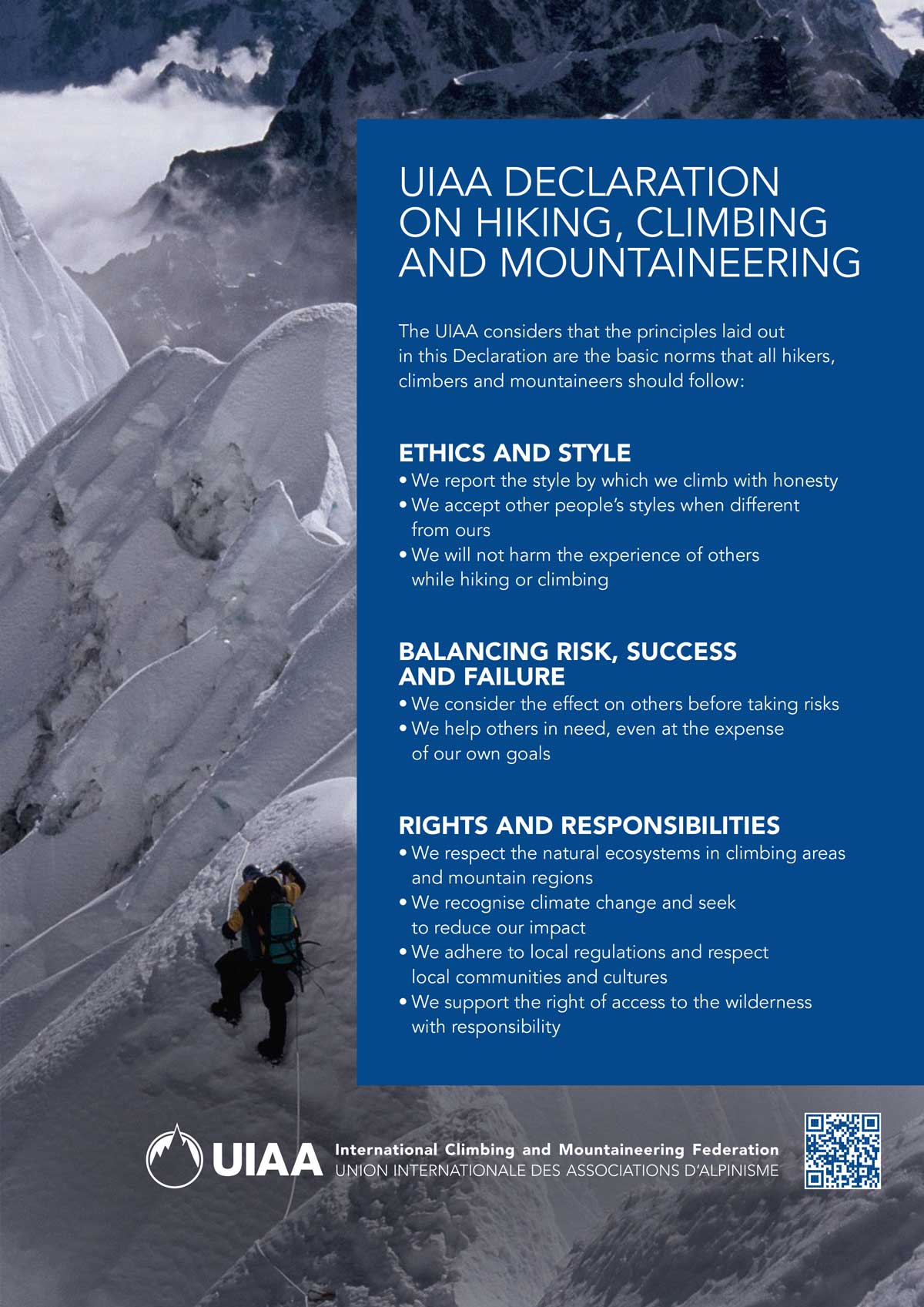
It presents nine key principles.
Ethics and Style
1. Be honest about the style in which you climb
When describing an ascent or route, be honest about how it was completed.
The way something is achieved is part of the achievement itself.
2. Respect other styles
There can be different approaches to climbing and mountaineering.
A style that one person considers the ideal does not automatically have to be the only acceptable approach for everyone else.
Respect for other styles is part of a healthy mountain community.
3. Do not diminish the experience of others
Your climb, training session or mountain trip should not unnecessarily interfere with other people's experience.
This becomes particularly important on popular routes and in areas with high visitor numbers.
Balancing Risks, Success and Failure
4. Consider the effect of your decisions on others
Risk in the mountains rarely affects only one person.
A decision can affect climbing partners, rescuers, other people on the route and local communities.
Understanding this is an important part of responsible mountain activity.
5. Help people in need
Personal goals are important, but they should not completely override human solidarity.
When someone is in danger, helping another person can be more important than completing your own plan.
Rights and Responsibilities
6. Respect natural ecosystems
Mountain areas are not simply scenery for our adventures.
They are living ecosystems that need protection.
7. Recognize climate change and seek to reduce your impact
The mountain community is directly witnessing the effects of a changing climate.
Responsible behavior toward the environment is therefore becoming an increasingly important part of mountain ethics.
8. Follow local regulations and respect local communities and cultures
Mountains are not inhabited only by visitors.
Many mountain regions are home to communities with their own traditions, cultures and ways of life.
Respecting those communities is an essential part of responsible travel.
9. Responsibly support access to the wilderness
Access to mountain and wilderness areas is important to everyone who enjoys outdoor activities.
But maintaining that access depends partly on how responsibly people use these places.
The Tyrol Declaration and the New UIAA Declaration - What Is the Difference?
The Tyrol Declaration became an important ethical document for a generation of climbers and mountaineers at the beginning of the 21st century.
The new Declaration on Hiking, Climbing and Mountaineering continues that tradition but takes a broader view.
It addresses not only relationships between climbers and mountaineers, but also the impact of our actions on nature, local communities, other visitors and the future of mountain environments.
And that makes sense.
In 2002, one important question was:
"How should we behave toward one another in the mountains?"
Today there is another question alongside it:
"How can we use the mountains in a way that keeps them accessible and alive for those who come after us?"
What Does This Have to Do with Travel Jewelry?
Travel Jewelry creates jewelry for people who love mountains, travel and an active lifestyle.
Our Mountain Collection includes pieces inspired by mountain peaks, alpine symbols and the culture of travel.
That is why the idea behind these declarations feels natural to us.
We did not create our own "mountain code", and we do not try to replace the principles developed by the international mountain community.
We simply share them.
With respect for the mountains.
With respect for the people who love them.
With respect for those who travel alongside us.
With respect for local communities and cultures.
And with an understanding that mountains are not simply a backdrop for a photograph. They are living environments that we enter as guests.
That is why mountain inspiration for us is not simply an aesthetic choice.
It is part of a culture that we love and value.
Mountain Ethics Are Not a List of Prohibitions
Perhaps the most important thing about both declarations is that they do not attempt to turn the mountains into a list of prohibitions.
Quite the opposite.
They leave people freedom of choice, freedom of style, freedom of route and freedom to pursue their own goals.
But that freedom comes together with responsibility.
Responsibility toward yourself.
Toward your partners.
Toward other people.
Toward nature.
And toward those who will come to these mountains after us.
That is where genuine mountain culture begins.
Love for travel and mountains, cast in metal.
What to Gift a Rock Climber: 20 Thoughtful Gift Ideas They'll Actually Use
The Climbing Carabiner: The Story of One of the Most Important Inventions in Mountaineering
Edelweiss: The Legendary Mountain Flower That Never Fades from Memory
Climbing Shoes: History, Evolution and the Diversity of Modern Climbing Footwear
Piolets d'Or - The Golden Ice Axe: History, Awards and Legendary Climbs
UIAA: History, Activities, Standards, Grading Systems and Its Role in Modern Mountaineering