Bicycle travel around the world is one of the most ambitious forms of adventure travel. Today, a journey of this kind can be planned with GPS, satellite maps, smartphones, online route information and modern touring equipment.
But more than a century ago, people were already attempting to travel around the world by bicycle.
There were no digital maps, no GPS, no mobile communications and no lightweight expedition bikes. There were paper maps, uncertain roads, mechanical problems and enormous distances.
The stories of these travelers became some of the most fascinating chapters in the history of bicycle travel.
Thomas Stevens - The First Bicycle Journey Around the World
One of the most important names in the history of global bicycle travel is Thomas Stevens.
In 1884, Stevens set out from San Francisco on a bicycle journey across the United States. His bicycle was very different from the touring bikes we know today. He rode a high-wheel bicycle with a front wheel approximately 50 inches, or 127 centimeters, in diameter.
On April 22, 1884, Stevens began his journey from San Francisco. He crossed the United States using roads, tracks and trails that were often far from what we would consider a modern cycling route.
By August, he had reached Boston, covering approximately 3,700 miles across the United States.
But this was only the beginning.
Stevens continued his journey through Europe and Asia. His route took him through countries including England, France, Germany, Austria-Hungary, Serbia, Bulgaria and the Ottoman Empire before continuing farther east.
Some sections of the journey required other forms of transportation, particularly when crossing seas. The bicycle itself also required constant attention and repairs along the way.
In December 1886, Stevens reached Yokohama, Japan, completing the cycling portion of his journey around the world. He then returned to the United States by sea.
His journey became one of the landmark achievements of early bicycle travel. The Library of Congress preserves a large collection of historical material relating to bicycle history and 19th-century cycling, including contemporary publications and books about long-distance bicycle journeys.
Library of Congress - Bicycles and Cycling History
For a modern cyclist, Stevens' journey is particularly remarkable because of the bicycle he used. It was created for an era when the idea of crossing continents by bicycle was still almost unimaginable.
Frank Lenz - A Journey That Ended in Tragedy
Several years after Stevens, another American cyclist set out on a journey around the world.
Frank Lenz began his expedition in 1892. He was a correspondent for Outing magazine and planned to travel eastward from the United States through Europe and Asia.
Unlike Stevens, Lenz never completed his journey.
In 1894, he disappeared while traveling through Asia. Contemporary reports stated that he had been killed in the region of present-day eastern Turkey.
His disappearance became one of the most tragic stories in the early history of long-distance cycling.
Lenz's expedition also demonstrates just how different bicycle travel was in the late 19th century.
For a modern traveler, a remote region can be difficult because of roads, weather or logistics. For a cyclist in the 1890s, these difficulties were combined with limited maps, almost no reliable long-distance communication and a transportation network that was still developing.
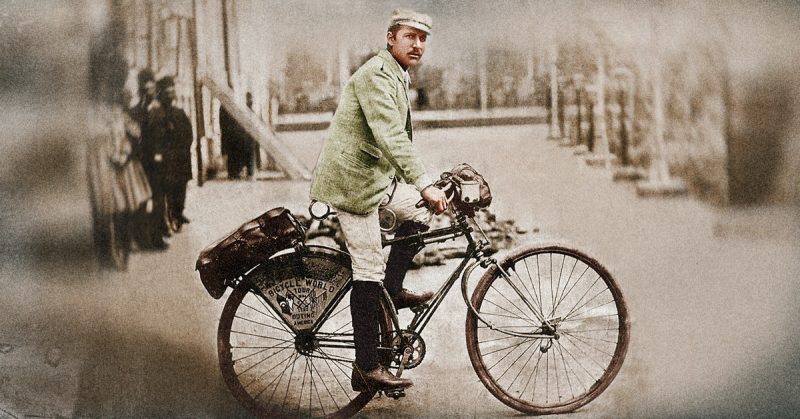
Annie Londonderry - Around the World During the Bicycle Boom
The story of Annie Londonderry is interesting not only because of her journey itself, but also because of the way she turned the expedition into a public story.
In 1894, Annie Cohen Kopchovsky, a mother of three from Boston, set out on a journey around the world by bicycle.
She left Boston in June 1894, beginning an expedition that lasted approximately 15 months.
Her journey did not involve cycling every mile. Like other around-the-world travelers of the period, she used ships between continents and combined cycling with other forms of transportation on some sections of the route.
Londonderry also understood the power of publicity. Her clothing, bicycle and public image became part of the story, while sponsorship and media coverage helped attract attention to her journey.
Her expedition became an important example of how bicycles were changing perceptions of travel and mobility for women in the late 19th century.
The Library of Congress includes Annie Londonderry in its historical resources on women and bicycles, while Smithsonian also documents her journey and the wider bicycle boom of the 1890s.
Library of Congress - Women and Bicycles

Why Did the Great Bicycle Journeys Begin in the Late 19th Century?
At first, it might seem strange that some of the earliest attempts at global bicycle travel took place when roads and transportation infrastructure were still relatively primitive.
But the late 19th century was also the beginning of the great bicycle boom.
The bicycle gave individuals a new level of personal mobility. It allowed people to travel much farther than they could on foot while remaining largely independent of railway schedules and horse-drawn transportation.
For a traveler, this meant something genuinely new.
There was no need to wait for a train or hire a horse for every stage of a journey. A person could simply get on a bicycle and continue along the road.
The bicycle quickly became more than a piece of sporting equipment. It became a practical means of transportation and a tool for exploration.
The scale of the bicycle boom was remarkable. In the United States, the number of bicycle manufacturers and the volume of production grew dramatically during the 1890s, creating an entirely new cycling culture.
From 19th-Century Expeditions to Modern Bicycle Travel
During the 20th century, bicycles became more reliable, roads improved and global transportation networks became increasingly developed.
An around-the-world bicycle journey gradually stopped being an expedition into an almost unknown world.
But that did not make it easy.
Thousands of miles remained thousands of miles.
Mountains remained mountains. Deserts remained deserts. Heat, cold, wind and fatigue did not disappear.
What changed most dramatically was the amount of information available to the traveler.
Today, before leaving home, a cyclist can examine satellite imagery, check weather forecasts, study roads, read reports from other travelers and plan a route in considerable detail.
Yet none of this eliminates the physical distance.
The kilometers still have to be ridden.
What Can an Around-the-World Bicycle Route Look Like?
There is no single standard route around the world.
One traveler may head predominantly east, while another may travel west.
Some routes cross several continents and use ships between them. Others are designed to maximize the amount of distance covered by bicycle.
This is why the phrase "around the world by bicycle" does not mean that every part of the journey must literally be ridden.
Oceans still have to be crossed by some form of transportation, while the exact route depends on geography, borders, seasons and the traveler's own goals.
That freedom is part of what makes these journeys so interesting.
The Hardest Part Is Not Always the Longest
On a map, an around-the-world bicycle journey can look like one enormous line.
In reality, it is made up of many completely different environments.
One section may pass through a large city with extensive infrastructure.
Then the road may enter a mountain region where a few dozen kilometers can take an entire day.
After that might come a desert.
Then another country, another language, another culture and completely different roads.
This is why an around-the-world journey is not simply a test of physical endurance.
It is also a constant process of adaptation.
The traveler does not simply cross countries. They repeatedly have to adapt the way they travel to the environment around them.
Around the World by Bicycle in the 21st Century
Modern expeditions can look very different from the journeys of Stevens or Londonderry.
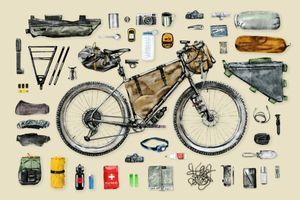
There are lightweight touring bicycles, gravel bikes, expedition bikes and modern luggage systems designed to carry equipment over long distances.
GPS navigation, satellite communication, smartphones and compact cameras have transformed the practical side of long-distance travel.
But even today, an around-the-world bicycle journey remains a serious undertaking.
A striking modern example is British adventurer Nick Sanders, who became the first person to cycle around the world on an electric bicycle. His journey covered approximately 19,000 miles and demonstrated how modern technology can become part of a very old form of adventure.
Cycling UK documented the journey in detail, including Sanders' route and his experiences on the road.
Cycling UK - Charging Around the World
The contrast with Thomas Stevens is striking.
Stevens traveled on a high-wheel bicycle without GPS, mobile communication or modern route information.
A modern cyclist can use satellite navigation, digital maps and instant communication.
Yet both are doing essentially the same thing - moving forward, one day and one kilometer at a time.
The Bicycle as a Way to See the World
Perhaps this is the most interesting part of long-distance bicycle travel.
An airplane can cross a continent in a few hours.
A car can cover hundreds of kilometers in a day.
A bicycle forces the traveler to slow down.
A city does not simply appear outside a window - you ride through it.
A mountain is not just something on the horizon - you have to cross it.
Between two major destinations on a map, dozens of smaller places suddenly become part of the journey.
Places that might never appear on a conventional tourist itinerary become part of the story.
That is why an around-the-world bicycle journey is not only about distance.
It is about a different way of seeing the world.
From Thomas Stevens to Modern Travelers
More than a century has passed since Thomas Stevens began his journey.
Bicycles have changed almost beyond recognition.
High-wheel bicycles have been replaced by lightweight frames, multiple gears, modern braking systems and specialized tires.
Paper maps have been supplemented or replaced by digital navigation.
Letters and telegraphs have given way to smartphones and satellite communication.
A 19th-century traveler could spend weeks without knowing what lay ahead. Today, much of a route can be studied before the journey even begins.
But the most important thing has not changed.
A person still gets on a bicycle and sets off.
That is why the stories of great around-the-world bicycle journeys remain relevant. Technology changes the way people travel, but the desire to explore remains.
Technology has changed. Bicycles have evolved, maps have become digital, and the rest of the world now fits into a smartphone. But the desire for adventure remains.
Jewelry for Those Who Love Bicycle Travel
For people who see the bicycle not simply as transportation but as part of their lifestyle, Travel Jewelry has a dedicated bicycle collection.
It includes silver jewelry inspired by details familiar to cyclists, including a bicycle chain link, a bicycle chainring and a brake disc.
Explore the Travel Jewelry Bicycle Collection
The Best Gift Ideas for Cyclists
Bicycle: History, Evolution and How It Changed the World
Bicycles and Cycling: Types of Bikes and Ways to Ride
Bikepacking: From Bicycle Travel to Modern Cycling Expeditions