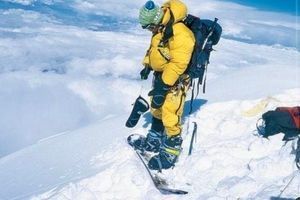
Above 8,000 metres, a ski descent begins long before the first turn. First, the skier must reach the summit, endure an exhausting climb, assess the snow, ice and weather, and find a line that can actually be skied. There is no groomed piste, lift or patrol here. There are crevasses, collapsing ice, rock steps, avalanche slopes and a body operating under an acute lack of oxygen.
The history of ski descents from the 14 eight-thousanders is not a contest for a single title. It is half a century of attempts, discoveries, incomplete routes and achievements that repeatedly redefined what might be possible at extreme altitude. On some peaks, skiers have descended from the very top to base camp; on others, they have skied only selected sections, while on a few, unsuccessful attempts remain the most significant part of the story.
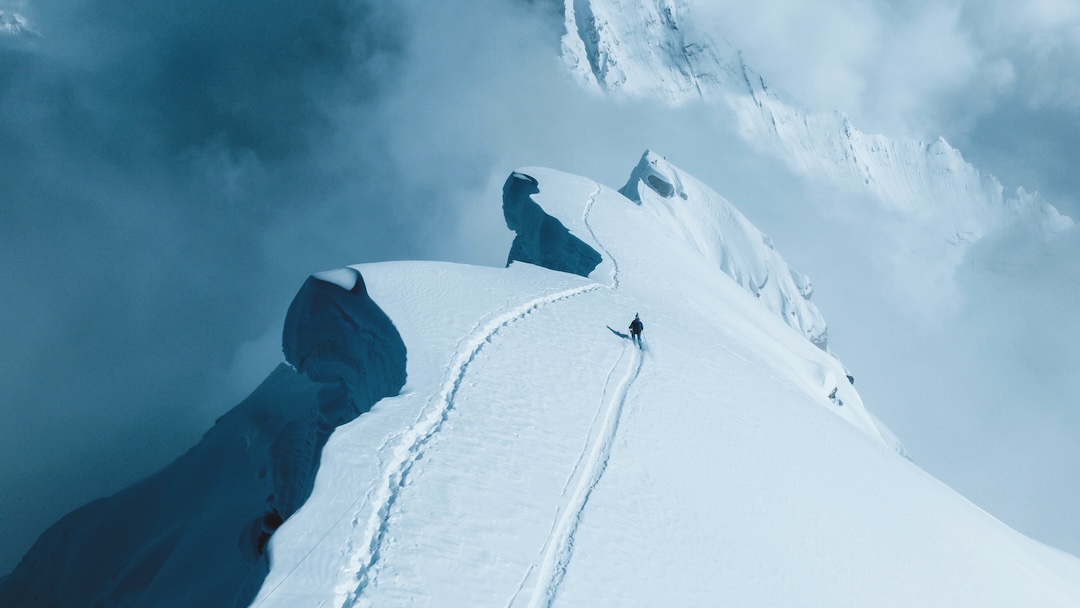
What does it really mean to ski down an eight-thousander?
News reports about extreme descents often use the phrase “the first descent of a mountain”, but it can describe very different achievements. One skier may have skied a few hundred metres from the summit before continuing on foot. Another may have started lower but skied almost the entire route to base camp. A third may have completed the full route while using supplemental oxygen. Each can be a significant achievement, but they are not interchangeable.
A descent from the summit means that the skier begins directly at the highest point, or at a starting point that sources clearly identify as the summit. On a snow-covered ridge, this can be harder to establish than it sounds: the top may be rocky, while a snow cornice can be unstable. It is therefore important to check not only the mountain's name, but also the actual starting point.
A complete descent also needs a clear definition. In the best-known Everest example, it means travelling from the summit to base camp. In other accounts, “complete” may mean skiing continuously from the upper point to the end of skiable terrain. If a skier removes their skis, descends on foot, uses a rope or finishes at an intermediate camp, that should be stated rather than hidden behind the general word “descent”.
Without supplemental oxygen means the athlete does not use bottled oxygen during the ascent and descent. They still breathe the surrounding air, but above 8,000 metres the partial pressure of oxygen is so low that the body operates close to its limits. This affects strength, coordination, thinking speed and decision-making. For a skier, these factors are critical: it is not enough to keep moving; every change in terrain demands precise control and judgment.
How to read the history below: we distinguish between the first ski tracks at extreme altitude, a descent from the summit, a complete route to base camp and a descent without supplemental oxygen. Where priority is disputed or sources describe only part of a route, we say so.
The first tracks: Everest and the tragic story of Annapurna
In 1970, Japanese skier Yuichiro Miura made his famous descent from the South Col area of Everest for the documentary The Man Who Skied Down Everest. He used a parachute to reduce speed on the steep slope, and the film turned the attempt into one of the best-known episodes in extreme skiing. Miura did not ski down from Everest's summit itself, but he showed that skis could be used to explore even the most extreme altitudes.
Nine years later, French climber Yves Morin set out for Annapurna with a far more ambitious plan: to combine an ascent of an eight-thousander with a ski descent. In 1979, he skied sections of the route and reached the summit, but died during the descent. His story is often cited in accounts of the first ski descent from an eight-thousander's summit, but it should not be presented as an unequivocally completed route all the way to base camp. It was a pioneering achievement in which the boundary between success and tragedy proved devastatingly thin.
This is where a key feature of the entire subject becomes clear: “first” can mean the first descent from a summit, the first ski run on a particular section or the first completed route. When sources use these definitions differently, it is more honest to explain the nuance than to choose the most dramatic claim.
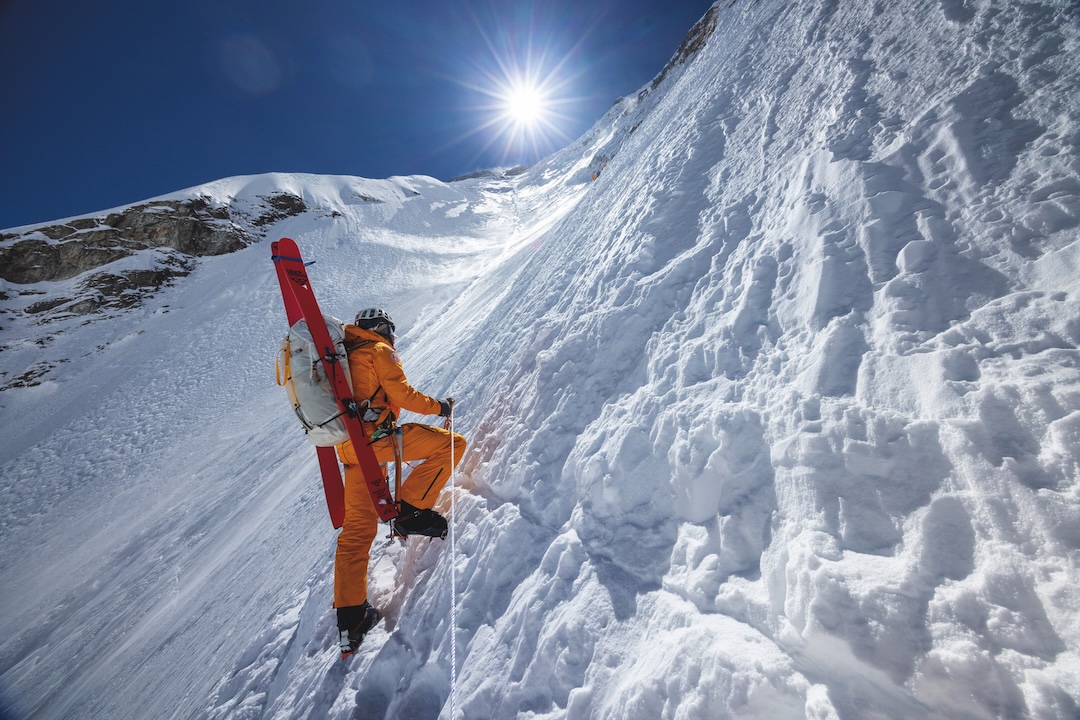
The 1980s: ski descents become an expedition goal in their own right
During the 1980s, skiers began to search more systematically for routes on eight-thousanders. Sylvain Saudan, one of the pioneers of extreme skiing, made a ski descent from Gasherbrum I in 1982. In 1984, a French team skied on Gasherbrum II: different team members skied sections from the summit to the upper camp, while Swiss climber Wilhelmus Pasquier is described in accounts as having skied from the summit to base camp over several days, including technically difficult sections. These early routes show that a “complete descent” does not necessarily mean one uninterrupted run without stops. What matters is which parts of the route the skier actually covered on skis and where the descent ended.
In 1988, French skier Véronique Périllat descended from the summit of Cho Oyu on a monoski. She became the first woman to make a ski descent from the summit of an eight-thousander. Monoskis were far less common then than modern equipment, and the route demanded not only skiing technique but serious high-altitude preparation. Her achievement became an important milestone in women's extreme sports.
Everest: three different chapters in one story
Everest shows particularly clearly why different records must not be conflated. In 1996, Hans Kammerlander skied down from the upper part of the route on the north side. He skied for roughly 300 metres from the summit, then removed his skis and descended on foot for about a thousand metres before continuing on skis. It was one of the first attempts to ski directly from Everest's summit, but it was not a complete ski descent to base camp.
In October 2000, Slovenian skier Davo Karničar made the first complete ski descent from Everest's summit to base camp via the south route without taking his skis off. He used supplemental oxygen. According to his account, the descent took about four hours and forty minutes. The route crossed dramatically different terrain: from open slopes above the South Col to steep icy sections and the Khumbu Icefall. The achievement was significant not only because Karničar skied from the highest point, but because he linked the summit and base camp in one ski route.
In 2006, Martin Letzter and Olof Sundström skied about 90 percent of the standard route from the summit to the North Col advanced base camp, using oxygen. This example again shows why the percentage of the route, starting point and finishing point matter: skiing 90 percent of the route is extraordinary, but it is not the same as skiing all the way to base camp.
In September 2025, according to the American Alpine Journal report on two major descents from Everest, Polish skier Andrzej Bargiel became the first person to climb Everest and complete a ski descent to base camp without supplemental oxygen. He spent about 16 hours on the final ascent above 8,000 metres, reached the summit and began skiing down. In the evening, he reached Camp II and stopped because of darkness. The next morning, he continued through the Khumbu Icefall without using ropes to descend on skis; a drone operated by his brother Bartek helped him navigate the complex ice maze. Stopping overnight does not make the route incomplete: what matters is that Bargiel completed it on skis from the summit to base camp.
K2: when the skis travel through the mountain, not simply downhill
At 8,611 metres, K2 is widely regarded as one of the most difficult mountains to climb. Its steep terrain, avalanche danger and limited options for retreat make a ski descent a different kind of challenge from skiing an open snow slope. It is not enough to find a line that can be skied; the skier must understand whether every section can be negotiated safely.
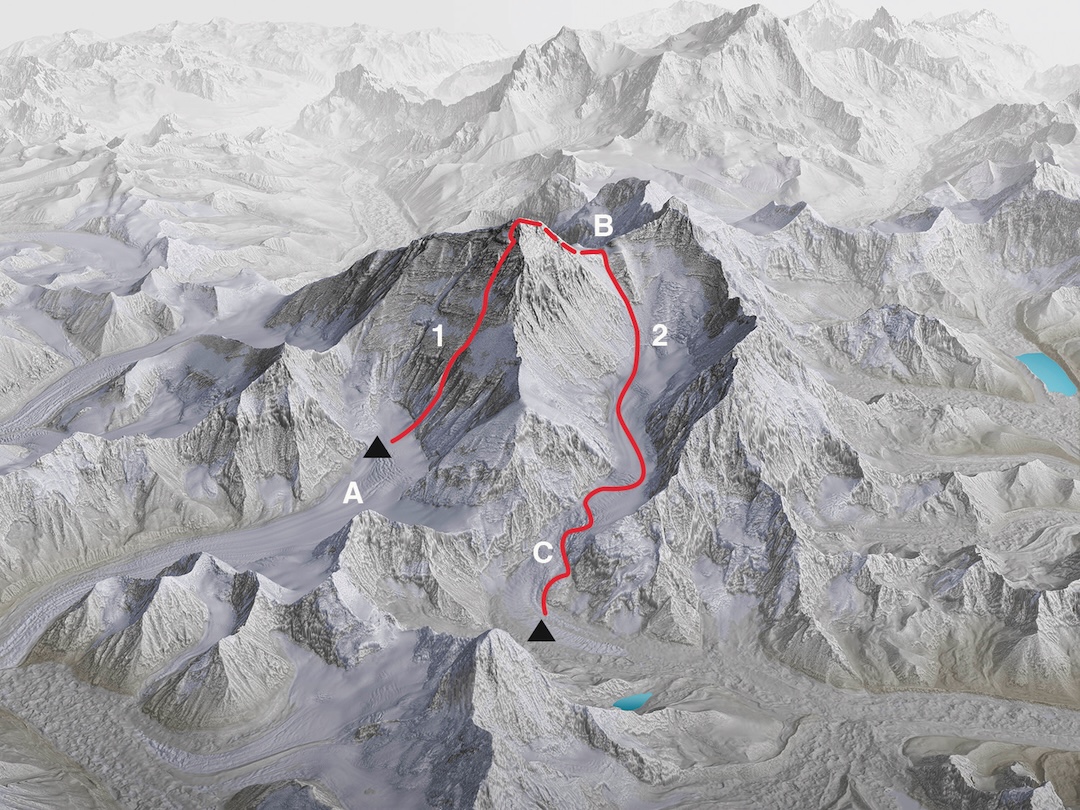
In 2018, Andrzej Bargiel made the first complete ski descent from K2's summit to base camp without removing his skis. He did not simply repeat one standard route: his line linked sections of different descent options, including parts of the normal route, the Basque route and a variant associated with the Polish route. This demanded careful reading of the terrain and a willingness to change plans. The achievement became a key stage in his long-term effort to make ski descents from eight-thousanders without supplemental oxygen.
K2 also reminds us that technical difficulty cannot be measured by vertical drop alone. A route may be shorter but much more dangerous because of rock, ice, narrow couloirs or the lack of a safe place to stop.
Lhotse and Manaslu: the beauty of a line and the cost of risk
In 2018, American mountaineers Hilaree Nelson and Jim Morrison made the first ski descent of the Lhotse Couloir on the mountain's west face. This was not an attempt to ski from Lhotse's highest point all the way to base camp, but a descent of a specific, difficult line on the 8,516-metre mountain. In high-altitude ski mountaineering, such routes can be historic even when they do not meet the definition of a complete descent from the summit.
Four years later, Nelson and Morrison attempted a ski descent on Manaslu. In September 2022, Nelson was caught in an avalanche near the summit and died. Her death was a painful reminder that experience, preparation and careful planning cannot remove every danger in the high mountains. In 2025, Morrison climbed Everest and scattered some of his partner's ashes at the summit. Their story became about more than priority and technique: it also became a remembrance of the people with whom we share the mountains.
The other peaks: the story is not a single list of records
Ski attempts on Manaslu date back to the early 1980s. In 1981, Austrians Joseph Millinger and Peter Woergoetter skied from a point about 30 metres below the rocky summit. Some accounts call this the first ski descent of an eight-thousander; others clarify that the starting point was not the highest point. In 2011, Adrian Ballinger was able to start from the very top with the help of a snow cornice. This story shows how a few metres and the shape of a summit can change how a record is described.
Broad Peak, Gasherbrum I and Gasherbrum II became part of the wider wave of high-altitude ski mountaineering. Bargiel later added these peaks to his programme of descents without supplemental oxygen. The early Gasherbrum II descents of 1984 varied in scope: some participants skied only as far as the upper camp, while Pasquier is described as having skied from the summit to base camp. This is not a minor detail in the footnotes; it is an example of why chronology must be read alongside route details.
Shishapangma also became part of Bargiel's series of descents without supplemental oxygen. For such achievements, the important point is not only that the skier reached the summit and descended, but that the ascent and descent were completed without bottled oxygen as parts of one expedition plan.
On Dhaulagiri, Makalu, Nanga Parbat and Kangchenjunga, the history of ski mountaineering is less familiar to a broad audience, and available summaries differ on starting points and how much of the descent was completed on skis. That does not mean there have never been ski attempts on these mountains; it means we should not assign a “first complete descent” or invent a specific pioneer without reliable evidence. In particular, a ski descent from Kangchenjunga's summit should not be claimed without a trustworthy account of the route.
The history of the 14 eight-thousanders therefore does not have the same ending on every mountain. On some, a complete route to base camp is documented; on others, a skier descended from the summit before continuing on foot, skied a particular couloir or took part in an expedition attempt. This variety is what makes the subject compelling: it is not a championship with one set of rules, but the evolution of a demanding mountain discipline.
Why a descent without supplemental oxygen is a separate frontier
Supplemental oxygen does not make an ascent or descent easy. It can help sustain performance, but the athlete still has to negotiate difficult terrain, cold, wind and avalanche risk. Going without bottled oxygen adds a further physiological burden: the body receives less oxygen, tires faster, and concentration and coordination may deteriorate precisely when the greatest precision is needed.
This matters especially on skis. A mountaineer descending on foot can check each step slowly and use ropes. A skier moves faster and must continually assess the surface, slope angle, snow firmness, crevasses and options for stopping. A record without supplemental oxygen is therefore not just another line in a biography. It combines a demanding ascent, endurance, technique and decision-making under hypoxic conditions.
Bargiel's 2025 Everest achievement was historic because it combined two challenges: he reached the summit without supplemental oxygen and completed the full ski route to base camp. His overnight stop at Camp II because of darkness does not diminish the result. Rather, it is an important reminder that knowing when to stop is part of mountain skill, not a sign of failure.
The people behind the records
Yuichiro Miura showed that skis could be a tool for high-altitude experimentation. Yves Morin represents the early era, when the limits of possibility were explored at enormous risk. Véronique Périllat proved that an eight-thousander's summit could be the setting for a historic achievement by a woman skier. Davo Karničar demonstrated that a complete route from Everest to base camp could be skied without removing the skis. Hilaree Nelson and Jim Morrison opened a difficult line on Lhotse. Andrzej Bargiel connected a long-term programme of ski descents from eight-thousanders with a new goal: completing a full descent from Everest without supplemental oxygen.
Their stories are different, and not all ended happily. But each shows that extreme ski mountaineering is not simply a matter of courage. It requires experience, careful attention to conditions, team support, the right equipment and a willingness to abandon a plan when circumstances change.
A track in the snow
A ski track on a mountain slope can disappear after the first snowfall. The story of these routes, however, remains in expedition reports, photographs and memories. More than half a century separates Miura's descent from the South Col area of Everest from Bargiel's route without supplemental oxygen. Skis, clothing, communications, weather forecasting and planning have all changed during that time. But one thing remains the same: no technology removes the dangers of the high mountains.
The best history of ski descents from the eight-thousanders is therefore not a list of winners. It is a story of people exploring the limits of what is possible, learning from earlier expeditions and leaving tracks on slopes that once seemed out of reach.
A symbol of a love for skiing and the mountains
For some people, skiing means winter weekends; for others, it means long routes, big mountains and a sense of freedom on the slope. The Travel Jewelry Ski Pendant can be a small symbol of that passion - for yourself or as a gift for someone whose life has long been shaped by the mountains.
Tiphaine Dupérier: Seven Years to Nanga Parbat and a Ski Descent from the Summit
Peter Habeler: The Climber Who Changed the Meaning of "Without Oxygen"
Piolets d'Or 2026: Winners, Outstanding Ascents and Special Awards
Ski and Snowboard Records: Speed, Height, Distance and Incredible Tricks
Types of Skis and Skiing Disciplines: From Cross-Country Skiing to Freeride and Speed Records
Ski Mountaineering: History, Evolution and the Most Challenging Ski Descents
Ski Travel: The History of Ski Touring, Ski Expeditions and Winter Journeys
The History of Skis: Evolution, Types, Technology and Skiing in Sport
Gift Ideas for a Skier: Practical and Meaningful Presents for Winter Enthusiasts