Today, a mountain bike can look almost like a high-tech piece of sporting equipment: a carbon frame, full suspension, hydraulic disc brakes, 29-inch wheels, tubeless tires, a 1x drivetrain and even electronic shifting.
But the first mountain bikes were very different. They could be heavy steel bicycles with wide tires that enthusiasts modified themselves for riding on dirt roads, trails and steep slopes.
The history of mountain biking did not begin in a factory or on the drawing board of a large corporation. It developed gradually, thanks to cyclists who wanted to ride where ordinary road bikes simply could not.
Within a few decades, this experiment grew into a huge global culture, a professional sport and an Olympic discipline.
Before the Modern MTB
It would be incorrect to name a single person as the inventor of the mountain bike. The history of MTB developed through several parallel efforts.
Even before the famous California riders, people were experimenting with bicycles for off-road riding. During the 1960s and 1970s, various designs appeared with wide tires, gear systems and other modifications that made ordinary bicycles better suited to dirt and rough terrain.
For example, in 1966 Rodger Rochell in Cincinnati modified a Schwinn frame to accommodate wider tires. In the early 1970s, similar experiments were being carried out by cyclists in California, including members of the Cupertino Riders group.
This is why it is more accurate to describe mountain biking as the result of a gradual evolution of the idea, rather than the invention of one person on one specific date.
Marin County - Where MTB Found Its Identity
One of the most important early centers of mountain biking was Marin County, California.
Around Mount Tamalpais, cyclists began using old heavy bicycles with wide tires that became known as "klunkers." They were nothing like modern MTBs. They had simple drivetrains, heavy steel frames and brakes that often struggled to survive extreme downhill runs.
But these bicycles allowed riders to do exactly what they wanted: climb a mountain, ride along dirt roads and then descend as quickly as possible.
The community of riders in Marin County gradually transformed these experiments into a distinct cycling culture.
The history of mountain biking from the Marin Museum of Bicycling and Mountain Bike Hall of Fame shows just how collaborative this process was. Joe Breeze, Gary Fisher, Charlie Kelly, Tom Ritchey and many other people were riding, breaking bicycles, repairing them and developing new solutions at the same time.
Repack - The Race That Accelerated MTB Development
One of the most important events in early mountain biking history was the Repack race.
The course ran down a steep slope near Fairfax. The descent was so demanding that the old drum brakes in the rear hubs overheated. The grease inside would lose its properties, meaning that the hub had to be "repacked" with fresh grease after the run.
On October 21, 1976, the first organized Repack race took place. Ten local riders lined up at the start, and Alan Bonds won the event.
But the importance of Repack went far beyond the race itself.
The riders regularly met, discussed their bicycles, experimented with new components and looked for ways to improve their machines. One rider would discover an interesting solution, and others would copy it or improve upon it.
This created one of the most important principles in the history of MTB: the bicycle evolved directly through riding.
Repack races continued until 1984, and during that period the old "klunkers" gradually gave way to bicycles specifically designed for mountain biking.
Joe Breeze and the Emergence of Purpose-Built MTBs
At some point it became clear that the old Schwinn bicycles could not withstand such demanding riding indefinitely.
This marked the beginning of a new chapter.
In 1977, Joe Breeze designed and built a bicycle specifically for mountain riding. His design became known as the Breezer.
Breezer Number 1 featured a new frame specifically designed for mountain biking and made from 4130 chromoly steel. Breeze built the first ten frames, completing the first bicycle in 1977. He immediately entered it in Repack and won the race.
This was a fundamental turning point.
Previously, bicycles had been adapted for mountain riding. Now bicycles were being designed specifically for the mountains.

Gary Fisher, Tom Ritchey and the First MTB Companies
Another important step was the emergence of the first companies producing dedicated mountain bikes.
In 1979, Tom Ritchey began producing specialized frames designed for wide tires. That same year, Gary Fisher and Charlie Kelly founded MountainBikes and used Ritchey frames to build complete bicycles.
This marked the transition from a small community of enthusiasts to a new bicycle market.
New component manufacturers, specialized workshops, magazines and racing events gradually appeared.
MTB was no longer simply an unusual way for a few cyclists in California to have fun.
Specialized Stumpjumper - MTB Enters Mass Production
The next major step came in 1981.
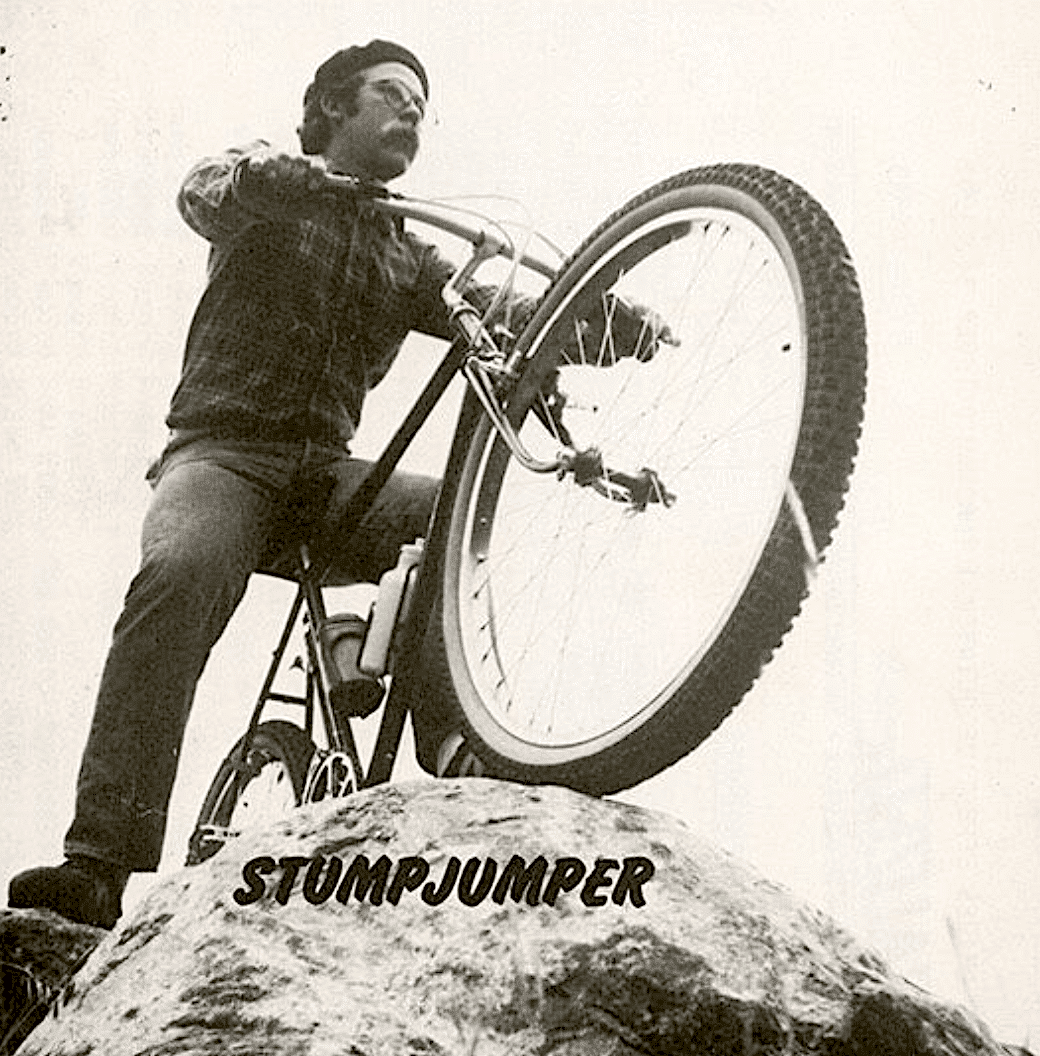
Specialized introduced the Stumpjumper, a model the company describes as the world's first production mountain bike.
Unlike expensive one-off custom builds, it could be purchased as a complete production bicycle.
Specialized still describes the Stumpjumper as the first production mountain bike, and the name remains part of the company's lineup today.
The original Stumpjumper looked very different from a modern trail bike. It had a steel frame, a rigid fork and components, some of which came from other bicycle categories.
But the important point was this: a mountain bike could now be purchased as a production product.
This became one of the key moments in the transformation of MTB from a subculture into a distinct part of the bicycle industry.
The 1980s: Mountain Biking Becomes a Sport
During the 1980s, mountain biking began spreading rapidly beyond California.
New manufacturers, racing series and specialized components appeared. The bicycles themselves evolved quickly as manufacturers worked to make them lighter, stronger and easier to control on rough terrain.
In 1983, Joe Breeze and other pioneers helped establish NORBA, the National Off-Road Bicycle Association, which worked to develop racing and access to riding areas.
By the end of the decade, it had become clear that mountain biking was no longer simply about modified bicycles for downhill riding. It had become a distinct sport with its own rules, athletes, manufacturers and culture.
The 1990s: MTB Reaches the International Stage
In 1990, the first UCI-recognized mountain bike world championships were held in Durango, Colorado. The World Cup followed in 1991.
This firmly established MTB as an international competitive discipline.
But the most important sporting milestone was still ahead.
In 1996, mountain biking made its Olympic debut in Atlanta.
And this is where an important distinction should be made: the Olympics do not include every form of mountain biking. The Olympic discipline is specifically Cross-country Olympic - XCO.

How the Mountain Bike Itself Changed
The history of MTB is not only the history of a sport. It is also an incredible story of technological evolution.
The first off-road bicycles were heavy steel machines. Their frames were designed to survive rough use, but there was nothing like today's optimization of weight, stiffness and suspension performance.
One of the early important frame materials was chromoly steel. Joe Breeze used it for his first purpose-built frames.
Later, aluminum alloys became increasingly important. They allowed manufacturers to reduce frame weight and create different structural designs.
Today, carbon fiber is widely used in high-end and professional mountain bikes. Manufacturers can control fiber orientation and tune the properties of different parts of a frame. It is no longer simply a matter of choosing between "steel or aluminum." It is a sophisticated engineering process involving stiffness, weight and the way the bicycle behaves on the trail.
From 26 Inches to 29 and Beyond
The first mass-produced mountain bikes used 26-inch wheels. For decades, that size was practically synonymous with mountain biking.
Then 27.5-inch wheels appeared, followed by the widespread adoption of 29-inch wheels.
Changing wheel diameter affected much more than the appearance of the bicycle. Larger wheels can roll over certain obstacles more easily and can provide greater stability on rough terrain. At the same time, they affect handling, acceleration and the geometry of the entire bicycle.
Modern XC bikes have therefore evolved from fully rigid 26-inch designs into 27.5- and 29-inch machines.
Some disciplines have also adopted so-called mullet bikes, which combine different wheel sizes front and rear.
From Rigid Frames to Full Suspension
One of the most visible changes was the introduction of suspension.
The first purpose-built MTBs were fully rigid. Then suspension forks began to appear, improving control over rocks, roots and rough terrain.
The next stage was full suspension - bicycles with suspension at both the front and rear.
This changed the very philosophy of mountain biking. Suspension is not simply about comfort. It helps the wheels maintain contact with the terrain for longer, improves control and allows riders to move faster through difficult sections.
Modern suspension systems can use air or coil springs, adjustable rebound and compression and different rear suspension kinematics.
In modern XC riding, the development moved from relatively limited front suspension to approximately 100-120 mm of travel, while full-suspension designs became increasingly common even in racing.
From Simple Brakes to Hydraulic Discs
Early MTBs did not always have brakes capable of confidently controlling the bike during long technical descents.
The technology gradually evolved from traditional rim brakes to disc brakes. Modern mountain bikes most commonly use hydraulic disc systems.
This brought greater braking power and improved modulation, especially in mud, water and long descents.
For downhill, this is particularly important. It is one of the fastest and most technically demanding MTB disciplines, where high speed, precision and control on steep technical terrain are essential.
From 3x and 2x to 1x
Another major revolution took place in drivetrain design.
Early MTBs could have several front chainrings combined with a cassette, providing a wide range of gears. Modern mountain bikes often use a 1x drivetrain - one front chainring and a wide-range cassette at the rear.
Removing the front derailleur simplified the system and made shifting easier to manage. The rider no longer needs to coordinate two derailleurs, while the overall drivetrain becomes more compact.
This transition to efficient 1x drivetrains became one of the key changes in modern MTB design.
But development did not stop there.
Today, electronic drivetrains are available in which the rear derailleur is powered by a battery and receives commands wirelessly. SRAM Eagle AXS, for example, combines a 1x drivetrain with electronic shifting and software configuration through a mobile app.
In other words, a component that once moved using a simple steel cable can now be controlled electronically.
Dropper Post - A Small Mechanism That Changed Riding Technique
One of the most characteristic components of a modern trail or enduro bike is the dropper post, or telescopic seatpost.
The idea is simple.
During a climb, the saddle stays high so the rider can pedal efficiently. Before a steep descent, the rider presses a control on the handlebar and lowers the saddle.
This gives the rider more freedom to move their body behind the center of the bike and better control the bicycle during descents.
It is a perfect example of how MTB development was not only about materials or speed. Even the rider's body position and the way a person interacts with the bicycle changed.
Tubeless - A Bike Without an Inner Tube
Another technology that has become common in modern MTB is the tubeless tire system.
A tubeless setup does not use a traditional inner tube. The tire and rim form an airtight system, while sealant can help close small punctures while riding.
One advantage is the ability to run lower tire pressures, which can improve grip on the terrain. Manufacturers also point to a lower risk of traditional tube-related punctures.
For technical riding, this is particularly important because contact with the ground and control over the bicycle can matter more than minimizing weight alone.
Geometry Became Just as Important as Materials
One of the most fundamental changes in MTB has been geometry.
Modern bikes differ dramatically from early mountain bikes not only in their components. They have different frame proportions, longer reach, different wheelbases, lower centers of gravity and, on many trail and enduro models, slacker head angles.
These changes made bicycles more stable at high speed and on technical descents.
At the same time, modern geometry is designed to preserve the ability to climb efficiently. Engineers are constantly searching for a balance between two opposing tasks: efficient climbing and controlled descending.
That is why a modern mountain bike is the result not of one major technological breakthrough, but of dozens of smaller decisions working together.
Mountain Biking Today: What Are the Main Disciplines?
Today, mountain biking is no longer a single discipline.
One of the best-known competitive formats is cross-country (XC). Riders complete several laps of a course with climbs, descents, rocks, roots and other technical features.
The main Olympic format is XCO, Cross-country Olympic. It uses a mass start and multiple laps of a technical course. Elite races typically last around 80-90 minutes.
There is also XCC, Cross-country Short Track - a shorter and extremely intense cross-country format where races generally last around 20-25 minutes.
Downhill (DHI) follows a completely different philosophy. The goal is to descend a technical course as quickly as possible. Climbing is not part of the race itself, while speed, control, jumps and technical sections are central to the discipline.
Enduro (EDR) combines climbing with technical timed downhill stages. It developed from the style of riding often referred to as all-mountain. The first Enduro World Series was held in 2013.
There is also cross-country marathon (XCM) - a long-distance version of cross-country, with courses that can range from roughly 60 to 160 km depending on the specific format. Endurance and the ability to maintain a high pace over difficult terrain are central to this discipline.

Which Mountain Bike Discipline Is Olympic?
This is a common source of confusion.
Although mountain biking includes many different disciplines, the Olympic discipline is specifically Cross-country Olympic - XCO.
Mountain biking made its Olympic debut in Atlanta in 1996. The Olympic program includes men's and women's XCO races. The same format is planned for the 2028 Los Angeles Games, with 72 mountain bike quota places - 36 for men and 36 for women.
This means that downhill, enduro and XCC are all established modern MTB disciplines, but they are not Olympic disciplines.
That distinction shows just how large mountain biking has become: the Olympic Games represent only one part of the much broader MTB world.
From Klunkers to High Technology
In roughly half a century, mountain bikes have changed in almost every respect.
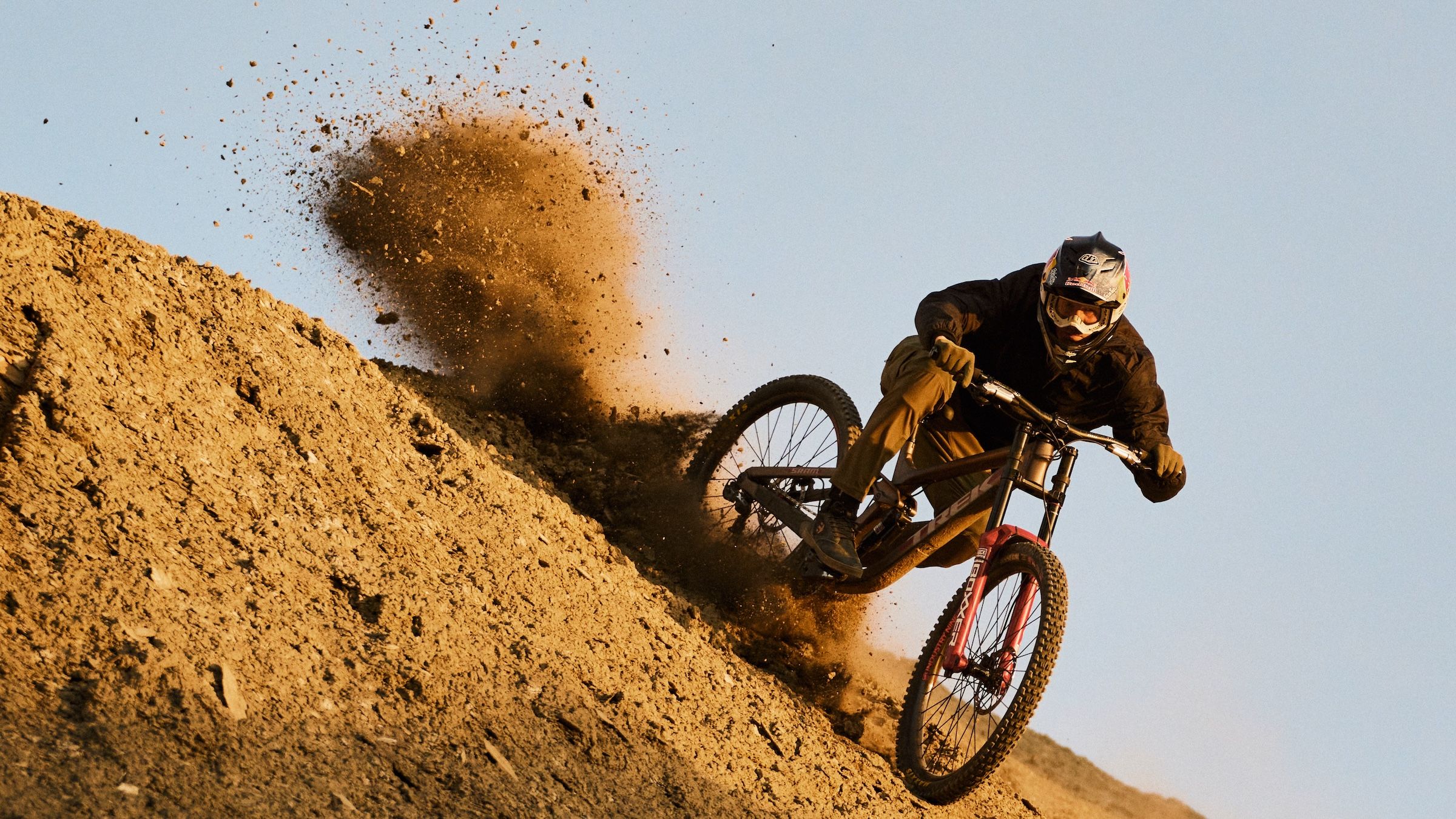
Heavy steel bicycles evolved into lightweight aluminum and carbon constructions. 26-inch wheels gave way to 27.5- and 29-inch wheels. Rigid frames evolved into sophisticated suspension systems. Rim brakes were replaced by disc brakes. Multiple front chainrings gradually gave way to simpler 1x drivetrains.
Dropper posts, tubeless systems, electronic shifting, advanced suspension systems and countless adjustment options became part of the modern mountain bike.
Today, engineers are no longer designing individual components in isolation. They are designing an entire system in which the frame, wheels, suspension, drivetrain, brakes and rider position all have to work together.
Mountain Biking as a Culture
But perhaps the most interesting part of MTB history is that these technologies appeared because people simply wanted to ride better.
The first riders did not have modern bicycles. They took old frames, fitted wider tires, experimented with gears, brakes and handlebars, and tried to make their bikes survive.
Then they started building their own frames.
Then they organized races.
Then manufacturers appeared.
Then came world championships.
And in 1996, mountain biking reached the Olympic Games.
Today, it is an international sport, a huge outdoor culture and a way to spend time in nature - from a short trail ride after work to multi-day mountain journeys.
That is why, for many riders, a bicycle has long been more than transportation or sporting equipment. It has become part of their lifestyle.
We captured that idea in the Travel Jewelry "Bicycle" jewelry collection. It includes jewelry inspired by the details and atmosphere of the cycling world - for people who see the bicycle not simply as a means of transportation, but as part of their own story.
From California Klunkers to Modern MTB
The history of mountain biking began with a very simple idea: to ride where an ordinary bicycle did not want to go.
That idea brought enthusiasts to Mount Tamalpais, led to the Repack races, inspired Joe Breeze, Gary Fisher, Charlie Kelly, Tom Ritchey and other pioneers, and eventually developed into an entire industry.
From the first chromoly steel frames to carbon full-suspension bikes, from mechanical shifters to wireless electronic systems, from local California races to the Olympic Games, mountain biking has continually evolved.
But the most important thing has remained unchanged.
The desire to ride farther, discover new routes, descend mountains, explore nature and simply enjoy the bicycle.
That is where it all began.
Sea to Summit: How Tim Macartney-Snape Walked from the Sea to the Summit of Everest
Famous Bicycle Journeys Around the World: From Thomas Stevens to the Present Day
Bikepacking: From Bicycle Travel to Modern Cycling Expeditions
Bicycles and Cycling: Types of Bikes and Ways to Ride