Africa is often associated with savannas, deserts and tropical forests, but its mountain world is just as remarkable. The continent is home to volcanoes rising almost 6,000 metres, equatorial ranges with glaciers, high plateaus, rugged summits and long mountain chains. Kilimanjaro, the imposing peaks of Mount Kenya, the mysterious Rwenzori, the Atlas Mountains and the Drakensberg all belong to this extraordinary landscape.
The highest point in Africa is Uhuru Peak on Mount Kilimanjaro, at 5,895 metres above sea level. Yet focusing on that single figure means missing much of the continent’s mountain diversity. Mount Kenya, Africa’s second-highest mountain, has several dramatic rocky summits that require technical climbing skills. The Rwenzori conceal glaciers among tropical vegetation, while the Atlas Mountains create an entirely different high-altitude world in the north.
The story of Africa’s mountains is about much more than elevations and dates. It is a story of geographical exploration, local guides, early expeditions, changing climates and people who ventured into places few had visited before. Women were among them, although their names were often left at the margins of mountaineering history.

1. Mountainous Africa: A Continent of Contrasts
Africa’s mountains are unevenly distributed. The highest peaks are concentrated mainly in the east and central parts of the continent, where tectonic processes associated with the East African Rift System have created volcanic massifs and uplifted plateaus. The Atlas Mountains stretch across the northwest, Mount Cameroon rises in the west, and the Drakensberg dominates parts of the south. The Sahara and Sahel also contain isolated highland areas that do not always resemble the familiar Alpine-style mountain chains.
African mountains have different geological origins. Kilimanjaro, Mount Meru, Mount Cameroon and the Virunga volcanoes are associated with volcanic activity. Mount Kenya is the remnant of an ancient volcanic complex; its hard igneous rock peaks were exposed as the original volcanic structure eroded. The Rwenzori are an uplifted block of the Earth’s crust, while the Atlas Mountains were formed through complex tectonic processes linked to the convergence of the African and Eurasian plates.
It is useful to distinguish individual summits from mountain massifs and ranges. Batian and Nelion, for example, are the two highest peaks of the same massif, Mount Kenya. Margherita is the highest point of Mount Stanley, which belongs to the Rwenzori range. Mawenzi is one of Kilimanjaro’s principal peaks, not a separate mountain system. For this reason, a ranking of Africa’s major mountain areas is not necessarily the same as a list of every individual summit on the continent.
2. Africa’s Highest Mountain Massifs and Peaks
The table below lists the highest points of some of Africa’s principal mountain massifs. It is not a ranking of every individual summit on the continent: some massifs contain several peaks higher than other independent mountains. Elevations are based on modern reference and mapping sources; published figures may differ slightly for certain summits.
| Mountain range or massif | Highest summit | Elevation | Country / countries |
|---|---|---|---|
| Kilimanjaro | Uhuru Peak (Kibo) | 5,895 m | Tanzania |
| Mount Kenya | Batian | 5,199 m | Kenya |
| Rwenzori | Margherita (Mount Stanley) | 5,109 m | Uganda / DR Congo |
| Mount Meru | Socialist Peak | 4,566 m | Tanzania |
| Simien Mountains | Ras Dashen (Ras Dejen) | about 4,550 m | Ethiopia |
| Virunga Mountains | Karisimbi | 4,507 m | Rwanda / DR Congo |
| Bale Mountains | Tullu Dimtu | 4,377 m | Ethiopia |
| Mount Elgon | Wagagai | 4,321 m | Uganda / Kenya |
| High Atlas | Mount Toubkal | 4,167 m | Morocco |
| Cameroon Volcanic Line | Mount Cameroon (Fako) | 4,095 m | Cameroon |
| Drakensberg | Thabana Ntlenyana | 3,482 m | Lesotho |
For a broader geographical overview, see the Africa Mountains Atlas, prepared by the United Nations Environment Programme (UNEP). This extensive publication explores not only the continent’s highest peaks, but also its geology, biodiversity, water resources and the importance of mountains to local communities.
Why do elevations sometimes differ? Maps and reference works may use different measurement systems, terrain models or historical data. Ras Dashen, for example, was often listed at 4,620 metres in older sources, while modern references more commonly give a figure of about 4,550 metres. This article avoids mixing older and newer figures without explaining the difference.
3. Kilimanjaro: The Roof of Africa
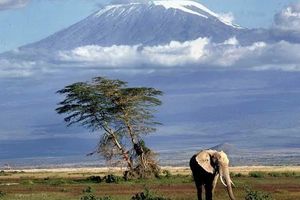
Kilimanjaro is the highest mountain on the continent and one of the world’s best-known freestanding volcanic massifs. It rises above northern Tanzania, close to the Kenyan border. Its three main volcanic centres - Kibo, Mawenzi and Shira - have distinct shapes and geological histories. The highest point, Uhuru Peak, lies on Kibo at 5,895 metres.
Kilimanjaro is remarkable for the dramatic succession of natural zones along its slopes. From lower agricultural land and montane forest, the terrain changes to heathland, alpine desert and the cold crater zone. Remnants of glaciers survive near the equator, although their area has shrunk considerably over the past century.
The first documented successful ascent of Kibo’s highest point took place in 1889. German geographer Hans Meyer and Austrian mountaineer Ludwig Purtscheller reached the summit with the support of a local team. We explore the mountain’s history, routes and climbing preparation in two separate articles in our Kili Cluster: “Kilimanjaro: Africa’s Highest Mountain” and “Climbing Kilimanjaro”.
4. Mount Kenya: Rocky Summits Above the Equator
Mount Kenya is Africa’s second-highest mountain. Its highest point, Batian (5,199 m), and neighbouring Nelion (5,188 m) form a striking pair of dark rocky summits. Unlike Kilimanjaro, where the standard routes to the highest point are trekking routes, climbing Batian and Nelion requires technical rock climbing, the use of protection and experience moving across exposed rock and ice.

The massif is the remnant of an ancient volcano. Its central rocky peaks consist of hard igneous rock that remained after the upper parts of the volcanic structure were destroyed. Glaciers and erosion carved valleys, cirques and sharp ridges. Today, the mountain’s ice cover is much smaller than it once was, and the remaining glaciers are particularly sensitive to changes in temperature and precipitation.
The first documented ascent of Batian took place in 1899. It was completed by British geographer Halford Mackinder together with guides César Ollier and Joseph Brocherel. In expeditions of that era, European leaders often received most of the attention in official accounts, even though the knowledge of local guides was crucial to success.
Women on Batian and Nelion
The history of women’s ascents on Mount Kenya includes several identifiable pioneers. In 1938, British climber Carol Carroll climbed Nelion accompanied by Kenyan guide Ayub Muthara. She is regarded as the first known woman to reach that summit. In the same year, Scottish mountaineer Una Cameron made the first documented ascent of Batian by a woman.
Cameron arrived in East Africa as an experienced climber, having already climbed in the Alps and the Caucasus. Her story was not limited to Mount Kenya. In the Rwenzori, she pioneered a new route on Mount Baker, also known as Kiyanja. Her name therefore connects two of Africa’s major mountain systems.
A modern historical account by the Mountain Club of Kenya, published by the American Alpine Club, brings into the story not only Carroll and Cameron, but also Kenyan climbers and guides whose contributions had often been overlooked. This is essential to a fuller understanding of African mountaineering history.
5. The Rwenzori: The Mountains of the Moon
The Rwenzori Mountains stretch along the border between Uganda and the Democratic Republic of the Congo. Their highest point is Margherita Peak (5,109 m), on Mount Stanley. Unlike volcanic Kilimanjaro, the Rwenzori are a high mountain block uplifted by tectonic forces. Their jagged peaks, glaciers, waterfalls, lakes and boggy valleys create one of Africa’s most unusual mountain landscapes.

The name “Mountains of the Moon” is associated with ancient geographical ideas about distant high mountains where the great rivers of Africa were thought to originate. In the nineteenth century, European explorers tried to match ancient descriptions with real geographical features. The Rwenzori became one candidate for the legendary mountains, although modern geography does not identify the ancient references with one definitive location.
The 1906 European expedition led by the Duke of the Abruzzi (Luigi Amedeo di Savoia) was a landmark in the exploration of the range. Its members climbed the principal peaks, made topographical observations and documented the glaciers and natural zones. At the same time, the Rwenzori had been known to local communities long before this expedition, and its success depended on the work and knowledge of African participants.
Women in the History of the Rwenzori
Una Cameron left a notable mark on the early history of women’s climbing in the region, particularly through her new route on Mount Baker. Another remarkable story belongs to Canadian climber Beryl Park. On 13 November 2010, at the age of 78, she reached Margherita Peak after a ten-day journey across bogs, rock, snow and glaciated terrain.
Park was not the first woman on Margherita - her achievement was different. Hungarian and Ugandan media reported her as the oldest woman of her age at the time to reach the Rwenzori’s highest summit. It is a story not about gender-based precedence, but about endurance, a long-held dream and the determination to remain active in later life.
6. The Atlas Mountains: North Africa and Mount Toubkal
The Atlas Mountains extend across Morocco, Algeria and Tunisia, separating the Mediterranean regions from the Sahara. The highest section is the High Atlas in Morocco, home to Mount Toubkal (4,167 m), the highest peak in North Africa.

Unlike the equatorial massifs of East Africa, the Atlas has a distinctly Mediterranean and mountain-desert character. Snow covers the higher peaks in winter, while the lower slopes can be hot and dry in summer. Valleys, rocky passes and high-altitude villages form a landscape in which mountain routes are closely connected with Amazigh culture - that of the Indigenous peoples of North Africa.
Toubkal is a popular trekking destination. In summer, the standard route generally does not require technical climbing, but altitude, loose slopes, weather and winter snow can make the ascent considerably more difficult. The fact that the mountain is more than 1,700 metres lower than Kilimanjaro is no reason to underestimate it.
The first documented ascents of Toubkal took place in 1923. Early European accounts of mountaineering in the region were dominated by male expeditions, but identifying a reliably documented first woman on the summit is more difficult. We will not invent such a claim: in this case, acknowledging a gap in the historical record is more accurate than attributing an achievement to someone without evidence.
7. The Ethiopian Highlands: Simien and Bale
The Ethiopian Highlands are one of Africa’s largest elevated regions. They were shaped by volcanic activity and uplift of the Earth’s crust, then deeply dissected by rivers and erosion. The result is a landscape of plateaus, gorges, steep escarpments and isolated peaks that can resemble a vast stone fortress.
The Simien Mountains and Ras Dashen
Ras Dashen (also known as Ras Dejen), Ethiopia’s highest peak, rises to about 4,550 metres in the Simien Mountains. Simien Mountains National Park is known for deep valleys and escarpments that reach roughly 1,500 metres in places. It is also an important centre of biodiversity: geladas, Ethiopian wolves and Walia ibex live here, and these wild species are found nowhere else in the world.

Rather than a landscape of sharp Alpine peaks, much of the Simien range resembles an immense high plateau cut by canyons. The scale of the elevation changes and the sweeping views make it one of the continent’s most distinctive mountain regions.
The Bale Mountains and Tullu Dimtu
Southeast of the Simien Mountains lie the Bale Mountains. Their highest summit, Tullu Dimtu, reaches 4,377 metres. Bale Mountains National Park protects one of Africa’s largest areas of Afro-alpine habitat above 3,000 metres. The landscape includes high plateaus, glacial lakes, wetlands, heathland and giant lobelias. Lower down, the slopes descend into the Harenna Forest, one of Ethiopia’s largest moist tropical forests.

The Bale Mountains matter for much more than mountaineering. They are a water source for extensive surrounding areas, a habitat for endemic species and a region of traditional pastoralism. Among the best-known animals are the Ethiopian wolf, mountain nyala and Bale monkey. The range shows how mountain ecosystems can support biodiversity and human livelihoods at the same time.
8. The Volcanic Mountains of Central and West Africa
The Virunga Mountains and Mount Karisimbi
The Virunga Mountains form a chain of volcanoes in the region of the East African Rift, where Rwanda, Uganda and the Democratic Republic of the Congo meet. Their highest peak is Mount Karisimbi (4,507 m), on the border between Rwanda and DR Congo. Nearby stand the active volcanoes Nyiragongo and Nyamuragira, known for frequent eruptions and lava flows.

The region’s volcanic soils are fertile, and its montane forests provide habitat for mountain gorillas. Virunga National Park in DR Congo and neighbouring protected areas are exceptionally important for the conservation of these animals. At the same time, the region faces serious challenges, including armed conflict, pressure on forests, poaching and volcanic hazards.
Mount Meru: Kilimanjaro’s Neighbour
Mount Meru (4,566 m) is located in Tanzania, near the city of Arusha and Arusha National Park. It is a stratovolcano with a large horseshoe-shaped caldera formed when the eastern side of the volcanic structure collapsed. Its silhouette can often be seen from Kilimanjaro, and the massif is an important part of northern Tanzania’s mountain landscape.

Meru has a character of its own. The ascent passes through forest, high-altitude grassland and an exposed volcanic ridge. Buffaloes, giraffes and colobus monkeys may be seen in the lower forest zones. For many travellers, climbing Meru is an adventure in its own right, not merely preparation for Kilimanjaro.
Mount Elgon: An Ancient Volcano on the Kenya-Uganda Border
Mount Elgon rises to 4,321 metres on the border between Kenya and Uganda. It is one of East Africa’s oldest volcanic massifs: its earliest eruptions date back approximately 24 million years. The summit of Wagagai lies on the edge of a vast caldera formed through the long-term erosion and collapse of the volcanic structure.
Elgon is also important to local culture. Among the Bagisu people, the mountain is known as Masaba and is connected with origin stories and cultural memory. Its slopes contain forests, waterfalls, caves and high-altitude grasslands. Unlike the sharp rock towers of Batian, the upper part of Elgon has a broad, more rounded character.
Mount Cameroon: A Volcano Above the Atlantic
Mount Cameroon, also known as Fako, rises to 4,095 metres near the coast of the Gulf of Guinea. It is an active stratovolcano and the highest peak in Cameroon. Its defining feature is the dramatic transition from a humid tropical coastline to cold high-altitude slopes. The volcano belongs to the Cameroon Volcanic Line, which extends from islands in the Gulf of Guinea into the African continent.

Numerous eruptions have been recorded, including in 1982, 1989, 1999 and 2000. The mountain’s slopes support several types of forest and high-altitude grassland, while the enormous change in elevation creates a wide range of local ecosystems.
Mary Kingsley: The Explorer Who Climbed Mount Cameroon
In September 1895, British explorer Mary Kingsley set out for Mount Cameroon. Her expedition took place during the rainy season, and the route led through wet forests, steep slopes and open volcanic terrain. Some of the porters refused to continue, but Kingsley did not abandon her attempt.

Her achievement needs to be described precisely. According to her own notes and subsequent historical research, Kingsley reached the lower of the volcanic massif’s two summits - the south-eastern crater summit - rather than Fako, the highest point. It would therefore be inaccurate to call her the first woman to climb Mount Cameroon’s highest summit. Her ascent was nevertheless an extraordinary feat of exploration for a woman travelling independently in the late nineteenth century.
Kingsley described her journey in Travels in West Africa, published in 1897. Her account is valuable not only as a travel narrative, but also as a record of the conditions of the time, her interactions with local guides and the colonial setting in which European expeditions took place.
9. The Drakensberg: The High Mountains of Southern Africa
The Drakensberg range stretches along the eastern part of South Africa and across Lesotho. Its highest point is Thabana Ntlenyana, at 3,482 metres, located in Lesotho. This is considerably lower than the peaks of East Africa, but the range is the principal high-mountain region of the continent’s south.

The Drakensberg is known for basalt plateaus, deep valleys, waterfalls and towering rock walls. Its landscape was shaped by volcanic outpourings and prolonged erosion. In many places, the mountains form a natural barrier between the interior of southern Africa and the Indian Ocean coast.
The region also has exceptional cultural significance. Numerous San rock paintings survive in the Drakensberg’s rock shelters. The San are one of the Indigenous peoples of southern Africa, and their art makes the mountains not only a natural landmark but also an archive of human history.
10. The Women Who Changed the History of African Mountaineering
Stories of the first ascents have often been told through the names of men - expedition leaders, geographers and climbers. Yet women also took part in early mountain journeys and later pioneered routes and reached the highest summits in their own right. Their stories are not always well documented, so it is important to distinguish confirmed ascents from disputed claims and achievements that involved a point below the highest summit of a massif.
Gertrude Benham: An Early Attempt on Kilimanjaro
British traveller and mountaineer Gertrude Benham climbed on Kilimanjaro in the early twentieth century; her ascent is generally dated to 1909. Her name is sometimes mentioned in connection with the first woman on the mountain’s summit. However, in a discussion published in the Alpine Journal after Sheila MacDonald’s ascent, expedition member William West explained that Benham reached the eastern rim of the crater, which is lower than Kibo’s highest point. Her climb was important, but it does not establish that she reached Uhuru Peak.
Sheila MacDonald: The First Well-Documented Woman on Kilimanjaro’s Highest Point
On 31 July 1927, 22-year-old Sheila MacDonald reached Kibo’s highest point with William West. Her account was published in the Alpine Journal in 1928. MacDonald described not only the final climb, but also the expedition’s complicated logistics, altitude sickness, food difficulties and the assistance provided by the local team.
The claim to precedence needs qualification. Before 1927, several women had already climbed the slopes of Kilimanjaro and reached the crater rim. Some attained high points, but not the mountain’s highest summit. For this reason, Sheila MacDonald is generally described as the first woman with a reliably documented ascent of Kibo’s highest point. This does not diminish the achievements of earlier women travellers; rather, it shows how women gradually made their way towards the summit.
Carol Carroll and Una Cameron: Two Summits on Mount Kenya
In 1938, Carol Carroll became the first known woman to reach Nelion, while Una Cameron made the first documented ascent of Batian by a woman. Both achievements are significant because the two summits are technically demanding. Unlike Kilimanjaro’s trekking routes, they require rock-climbing skills, the use of protection and confidence on exposed terrain.
The role of Ayub Muthara, the Kenyan guide who accompanied Carroll to Nelion, deserves particular recognition. In historical accounts of the period, local climbers were often overshadowed by European participants, even though the expedition might not have succeeded without their experience and knowledge of the mountain.
Beryl Park: Margherita at the Age of 78
In November 2010, Beryl Park reached Margherita Peak at the age of 78. She had dreamed of the Rwenzori for about thirty years and finally joined an expedition after deciding she no longer wanted to postpone the goal. The ten-day route crossed mud, bogs, snow and rocky sections. Her achievement became known as a remarkable age-related record, but it was not the first ascent of the summit by a woman.
Asifiwe Makere: A New Generation of Tanzanian Mountain Guides
The modern story of women in African mountaineering is not only about records. Tanzanian Asifiwe Makere grew up in the Kilimanjaro region. At 22, she first climbed the mountain as a porter and later became a lead guide. She helps other local women enter the tourism profession and gain financial independence.
Her journey reflects changes in the climbing industry itself. Until relatively recently, women were rarely represented among high-altitude support teams. Today, they work as porters, cooks, assistant guides and group leaders. For visitors, this is more than a symbolic change: local women are gaining opportunities to work professionally in the mountains that form part of their home environment.
Historical accuracy matters. For some African peaks, no reliable record identifying the first woman to reach the summit is readily available. This does not mean women were absent. It means the archives are incomplete and the history of mountaineering did not record every expedition participant equally.
11. Mountaineering in Africa Today
Africa’s mountains offer very different kinds of journeys. Kilimanjaro attracts trekkers who want to reach the continent’s highest point without technical climbing on the standard routes. Mount Kenya and the Rwenzori appeal to experienced mountaineers seeking rock routes, icy sections and demanding high-altitude traverses. Toubkal and the Simien Mountains are well suited to trekking, while Mount Cameroon combines volcanic terrain with a tropical climate.
Conditions on different massifs cannot be compared by elevation alone. On Kilimanjaro, acclimatisation is often the main challenge. On Batian, it is the technical difficulty of the rock routes. In the Rwenzori, climbers face a combination of moisture, bogs, ice and changeable weather. In the Atlas, seasonal snow, heat and water scarcity may be important factors. Before any expedition, travellers should check current national park regulations, guide requirements, weather conditions and the security situation in the region.
The people who make expeditions possible deserve equal consideration. Guides, porters, cooks, drivers and conservation workers are an integral part of the mountain experience. Responsible mountaineering means fair pay, safe load limits, proper equipment for the team, respect for local traditions and minimal environmental impact.
12. The Future of Africa’s Mountains: Glaciers, Water and Nature
Africa’s high mountain environments are particularly sensitive to climate change. The glaciers of Kilimanjaro, Mount Kenya and the Rwenzori are shrinking, and their extent is already far smaller than it was in the first half of the twentieth century. The causes vary from one massif to another: temperature, precipitation, humidity, cloud cover and the balance between ice accumulation and ice loss all play a role.
The importance of mountains extends far beyond mountaineering. They form watersheds, feed rivers and springs, sustain forests and high-altitude grasslands, and provide water for cities and rural communities. Changes in mountain ecosystems can affect water supplies, agriculture, tourism and biodiversity across much larger areas.
Protecting mountain environments requires a combination of scientific research, conservation policy and the participation of local communities. National parks protect habitats for rare species, but they must also take into account the needs of people who live on mountain slopes and depend on natural resources. Safeguarding Africa’s mountains is not simply a matter of preserving beautiful scenery; it is also about the future of water, forests and entire regions.
13. Africa’s Mountains: More Than a List of Elevations
Africa’s mountains do not form one uniform landscape. The continent has the isolated volcanic giant of Kilimanjaro, the sharp rock towers of Mount Kenya, the glaciated peaks of the Rwenzori, the canyons of the Simien Mountains, the volcanic landscapes of the Virunga, snow-covered Toubkal and the broad high plateaus of the Drakensberg. Each range has its own geological origins, natural conditions and history of exploration.
The stories of women who climbed these mountains add a human dimension to the geography. Sheila MacDonald, Carol Carroll, Una Cameron, Beryl Park, Mary Kingsley and today’s Tanzanian women guides represent different generations for whom mountains became places of discovery, professional opportunity, freedom and personal choice.
Peaks can be measured in metres, routes in kilometres and ascents in hours or days. But the meaning of mountains cannot be reduced to numbers. It lives in local cultures, in the work of guides, in high-altitude ecosystems and in the people who keep returning to the mountains.
A keepsake of an African summit. Kilimanjaro is more than Africa’s highest mountain: it is a symbol of a great journey, a dream of reaching the summit and a personal achievement. Travel Jewelry offers a 925 sterling silver Kilimanjaro pendant, preserving the mountain’s silhouette as a reminder of a continent explored or a summit still waiting to be reached.
Africa’s mountains remain a world of contrasts: hot and icy, rugged and full of life, familiar on maps yet still rich with stories waiting for a curious explorer.
Climbing Kilimanjaro: Routes, Trekking, Costs and Records
Kilimanjaro: Africa’s Highest Mountain and Its Natural Wonders
Little-Known Antarctic Mountains and Modern Expeditions: Peaks Beyond the Best-Known Routes
Vinson Massif: Climbing Antarctica’s Highest Peak
The Highest Mountains in Ukraine: Hoverla, Brebeneskul, Pip Ivan and Other Peaks
What to Gift a Rock Climber: 20 Thoughtful Gift Ideas They'll Actually Use
Everest Base Camp Trek - One of the Greatest Adventures on Earth