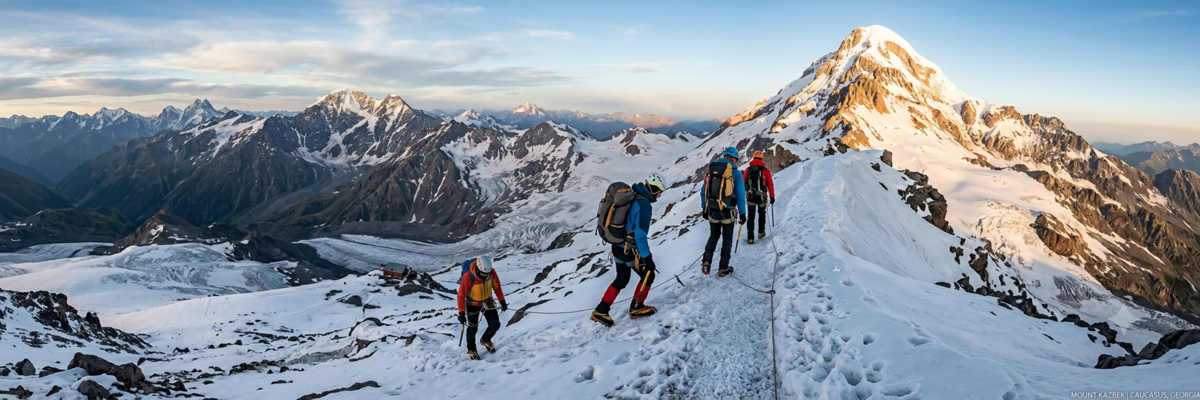
Mount Kazbek is one of the most iconic mountains of the Caucasus, attracting mountaineers, hikers, photographers, and travelers from around the world. Its snow-covered summit rises above glaciers, alpine valleys, and ancient churches, creating one of the most recognizable landscapes in Georgia.
For many climbers, ascending Kazbek is their first experience on a mountain above 5,000 meters. For others, it is a place they return to time and time again. Combining breathtaking scenery, rich history, local legends, and centuries-old cultural landmarks, Kazbek has earned its place among the most beloved mountains of the Caucasus.
Mount Kazbek at a Glance
-
Elevation: 5,054 m (16,581 ft)
-
Mountain Range: Greater Caucasus
-
Type: Dormant stratovolcano
-
Location: On the border between Georgia and Russia
-
First documented ascent: 1868
-
Most famous landmark: Gergeti Trinity Church
-
Main mountain shelter: Bethlemi Hut (former Meteo Station)
Where Is Mount Kazbek?
Mount Kazbek stands in the central part of the Greater Caucasus, forming part of the border between Georgia and Russia. At 5,054 meters, it is one of the highest peaks in the region.
Kazbek is a dormant stratovolcano, formed hundreds of thousands of years ago. Today, its upper slopes remain covered by glaciers that feed numerous mountain rivers.
The classic climbing route begins on the Georgian side, from the town of Stepantsminda, making it the most popular approach for climbers from around the world.
The Origin of the Name "Kazbek"
Interestingly, the mountain has several historical names.
In Georgian, it is called Mkinvartsveri (მყინვარწვერი), meaning "Ice Peak" or "Glacier Peak."
Its Ossetian name is Urshkhokh, often translated as "White Mountain."
The internationally known name Kazbek is believed to originate from Kazibek, a local feudal lord who once owned land near the mountain. Over time, this name appeared on European maps and eventually became the most widely used.
Legends of Mount Kazbek
Kazbek holds a special place in the mythology of the Caucasus.
According to Georgian legend, the mountain is where Amirani, often referred to as the Georgian Prometheus, was chained to the rocks. As punishment for helping humanity and sharing knowledge with people, the gods condemned him to eternal suffering high in the mountains.
Legend says that an eagle visits him every day, while each night his chains almost break—only to be reforged again by mythical blacksmiths.
These stories have been passed down for centuries and have made Kazbek not only a famous mountain but also a powerful symbol of courage, resilience, and freedom.
Gergeti Trinity Church – The Spiritual Symbol of Kazbek
At the foot of the mountain stands one of Georgia's most famous landmarks: Gergeti Trinity Church.
Built in the 14th century at an altitude of more than 2,100 meters, the church has become an enduring symbol of the Kazbegi region.
Throughout history, valuable religious relics were brought here during times of war to protect them from destruction.
Today, the church is one of the most photographed locations in Georgia. With Mount Kazbek rising dramatically behind it, the view has become one of the country's most recognizable landscapes.
For many climbers, visiting Gergeti Trinity Church marks the symbolic beginning of their ascent.
Stepantsminda – The Town Beneath Kazbek
Most expeditions to Mount Kazbek begin in Stepantsminda, formerly known as Kazbegi.
This small mountain town has become the main tourism hub of the region, welcoming climbers, hikers, photographers, and travelers throughout the year.
Stepantsminda also offers some of the finest panoramic views of the mountain.
Mountaineering on Kazbek
Mount Kazbek is widely considered one of the best introductory 5,000-meter peaks for aspiring mountaineers.
Although the standard route is technically straightforward, the climb still requires good physical fitness, proper acclimatization, glacier travel skills, and respect for rapidly changing mountain weather.
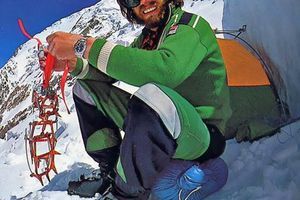
For many climbers, Kazbek is where they first learn to use crampons, an ice axe, and rope travel techniques on glaciers.
It often becomes the beginning of a lifelong passion for mountaineering.
The First Ascent
The first documented ascent of Mount Kazbek took place in 1868.
It was completed by British mountaineer and explorer Douglas Freshfield, accompanied by local guides.
His expedition played an important role in introducing the Caucasus to European mountaineers and helped establish Kazbek as one of the region's classic climbing objectives.
Bethlemi Hut – The Legendary Mountain Shelter
One of the most iconic places on Mount Kazbek is Bethlemi Hut, often still referred to as the former Meteo Station.
Originally built as a high-altitude weather station during the 20th century, the building later became the primary mountain refuge for climbers attempting the summit.
Today, although it no longer operates as a meteorological station, Bethlemi continues to serve as the main overnight shelter where climbers rest, acclimatize, prepare their equipment, and wait for favorable weather before summit day.
For thousands of mountaineers, spending a night at Bethlemi has become an unforgettable part of the Kazbek experience.
When Is the Best Time to Climb Kazbek?
The main climbing season typically runs from late June through early September.
During these months, weather conditions are generally more stable, glaciers are easier to navigate, and most climbing expeditions take place.
However, mountain weather on Kazbek is famously unpredictable. Sunshine can quickly give way to strong winds, dense fog, or snowfall, even in the middle of summer.
Successful ascents depend not only on physical preparation but also on patience and choosing the right weather window.
Why Has Kazbek Become One of the Most Popular Mountains Among Ukrainian Mountaineers?
For several generations of Ukrainian climbers, Kazbek has become a truly special mountain.
Its relative accessibility, beautiful climbing route, moderate technical difficulty, and the opportunity to climb a peak above 5,000 meters have made it one of the most popular mountaineering destinations.
For decades, Ukrainian alpine clubs organized training expeditions here, and countless climbers completed their very first high-altitude ascent on Kazbek.
For many, it marked the beginning of a lifelong journey into the mountains.
Nature Around Mount Kazbek
The beauty of Kazbek extends far beyond its summit.
The region is home to impressive glaciers, alpine meadows, deep valleys, and crystal-clear mountain streams.
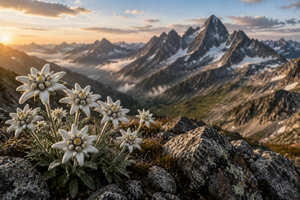
During summer, colorful wildflowers bloom across the slopes, including the legendary edelweiss, one of the most iconic flowers of the high mountains.
Golden eagles soar above the ridges, while Caucasian tur can often be spotted on steep rocky slopes.
Interesting Facts About Mount Kazbek
-
Mount Kazbek is a dormant stratovolcano.
-
It rises to 5,054 meters (16,581 ft).
-
Its Georgian name means "Ice Peak."
-
Gergeti Trinity Church is one of Georgia's most famous landmarks.
-
Bethlemi Hut has served generations of climbers for decades.
-
Thousands of climbers attempt Kazbek every year.
-
For many mountaineers, Kazbek becomes their first summit above 5,000 meters.
The "Kazbek" Sterling Silver Pendant by Travel Jewelry
Kazbek is one of those mountains that stays with you forever.
For some, it represents their first summit above five thousand meters. For others, it is the realization of a lifelong dream or the beginning of their mountaineering journey.
That is exactly why we created our Kazbek Sterling Silver Pendant. Its silhouette captures the distinctive shape of this magnificent mountain, serving as a reminder of sunrise above the Caucasus, the road to Gergeti Trinity Church, a night at Bethlemi Hut, and the unforgettable feeling of reaching the summit.
Whether you have already climbed Kazbek or simply dream of standing on its summit one day, the pendant is a lasting symbol of that connection.
Conclusion
Mount Kazbek is far more than a 5,054-meter peak. It is a place where history, mythology, spirituality, mountaineering, and the spectacular landscapes of the Caucasus come together.
Every year, thousands of people travel here not only to reach the summit but also to experience the unique atmosphere that surrounds this remarkable mountain.
Perhaps that is Kazbek's greatest magic: once you've seen its snow-covered summit glowing in the first light of dawn, a part of it stays with you forever.