Chalk is such a familiar part of a climber's gear that we rarely stop to think about where it came from.
White powder on the palms, a chalk bag around the waist, a few quick movements of the hands before a difficult section - today, all of this is almost inseparable from climbing. But in the first half of the 20th century, climbers managed without chalk.
Its arrival was not the result of a special invention for climbing. Instead, it came from a rather simple idea: bringing the experience of gymnasts onto the rock.
As a result, a small amount of magnesium carbonate became one of the seemingly minor pieces of equipment that had a significant influence on the development of modern climbing.
What Is Climbing Chalk?
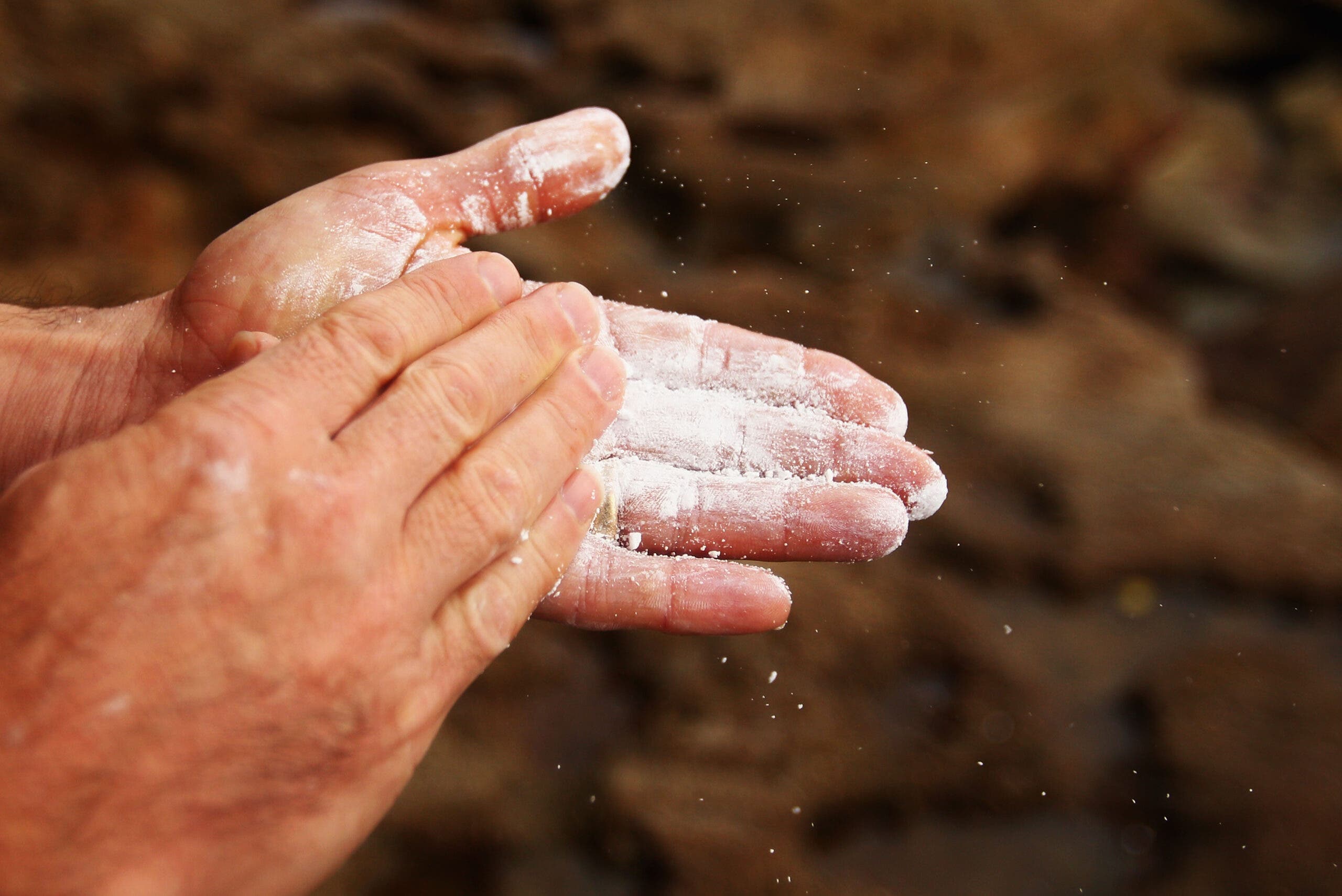
The chalk used by climbers is a special sports product based primarily on magnesium carbonate. In its simplest form, it can be described by the chemical formula MgCO₃, although the actual composition of commercial climbing chalk may vary depending on the manufacturer and production method.
Its main purpose is to reduce moisture on the surface of the skin.
When your palms become sweaty, contact between the skin and a climbing hold becomes less consistent. Chalk helps control this moisture and, as a result, maintain the necessary friction. The International Federation of Sport Climbing also defines chalk as a substance, often magnesium carbonate, used to reduce moisture and improve friction.
It is important to understand one thing: chalk does not make your hands sticky.
It is not glue, nor does it literally attach your fingers to the hold. Instead, it helps create more favorable conditions for contact between the skin and the surface.
That is why magnesium carbonate is not used only by climbers. It has long been used in gymnastics, weightlifting and other sports where a reliable grip is important.
What Is Climbing Chalk Made From?
The main component of climbing chalk is magnesium carbonate.
One natural source for producing it is the mineral magnesite. It is mined, processed and used to produce magnesium compounds, including materials used in sports chalk.
So the bag of chalk sitting in a climbing shop is not simply crushed natural rock.
The raw material goes through industrial processing, and the finished product can have different structures and compositions depending on the manufacturing process.
That is why chalk from different manufacturers can feel quite different: one may be extremely fine and soft, another more grainy, while some products contain larger chunks.

How Did Chalk Make Its Way Into Climbing?
The history of climbing chalk is particularly interesting because its introduction is connected with someone who looked at climbing somewhat differently from many of his contemporaries.
His name was John Gill - an American mathematician, gymnast and one of the pioneers of modern bouldering.
During the 1950s, Gill began developing short, difficult and highly dynamic climbing problems. He brought an approach from gymnastics into climbing - working with balance, dynamics, strength and movement control.
And along with this approach came chalk.
Gill later recalled that, as a gymnast, he was accustomed to using magnesium carbonate during training. In the mid-1950s, he began taking a piece of chalk with him onto the rocks. According to his own recollections, this happened after he noticed climbers using dry forest soil on their hands.
The beginning of Gill's use of chalk is most commonly dated to 1954.
So the story can be summarized quite simply:
gymnastics → John Gill → chalk on the rocks → modern climbing.
Why Was This Important?
At first glance, the appearance of a powder on climbers' hands might seem like a minor detail.
But it fit perfectly into the changes taking place in climbing during the 1950s and 1960s.
John Gill viewed bouldering not simply as training for longer routes, but as a discipline in its own right, where movement difficulty, strength, balance, coordination and dynamics mattered.
His approach was heavily influenced by gymnastics. In 1969, Gill published his famous essay The Art of Bouldering in the American Alpine Club, which became one of the important texts in the development of bouldering.
Chalk fit naturally into this new style.
When the hands are less sweaty, a climber can work more confidently with small holds, perform dynamic movements and maintain the necessary friction for longer.
Chalk was certainly not the only reason modern climbing developed. Technique, equipment, training methods, route development and the overall approach to climbing were changing at the same time.
But chalk became one of the small technological elements that helped this new style develop.
How Does Climbing Chalk Work?
Imagine a typical situation.
You start climbing.
During the first few moves, your hands are dry and your grip feels good.
After several minutes, your palms become sweaty.
On a large, rough hold, this may not be particularly noticeable. But on a small or smooth hold, even a small amount of moisture can affect how the contact feels.
Chalk helps remove some of that moisture.
The basic principle is:
less moisture → more consistent contact → better-controlled friction.
But there is an important nuance.
More Chalk Does Not Automatically Mean More Grip
The International Federation of Sport Climbing notes that excessive chalk can have the opposite effect and reduce friction.
That means experienced climbers do not necessarily try to make their hands as white as possible.
The goal is to control moisture, not cover your hands in as much powder as possible.
What Types of Climbing Chalk Are There?
Today, climbers can choose not only between different brands, but also between several different chalk formats.
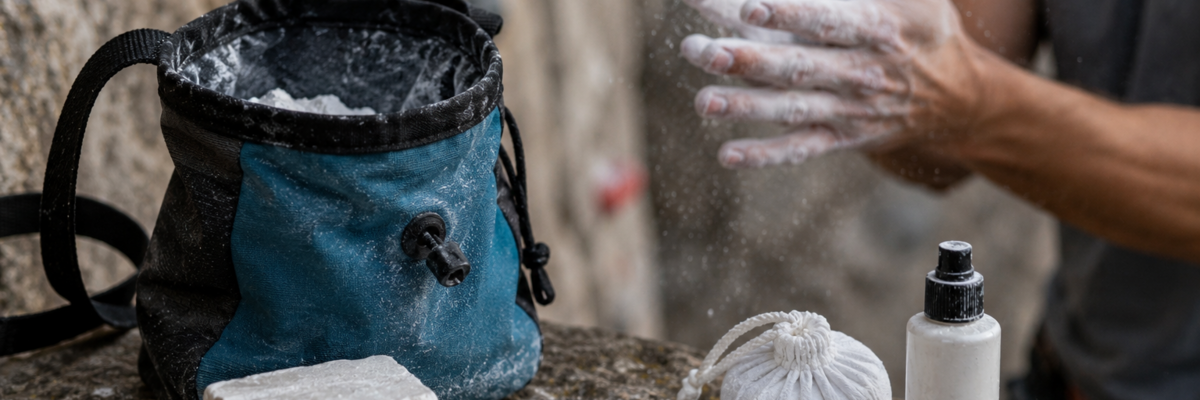
Loose Chalk
This is the classic option.
The powder can be applied directly to the hands or taken from a chalk bag.
It can be extremely fine or have a more granular texture.
There is also chunky chalk - chalk containing larger pieces.
The advantage of loose chalk is its simplicity and the ability to control how much you apply.
The obvious disadvantage is that fine powder can easily become airborne.
Chalk Block
This is compressed chalk in the form of a solid block.
It can be used directly or broken into smaller pieces.
This format makes it relatively easy to control the amount of chalk being used, and the block is generally convenient to transport without creating much dust.
Chalk Ball
The chalk is contained inside a special porous fabric.
When the climber squeezes the ball, a small amount of powder passes through the fabric and reaches the hands.
This allows chalk to be applied more gradually and reduces airborne dust.
That is why chalk balls are often used in climbing gyms, where excessive powder in the air can be an issue.
Liquid Chalk
Liquid chalk looks completely different.
It is a liquid mixture that is applied directly to the skin. After the liquid base evaporates, a thin layer of chalk remains on the hands.
It is often used as a base layer, followed by loose chalk when necessary. This combination is also recommended by the IFSC.
Advantages of liquid chalk include:
-
even application;
-
very little airborne dust;
-
longer-lasting coverage;
-
convenience when climbing indoors.
However, it is less convenient to reapply during climbing, so loose chalk remains extremely popular.
Can You Use Liquid and Loose Chalk Together?
Yes.
And this is a very common approach.
For example:
liquid chalk → base layer
loose chalk → reapplication while climbing
This allows climbers to combine the advantages of both formats.
Of course, the exact approach depends on the individual climber, the conditions and how much their hands sweat.
The Chalk Bag - A Small but Important Climbing Accessory
Chalk needs not only to be used, but also carried conveniently.
That is where one of the most recognizable climbing accessories comes in - the chalk bag.
Its basic design is simple: a small container with a wide opening that can be attached to a waist belt or a dedicated strap.
But modern chalk bags can be very different from one another.
They come in:
-
compact and small designs;
-
larger sizes;
-
cylindrical shapes;
-
rounded shapes;
-
different closure systems;
-
additional pockets;
-
different materials;
-
bright colors;
-
minimalist designs;
-
unusual and creative shapes.
For bouldering, climbers often use large chalk buckets that stand on the ground. For roped climbing, smaller individual chalk bags are attached around the waist and remain accessible during the route.
And this is where something interesting happens.
The chalk bag has long since stopped being just a technical container.
It is also part of a climber's personal style.
Some people choose a minimalist black bag, others prefer bright colors and geometric patterns, while some look for handmade or unusual designs.
Just like climbing shoes, the chalk bag has become one of the objects that instantly identifies someone as a climber.
Chalk and Natural Rock
As chalk became increasingly popular, another issue appeared.
White powder is highly visible on natural rock.
This is especially noticeable when hundreds or thousands of climbers use the same routes over time.
Chalk can accumulate on holds and rock surfaces, creating what is often called chalk graffiti - characteristic white marks and streaks.
As a result, some natural climbing areas restrict the use of chalk or introduce requirements regarding its color.
This does not mean that chalk is automatically "harmful to nature."
The issue is more complicated.
It can depend on:
-
the number of climbers;
-
the type of rock;
-
how long the chalk remains on the surface;
-
weather conditions;
-
vegetation growing on the rock;
-
regulations for a particular natural area.
That is why climbers should always check local rules when climbing outdoors.
Did Chalk Exist Before John Gill?
Yes, and there is an interesting detail here.
Gymnastic chalk existed long before climbers started using it on rock.
That is why it is more accurate to talk about bringing an existing sporting tool into a new discipline, rather than the "invention of climbing chalk."
There were also other ways climbers experimented with improving grip.
For example, in Fontainebleau, France, there is a long tradition of using pof - a type of resin made from tree sap. It is different from ordinary chalk and has its own history in climbing.
So the search for better grip on rock did not begin with white powder.
Chalk simply became the most widespread solution.
Can Different Chalk Products Feel Different?
Yes.
Even when magnesium carbonate is the main ingredient, different products can vary in:
-
particle size;
-
texture;
-
density;
-
moisture absorption;
-
amount of dust;
-
feel on the skin.
That is why two bags of chalk can behave quite differently.
Some climbers prefer extremely fine and soft chalk, others prefer something more granular, while some prefer a chalk ball or liquid formula.
In this sense, choosing chalk is somewhat similar to choosing climbing shoes.
There is no single universal option that works best for everyone.
Chalk as Part of Climbing Culture
During its history, chalk has gone through an impressive transformation.
It was once a simple tool used by gymnasts.
Then John Gill brought it onto the rocks.
It became part of the emerging culture of bouldering.
Later, it spread throughout sport climbing and traditional climbing.
Today, there are dozens of different formats, specialized mixtures, liquid chalk, chalk balls, blocks, large bouldering buckets and small individual chalk bags.
And all of this began with a very simple idea:
if chalk helps a gymnast maintain a better grip on an apparatus, perhaps it could help on rock as well.
From Gymnastics to Modern Climbing
The history of chalk can even be viewed as a small model of climbing's own evolution.
Gymnastics
↓
John Gill and the 1950s
↓
Chalk on rock
↓
Development of bouldering
↓
More complex techniques and dynamic movement
↓
Modern sport climbing
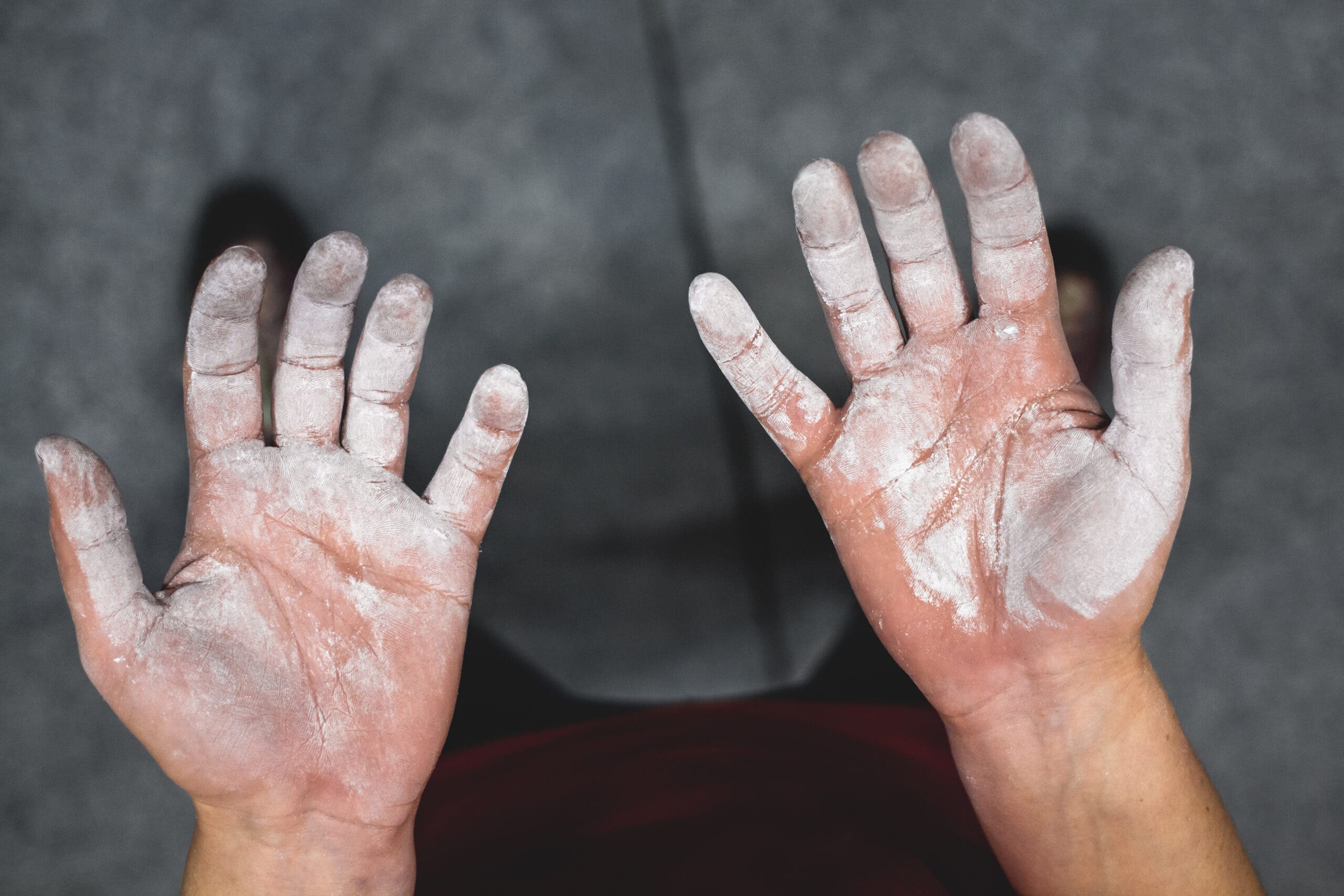
Today, it is difficult to imagine a climbing gym without the characteristic white powder on climbers' hands and holds.
And it is even harder to imagine that there was once a time when it was not there at all.
Chalk is one of the simplest pieces of climbing equipment. It costs far less than a good pair of climbing shoes, a rope or technical safety equipment.
But its history shows something important:
big changes in sport do not always begin with a big invention.
Sometimes they begin with someone simply taking a familiar idea and applying it in a new environment.
In climbing, that person was John Gill, and a simple block of gymnastic chalk became part of the history of modern climbing.
Climbing Shoes: History, Evolution and the Diversity of Modern Climbing Footwear
The Climbing Carabiner: The Story of One of the Most Important Inventions in Mountaineering
What to Gift a Rock Climber: 20 Thoughtful Gift Ideas They'll Actually Use