Today, the bicycle seems so familiar that it is difficult to imagine how unusual the idea of a two-wheeled vehicle was two centuries ago.
A bicycle can now be urban transport, a sports machine, a tool for mountain descents, road racing, gravel riding or multi-day adventures. Yet all of these bicycles evolved from much simpler designs.
Over roughly two centuries, the bicycle developed from a wooden machine that required the rider to push along with their feet into high-tech carbon bikes with electronic drivetrains, sophisticated suspension systems and highly specialized components.
The history of the bicycle is not simply a history of technology. It is also a story of sport, travel, mobility and the human desire to go farther.
Before the Bicycle: How People Came to the Idea of Two Wheels
Humans had known the wheel for thousands of years. But creating a vehicle that allowed one person to travel quickly on two wheels without a horse or another animal proved to be a much more difficult challenge.
The history of early two-wheeled machines contains several disputed episodes. For example, the Smithsonian discusses French constructions from the late 18th century known as célérifère, although their role in the direct evolution of the bicycle remains uncertain.
The story becomes much clearer from 1817 onward.
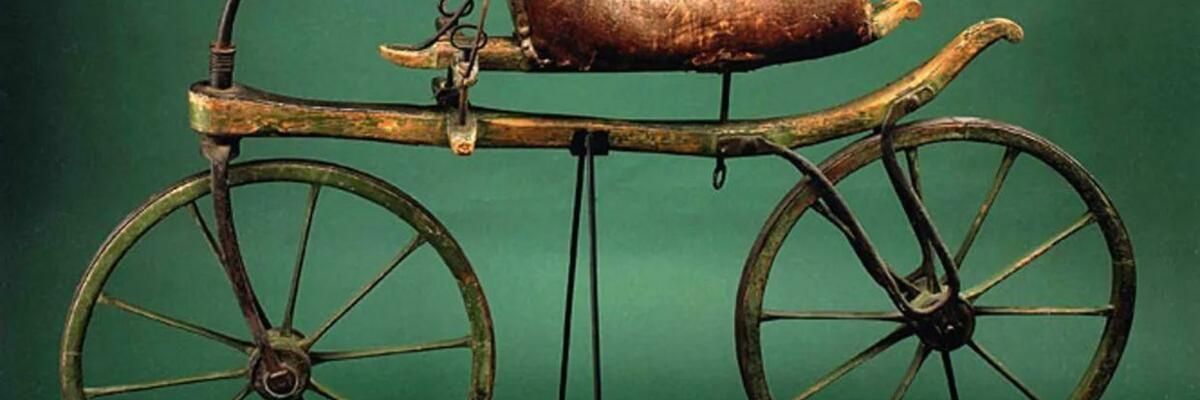
That was the year German inventor Karl Drais created a two-wheeled machine known as the Laufmaschine, or "running machine."
It became one of the key steps toward the modern bicycle.
Karl Drais' Draisine - The First Major Step
In 1817, Karl Drais introduced a wooden two-wheeled machine with a steerable front wheel.
There were no pedals yet.
The rider sat on a saddle and pushed against the ground with their feet, essentially running while sitting on the machine.


Drais used his machine for transportation, including travel through forest areas where he worked. The design soon became known in Europe, and Drais patented his invention in 1818.
At first glance, this was still very far from a modern bicycle.
But it already had two extremely important features:
-
two wheels arranged one behind the other;
-
a way to steer the front wheel.
The basic principle that would later define the bicycle was already there.
There was just one problem:
The rider still had to run.
Pedals: The Bicycle Begins to Move Under Its Own Power
The next major step was the introduction of pedal drive.
During the middle of the 19th century, inventors experimented with designs in which pedals directly powered one of the wheels. This period saw the emergence of the term bicycle and the gradual development of a construction that would eventually become familiar to us.
However, the early pedal bicycles looked very different from modern ones.
One of the most famous designs had an enormous front wheel.
The Penny-Farthing - A Bicycle That Looks Almost Crazy Today
Place a modern bicycle next to a penny-farthing and they might look like two completely unrelated machines.


The penny-farthing, also known as the ordinary or high-wheel bicycle, had a huge front wheel and a much smaller rear wheel.
Why?
Because the pedals were directly connected to the front wheel. One turn of the pedals produced one turn of the wheel.
Increasing the wheel diameter therefore allowed the rider to travel farther with each pedal revolution and achieve greater speed.
But there was a serious price to pay.
The rider sat high above the ground. Even a small obstacle could turn into a dangerous fall over the handlebars.
A different kind of bicycle was needed - one that was not only fast but also safer.
The "Safety Bicycle" - The Birth of the Familiar Design
During the 1870s and 1880s, bicycle designers gradually moved toward a completely different configuration.
The rider would sit lower, the two wheels would be approximately the same size, and the drive system would transfer power to the rear wheel.
One of the most important designs was the Rover Safety Bicycle, created by John Kemp Starley in 1885.
It already had the basic characteristics of a modern bicycle:
-
two wheels of approximately equal size;
-
a diamond-shaped frame;
-
chain drive;
-
a steerable front wheel;
-
a lower riding position.
The Science Museum describes the 1885 Rover as the first successful safety bicycle with the basic layout of the modern bicycle.
This was a genuine turning point.
The pedals were no longer directly connected to the wheel.
Pedals → front chainring → chain → rear sprocket → rear wheel.
The chain allowed the pedals to be positioned between the wheels, making the bicycle safer and more efficient.
Pneumatic Tires and Another Major Step
The bicycle's basic architecture was now much closer to what we know today, but riding could still be quite uncomfortable.
Another major development was the pneumatic tire.
In 1888, John Boyd Dunlop patented a pneumatic tire design that became widely used on bicycles. Around the same period, drivetrains and braking systems were also being improved.
By the end of the 19th century, the bicycle had developed into a machine that already looked surprisingly modern.
The result was a genuine bicycle boom.
The Bicycle Boom: How the Bicycle Changed Society
The bicycle turned out to be much more than a new toy.
Before automobiles became widespread, it became one of the most accessible forms of individual transportation.
A person could:
-
travel dozens of kilometers independently;
-
commute to work;
-
visit neighboring towns;
-
travel;
-
exercise;
-
explore the surrounding area.
During the 1880s and 1890s, bicycle fever spread across Europe and the United States.
It even influenced social norms.
The bicycle became particularly important for women. The safer design made cycling a much more practical means of transportation and contributed to changing women's clothing and ideas about mobility and independence.
In other words, the bicycle did not simply change transportation.
It changed the very idea of personal freedom of movement.
From Transportation to Sport
Once bicycles became fast and reliable enough, people naturally began racing them.
Bicycle racing emerged in the 19th century and gradually developed into a major international sport.
Cycling was already part of the program at the first modern Olympic Games in Athens in 1896. Today, the Olympic program includes road, track, BMX and mountain biking disciplines.
One of the greatest symbols of road cycling became the Tour de France.
The first edition began on July 1, 1903. Sixty cyclists started the first stage, which covered 467 kilometers.
The bicycle was gradually transforming from a means of transportation into a highly specialized sporting machine.
How the Bicycle Became a Tool for Travel
Sport was far from the only direction of development.
From the very beginning, the bicycle offered something new:
the ability to travel long distances under your own power.
Cyclists no longer had to depend entirely on horses, railways or stagecoach schedules.
A culture of long-distance bicycle travel gradually emerged.
There were:
-
touring bicycles;
-
luggage racks;
-
specialized bags;
-
lighter frames;
-
more reliable drivetrains;
-
equipment for self-supported journeys.
In the modern world, this idea has found new life in bikepacking - traveling with minimal luggage attached directly to the bicycle.
The bicycle has, in a way, returned to one of its original ideas:
Just get on and go somewhere far away.
MTB: When the Bicycle Went Off-Road
The next major stage of bicycle evolution happened far away from smooth city roads.
In the 1970s, cyclists in California began modifying bicycles for downhill riding on mountain roads and trails.
This gradually developed into the culture of mountain biking.
The UCI traces the origins of modern mountain biking to California in the 1970s, where enthusiasts in Marin County began riding and racing on mountain terrain.
From there, development accelerated.
Different disciplines emerged:
-
cross-country (XC) - riding across varied terrain;
-
trail - technical and diverse off-road riding;
-
enduro - combining climbs with fast technical descents;
-
downhill - extremely fast descents on demanding courses.
For each discipline, bicycles began to develop their own geometry, suspension systems, brakes, wheels and components.
Mountain biking became an Olympic discipline in 1996.
The bicycle had once again changed its environment.
Gravel: The Bicycle Between Road and Off-Road
Modern bicycle evolution has not stopped.
One of the most interesting examples is gravel cycling.
Gravel bicycles and gravel racing combine characteristics of road and mountain bikes and are designed primarily for riding on unpaved surfaces such as gravel, dirt, forest and farm roads.
The idea itself is much older than the modern term gravel.
Many early European races were held on roads covered with gravel or cobblestones. Modern gravel culture developed particularly strongly in North America, while the discipline has since grown into an international racing format.
In 2022, the UCI launched the Gravel World Series and held the first UCI Gravel World Championships.
Today, gravel combines several things:
the speed of a road bike + the ability to leave the pavement + the versatility needed for long-distance travel.
That combination is one reason gravel has developed so quickly.
One Bicycle, Many Ways to Ride
Looking at the modern cycling world, it becomes clear just how far the bicycle has moved from Drais' running machine.
Today, a bicycle can be:
Urban - for everyday transportation.
Road - for speed and racing.
Gravel - for pavement, gravel and long-distance routes.
MTB - for mountains and rough terrain.
Downhill - for high-speed descents.
BMX - for tricks and short, dynamic courses.
Touring - for multi-day journeys.
Bikepacking - for self-supported adventures with minimal equipment.
And even within these categories, bicycles continue to specialize.
The Components That Became Symbols of the Bicycle
Interestingly, you sometimes don't need to see an entire bicycle to recognize it.
A few characteristic components are enough.
The Chain
The chain became one of the key components that made the modern bicycle possible.
It transfers power from the pedals to the rear wheel, allowing the pedals to sit between the wheels and eliminating the need for the enormous front wheel of the penny-farthing.
The Chainring
Chainrings work together with the chain and determine the drivetrain's gear ratio.
Changing the size of the chainrings and sprockets allows riders to choose the right balance between speed and pedaling effort.
The Brake Rotor
Another distinctive symbol of the modern bicycle.
Disc brakes became particularly widespread on mountain bikes and other bicycles where powerful, controlled braking is important. Today, they are also common on many road and gravel bicycles.
All of these components were originally designed for purely practical reasons.
Over time, however, they became so recognizable that they turned into symbols of cycling culture.
A bicycle can therefore be represented not only by an image of the entire machine, but also by a chain link, a chainring or a brake rotor.
From Technical Component to Symbol
This is an interesting feature of any culture.
Objects that were originally created for a purely functional purpose can eventually acquire a completely different meaning.
For a cyclist, a chain link is not simply a piece of metal.
A chainring is not merely part of the drivetrain.
A brake rotor is not simply a component of a braking system.
They can remind someone of:
-
their first ride;
-
a long-distance journey;
-
a favorite bicycle;
-
a cycling trip;
-
a race;
-
freedom of movement;
-
people they have traveled hundreds of kilometers with.
This is how cycling symbolism is created.
That is also why cycling can be represented through a single recognizable detail rather than an entire bicycle.
The Bicycle as a Way of Life
Over two centuries, the bicycle has changed almost beyond recognition.
Yet its central idea remains remarkably simple.
Two wheels. One person. Movement.
Once, the bicycle was a strange wooden machine that required the rider to push along with their feet. Then it became the dangerous penny-farthing before evolving into the safety bicycle with a chain and pneumatic tires.
Then came road racing, touring, mountain biking, BMX, gravel and bikepacking.
Each new stage added not only technical capabilities but also new ways of living with the bicycle.
For one person, a bicycle is transportation.
For another, it is sport.
For someone else, it is a way to spend a weekend in the mountains.
For someone else, it is a way to cover hundreds of kilometers in a single day.
And for someone else, it is a way to see the world.
That is why the history of the bicycle is not simply the history of an invention.
It is the history of humanity's constant search for freedom of movement.
From Karl Drais' first running machine to modern carbon gravel and mountain bikes, more than two centuries have passed. The technology has changed almost completely, but the desire remains the same:
get on the bicycle and go farther.