A bicycle has long been much more than a means of transportation.
For some people, it is a sport. For others, it is a way to get around the city. And for many, it is a way to leave home and travel much farther than an ordinary trip would allow.
Bicycle travel has a special quality: there is no "missing" space between the starting point and the destination. The road itself becomes part of the journey.
Today, the word "bikepacking" is often used to describe this kind of travel. It is associated with lightweight equipment, frame bags, gravel roads and self-supported routes.
But the idea of traveling by bicycle is much older than modern bikepacking.
What is bikepacking?
Bikepacking is a form of self-supported bicycle travel in which the necessary equipment is carried directly on the bicycle.
Modern setups often use compact bags attached to:
- the frame;
- the saddle;
- the handlebars;
- the top tube;
- the fork.
This approach keeps the bicycle relatively compact and is particularly well suited to gravel roads, trails and routes with difficult surfaces.
However, it is important to distinguish between the history of the activity and the history of the term.
Long-distance bicycle travel existed long before the word "bikepacking" appeared. According to Cycling UK, the term emerged in 1973, while bicycle travel itself has a much longer history. Cycling UK on the difference between cycle touring and bikepacking

Bicycle travel began long before bikepacking
Once bicycles became reliable enough for longer journeys, people began using them for more than everyday transportation.
During the 19th century, cyclists were already undertaking long-distance journeys. Roads were much rougher, navigation was more difficult, and bicycles and equipment were heavier and less reliable than they are today.
Yet the bicycle offered something extremely valuable: freedom.
Travelers did not have to depend on railway schedules or horses. They could choose their own direction, stop whenever they wanted and gradually explore unfamiliar territory.
The history of modern bicycle travel should therefore be seen as a continuation of a much older tradition.
Modern bags, lightweight materials and GPS navigation have changed the way people travel.
But the basic idea remains the same.
Get on a bicycle and go farther than an ordinary ride would take you.
Hemistour - an expedition that changed bicycle travel
One of the most important chapters in the history of modern bicycle travel was the Hemistour expedition.
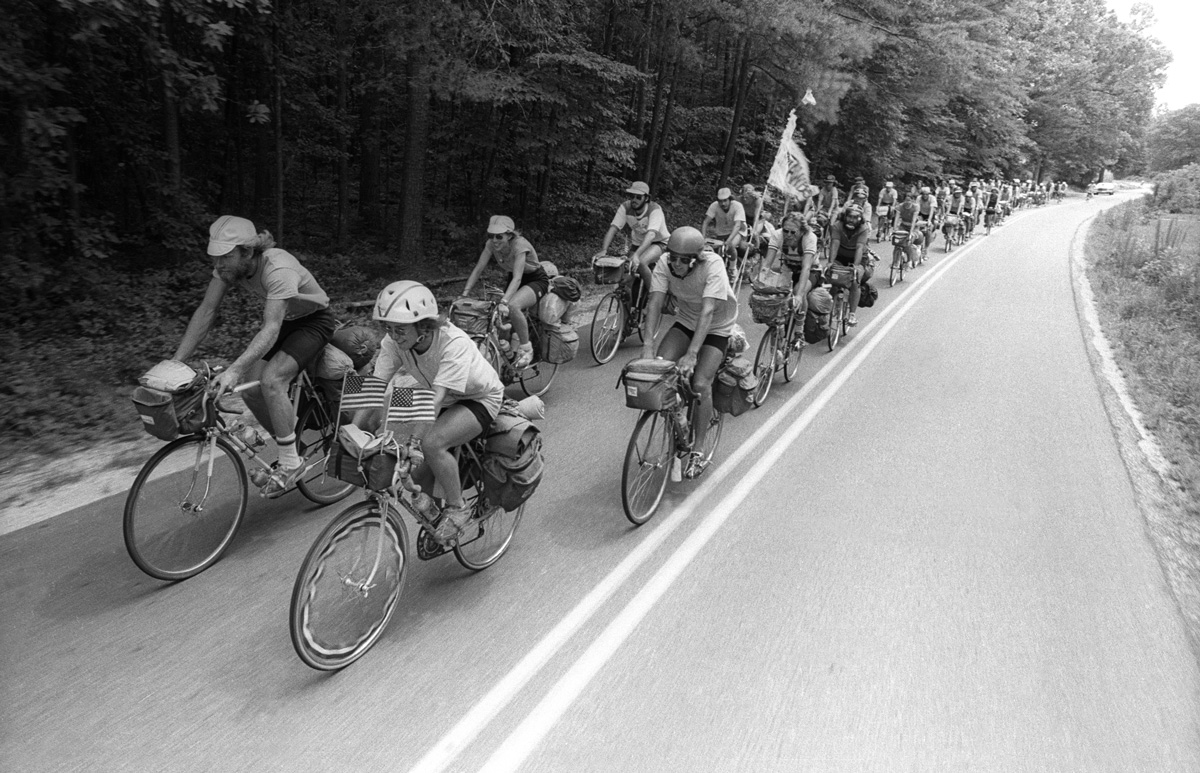
In June 1972, Dan and Lys Burden and Greg and June Siple set out from Anchorage, Alaska.
Their ambition was enormous: they planned to travel by bicycle from Alaska to Patagonia.
The journey turned into a multi-year expedition. Dan and Lys Burden eventually had to stop after Dan became ill, while Greg and June Siple continued south and completed the journey in Tierra del Fuego in 1975.
Hemistour was important not only because of its scale.
It demonstrated that bicycles could serve as the primary means of transportation during an extremely long, self-supported journey across an entire continent.
The expedition also helped inspire Bikecentennial, a major cross-country bicycle journey organized in the United States for the country's bicentennial in 1976.
That project later became part of the history of the Adventure Cycling Association. Adventure Cycling Association on Hemistour and Bikecentennial
Where did the word "bikepacking" come from?
There is an interesting historical detail here.
The term "bikepacking" appeared in the May 1973 issue of National Geographic in an article about a journey through Alaska and Canada.
In other words, the word appeared about a year after Hemistour had begun.
But the equipment used by the expedition's riders does not quite match what we would consider modern bikepacking today. They used traditional racks and panniers.
This distinction is important.
1973 should be considered the year the term appeared, not the year bikepacking was invented.
The modern meaning of the word developed much later, alongside lightweight bicycle bags, mountain bikes, gravel bikes and a growing culture of self-supported travel. BIKEPACKING.com on the history of bikepacking
It is a good example of how a name can gradually acquire a more specific meaning while the underlying activity is much older.
Bicycle touring, bicycle trekking and bikepacking
These terms are often used interchangeably, although there are some differences.
Bicycle touring is the broadest concept. It includes bicycle journeys of different lengths and levels of difficulty.
It can be a weekend trip, a multi-week journey or a route across several countries.
Bicycle trekking is closer to the traditional idea of a trek, with the bicycle serving as the primary means of transportation. Riders carry their equipment and plan food, water, overnight stops and the route.
Bikepacking, in its modern sense, is more closely associated with compact equipment carried directly on the bicycle and the ability to travel independently, including on routes where conventional tourist infrastructure is limited.
There is no strict boundary between these concepts.
The same journey can be bicycle touring, a bicycle trek and bikepacking at the same time.
How equipment changed bicycle travel
One of the biggest changes in recent decades has involved equipment rather than bicycles themselves.
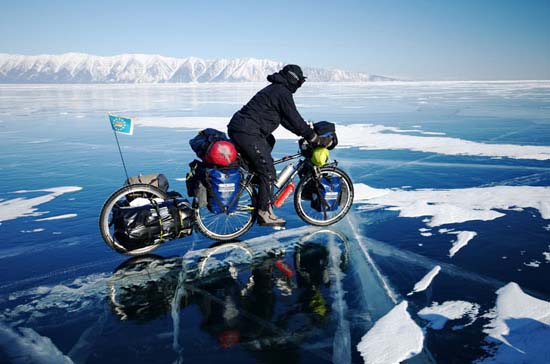
Traditional bicycle touring has long been associated with racks and large panniers.
It is a practical system that allows riders to carry a substantial amount of equipment.
But the development of lightweight materials created another approach.
Compact bags appeared that could be attached directly to the bicycle frame. Equipment became lighter, smaller and better suited to traveling on gravel roads and trails.
At the same time, tents, sleeping bags, stoves, technical clothing, water-treatment systems and navigation equipment continued to evolve.
As a result, bicycle travel became less dependent on infrastructure.
This is one of the main reasons modern bikepacking has become so appealing.
Bikepacking does not necessarily mean a long expedition
The word "bikepacking" can easily evoke images of a months-long journey across a continent.
In reality, the scale can be completely different.
A one-day trip.
A night outside the city.
A multi-day bicycle journey.
A month-long expedition.
All of these can follow the same basic principle: the bicycle remains the primary means of transportation, while the traveler carries the necessary equipment along the way.
That is why modern bicycle travel attracts such different people.
For some, a weekend is enough.
Others spend several weeks on the road.
And for some, the bicycle becomes a way to travel across an entire continent.
Bicycle travel in Ukraine
Ukraine offers a remarkable variety of landscapes for bicycle travel.
Forests, steppes, river valleys, plains, rolling hills and the Carpathian Mountains allow for routes of very different character.
A bicycle journey through Ukraine can be a relaxed trip between small towns and villages.
It can also become a fully self-supported route involving gravel roads, elevation gain and nights outdoors.
Modern outdoor platforms already contain collections of routes in Ukraine marked as bikepacking. Outdooractive, for example, has a dedicated section for long-distance cycling and bikepacking routes in Ukraine. Outdooractive - bicycle and bikepacking routes in Ukraine
At the same time, routes in Ukraine require particularly careful checking before departure.
Road conditions change, access to some areas may be restricted, and the current security situation takes priority over any route published earlier.
A modern bicycle journey in Ukraine is therefore not just about choosing an attractive line on a map.
It also means checking whether that route is currently appropriate and accessible.
From a bicycle trip to a cycling expedition
At some point, an ordinary bicycle journey can become an expedition.
The difference is not necessarily the number of kilometers.
An expedition may involve complex logistics, long periods of self-sufficiency, difficult terrain or travel through several countries.
In such a journey, the bicycle becomes more than transportation.
It becomes part of the entire system that supports the traveler.
Food, water, clothing, navigation, repair equipment and overnight gear all have to travel together with the rider.
This is why major cycling expeditions often have more in common with traditional expeditions than with ordinary tourism.
Around the world by bicycle
One of the most ambitious forms of bicycle travel is the round-the-world journey.
Cycling around the world means much more than covering an enormous distance.
Travelers have to cross borders, deal with different climates, maintain their bicycles, find food and water, arrange accommodation and solve countless logistical problems.
A round-the-world bicycle journey is therefore a complex project in which physical endurance is only one part of the challenge.
The history of such journeys shows just how far the simple idea of bicycle travel can go.
From a weekend ride to a journey around the planet.

The bicycle as a way to see the world
In conventional travel, people often see individual destinations.
A city.
A hotel.
A landmark.
Then another city.
A bicycle changes that experience.
You see not only the destination, but everything between the starting point and the place you are trying to reach.
You can stop beside a river.
Turn onto a dirt road.
Pass through a small village.
Watch the sunset far from the city.
Change your route simply because the road ahead looks interesting.
That is one of the special qualities of bicycle travel.
A bicycle is fast enough to cover significant distances, but slow enough to keep the traveler directly connected to the surrounding landscape.
The bicycle as part of a personal story
For many people, a bicycle eventually becomes part of their personal story.
There is the bicycle on which they first rode 100 kilometers.
The route they will remember for the rest of their life.
Their first mountain trip.
Their first multi-day journey.
Their first trip to another country.
That is why cycling has developed its own visual language.
A chain, gear, wheel or brake disc may simply be mechanical components to someone else.
To a cyclist, they can represent roads, routes and experiences.
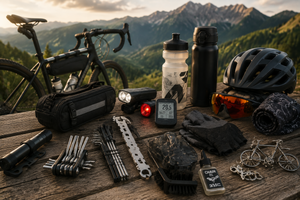
That idea inspired the Travel Jewelry bicycle collection.
It includes silver pendants and earrings inspired by bicycle components such as a chain, gear and brake disc.
Small symbols of a much bigger passion - a way to keep the bicycle close even when the bicycle itself is at home.
From Hemistour to modern bikepacking
In more than half a century, bicycle travel has changed enormously.
The riders of Hemistour set out with the equipment available in the early 1970s.
Today, cyclists have lightweight materials, specialized bags, modern navigation, satellite communication and many more possibilities for self-supported travel.
But the basic principle has remained the same.
A bicycle.
Equipment.
A route.
The road.
And the freedom to decide where to go next.
That is why modern bikepacking should not be seen simply as a new trend in cycling culture.
It is a continuation of a much older tradition - traveling through the world on two wheels.
And perhaps its greatest value is not how many kilometers will be covered.
It is how much of the road you get to see with your own eyes.
The Best Gift Ideas for Cyclists