Today, skis can mean many different things: sports equipment, a way to travel through the mountains, a tool for ski mountaineering, or simply part of winter culture.
But thousands of years ago, two wooden boards under your feet had a much simpler purpose - to help people move through deep snow.
Over the centuries, skis have gone through an extraordinary transformation. Simple wooden constructions have evolved into highly engineered products made from wood cores, metal laminates, fiberglass, carbon fiber and carefully calculated geometries.
Yet the basic principle has remained the same: distribute body weight over a larger area and make movement across snow more efficient.
When did the first skis appear? When did skiing become a sport? Why are modern skis equipped with metal edges? What changed with carving skis? What types of skis exist today? And how did skis become a tool for descending some of the world's highest mountains?
When Were the First Skis Invented?
It is impossible to name a single inventor of the ski.
Skis most likely developed gradually in different parts of northern Eurasia as a practical response to one problem - traveling across deep snow.
Walking through loose snow without specialized equipment requires enormous effort. A wider wooden surface distributes a person's weight over a larger area, allowing them to sink much less deeply into the snow.
Archaeological discoveries show that people were using skis thousands of years ago. In Norway, the Drevja ski has been dated to approximately 5,200 years ago. It is considered the oldest known ski discovered in Norway. The Holmenkollen Ski Museum's collections cover roughly 5,000 years of skiing history.
This means that the history of skis is better understood not as the invention of a single country or individual, but as the gradual development of a technology by people who needed to travel across snowy landscapes.
What Were Ancient Skis Like?
The first skis were made from wood, but describing them simply as primitive boards would be misleading.
Their shapes already reflected the practical requirements of traveling across snow.
Wood had to be selected, shaped, bent and given the right combination of flexibility and strength. The front of the ski was curved upward so that it would not dig into the snow.
Different regions developed their own designs.
Some skis were extremely long, while others were shorter. In some traditions, the two skis even had different functions: one was longer and designed primarily for gliding, while the other was shorter and used for pushing.
Leather straps and other simple systems were used to secure the foot.
Interestingly, some ancient solutions have direct parallels in modern ski equipment. For example, materials were sometimes used to improve traction on snow - a principle that resembles the function of modern climbing skins.

Skis as Transportation, Hunting and Military Equipment
For most of their history, skis were not a sport.
They were a tool.
They were used for:
-
hunting;
-
traveling between settlements;
-
transporting goods;
-
winter trade;
-
reconnaissance;
-
military campaigns.
For people living in northern regions, skis could be as important as boats were to communities living along major rivers.
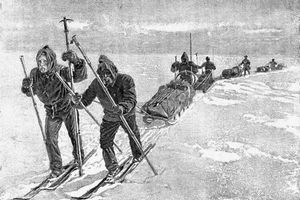
They also became important in warfare. Ski troops could move through snowy forests and mountains much faster than soldiers traveling on foot.
This created another important branch of ski history - military skiing.
But gradually, skis acquired another purpose.
Sport.
How Did Skiing Become a Sport?
Ski culture developed particularly rapidly in Scandinavia.
During the nineteenth century, Norway saw the emergence of ski clubs, competitions and specialized skiing techniques.
One of the most important figures of this period was Sondre Norheim, often described as one of the founders of modern skiing. He experimented with ski shapes, bindings and turning techniques.
This was when skis began to separate according to their intended purpose.
Some designs were better suited to traveling long distances. Others were designed for turning and descending slopes. Others were adapted for jumping.
This was a fundamental moment in ski history.
Skis stopped being a single-purpose means of transportation and began to specialize according to different tasks.
From Wood to Engineered Construction
For centuries, wood remained the primary material.
But ski makers continuously experimented with its properties.
Important factors included:
-
the type of wood;
-
the direction of the grain;
-
thickness;
-
shape;
-
flexibility;
-
stiffness;
-
bending techniques.
A good ski needed to be strong, flexible and light at the same time.
During the twentieth century, however, traditional wooden construction gradually gave way to new materials.
And one of the most important elements of this technological revolution was metal.
Metal Edges - A Small Detail That Changed Skiing
It is important to distinguish between metal skis and metal edges.
They are not the same thing.
A ski edge is a metal strip running along the lower sides of the ski. It bites into hard snow or ice when the skier puts the ski on edge.
Before effective metal edges became common, maintaining control on hard surfaces was considerably more difficult.
Metal edges improved grip, braking and turning on firm snow.
The development of ski edges was part of the same technological revolution that eventually led to composite ski construction. Howard Head's early designs, for example, used aluminum extensively but eventually incorporated steel edges because aluminum edges lost their sharpness too quickly.
Howard Head and the Composite Ski Revolution
One of the most important moments in the history of modern skis came from the work of American engineer Howard Head.
Before becoming involved with skis, Head worked in the aviation industry.
After struggling with traditional skis himself, he began to believe that the problem was not simply the skier's technique - the equipment itself could be improved.
He began applying ideas from aircraft construction and experimented with aluminum, wood and lightweight materials.
In 1947, Head began developing his aluminum ski design, and in 1950 he founded HEAD Ski Company.
His idea was not simply to make a "metal ski." He was creating a layered structure in which different materials performed different functions.
This approach eventually became a foundation for modern sandwich construction.
It was a major step forward.
The ski was gradually becoming an engineered product rather than simply a shaped piece of wood.
How Is a Modern Ski Constructed?
A modern ski may look relatively simple.
Inside, however, it is a sophisticated multilayer structure.
A typical ski may contain:
-
a wood or composite core;
-
fiberglass;
-
carbon fiber;
-
metal laminates;
-
polymer materials;
-
steel edges;
-
a base;
-
a protective and decorative top layer.
Each element has a specific function.
The core determines much of the ski's flex and character.
Fiberglass and carbon fiber reinforce the construction.
Metal laminates can increase stability and stiffness.
Edges provide grip on hard snow.
The base provides the sliding surface and interacts with ski wax.
A modern ski is therefore essentially a system in which every layer influences the behavior of the whole product.
Sidecut - Why Aren't Modern Skis Straight?
Look at a modern ski from above and you will notice a distinctive shape: the tip and tail are wider than the center.
This is called sidecut.
This geometry allows the ski to form an arc when it is tilted onto its edge.
Interestingly, sidecut is not an invention of the late twentieth century. It existed in traditional Telemark skis, although it was much less pronounced. Early Norwegian skis could have only a few millimeters of sidecut, while modern racing skis have much more pronounced geometry.
The technology did not appear from nowhere.
It simply became much more refined.
Carving Skis and the Transformation of Ski Technique
During the 1990s, ski geometry went through another revolution.
Modern carving skis appeared with much more pronounced sidecut.
They allowed skiers to use the edges more effectively and carve turns along an arc.
This changed not only ski construction, but skiing technique itself.
Traditional long skis required significant body movement and more technically demanding turning techniques. Carving skis allowed skiers to use the geometry of the equipment itself much more effectively.
From this point onward, the ski literally began to help the skier turn.
Camber and Rocker
Two other important concepts in modern ski geometry are camber and rocker.
Camber is the upward curve in the middle of the ski when it is resting unweighted on a flat surface.
Under the skier's weight, this construction helps distribute pressure and maintain effective edge contact.
Rocker refers to an upward curve toward the tip or tail. It makes skis easier to maneuver in soft and deep snow.
Modern manufacturers combine these characteristics in different ways.
A ski can, for example, have camber underfoot and rocker at both the tip and tail.
This is another example of how sophisticated modern ski geometry has become.
What Types of Skis Exist Today?
There is no longer a single universal ski.
Different conditions and disciplines require different characteristics.
Alpine Skis
Designed primarily for skiing on prepared slopes.
They are optimized for control, precision and efficient edge performance.
Race Skis
Competition skis designed for specific disciplines.
They are generally stiffer and more precise, with designs optimized for events such as slalom, giant slalom, Super-G and downhill.
All-Mountain Skis
Versatile skis designed for a variety of conditions.
They aim to combine good performance on groomed slopes with the ability to venture beyond them.
Freeride Skis
Wide skis designed for deep snow and off-piste terrain.
Their greater surface area helps them stay higher in soft snow.
Freestyle Skis
Designed for terrain parks, jumps, tricks and other freestyle disciplines.
They need to withstand very different forces and often use twin-tip designs that allow skiing in both directions.
Touring Skis
Designed for ski touring in the mountains.
Weight is especially important.
The skier has to gain elevation under their own power, so every unnecessary gram becomes noticeable over a long ascent.
Cross-Country Skis
Cross-country skis are fundamentally different from alpine skis.
They are designed for efficient travel over long distances rather than fast downhill skiing.
Telemark Skis
Used for Telemark skiing, a discipline characterized by a distinctive turning technique in which the skier's heel is not fixed in the same way as in traditional alpine skiing.
Skis Become an Olympic Sport
Modern skiing is an enormous world of different disciplines.
The Winter Olympics include:
-
alpine skiing;
-
cross-country skiing;
-
freestyle skiing;
-
ski jumping;
-
Nordic combined;
-
biathlon;
-
ski mountaineering.
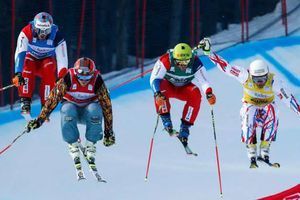
The 2026 Winter Olympics in Milano Cortina marked an especially interesting development: ski mountaineering became an Olympic sport.
The program includes men's and women's sprint events as well as a mixed relay.
This is particularly symbolic.
Ski mountaineering brings skis back to one of their oldest purposes - helping people travel through mountains.

From Ski Resorts to High Mountains
Skis have long moved beyond prepared slopes.
Ski touring allows people to climb mountains without lifts.
Special touring bindings allow the heel to move freely during the ascent, while climbing skins attached to the base provide traction on snow.
At the summit, the skier removes the skins, locks the bindings into downhill mode and skis back down.
The principle is surprisingly close to the original purpose of skis.
The difference is that modern skiers can travel for many kilometers through the mountains, climb thousands of vertical meters and descend complex alpine routes.
Ski Mountaineering: When Skis Become Part of Mountaineering
Ski mountaineering is a different level altogether.
Here, skis are only one tool used to complete a mountain route.
A ski mountaineer may:
-
climb on skis;
-
use climbing skins;
-
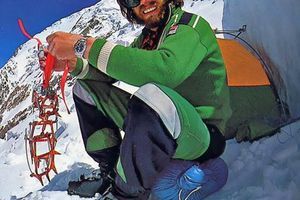
switch to crampons;
-
use an ice axe;
-
move on a rope;
-
climb technical sections;
-
carry skis on a backpack;
-
and eventually use them for the descent.
The skis therefore become part of the mountaineering system.
Modern ski mountaineering sits somewhere between skiing, mountaineering and mountain travel.
Skiing from the World's Highest Mountains
Perhaps the most spectacular chapter of modern ski history takes place in the Himalayas.
Ski descents from 8,000-meter peaks have become a unique part of mountaineering history.
One of the best-known pioneers was Japanese skier Yuichiro Miura, who made his famous ski descent on Mount Everest in 1970.
In the twenty-first century, the possibilities have expanded dramatically.
Modern skiers and mountaineers have completed extremely difficult descents from some of the world's highest mountains, where skis are not simply a way to enjoy a descent but can become part of the strategy for completing an alpine route.
Polish ski mountaineer Andrzej Bargiel has become particularly well known for ambitious Himalayan ski descents.
At this level, the phrase "skiing" almost stops being adequate.
It is mountaineering in which the ski descent is an integral part of the route.
Skis as a Design Culture
There is another fascinating side of modern skis that is easy to overlook when discussing technology.
Skis have become objects of design.
Traditional wooden skis often displayed natural wood textures or relatively restrained decoration. Modern skis, by contrast, can be genuine examples of graphic design.
There is everything from:
-
retro aesthetics;
-
minimalism;
-
geometric patterns;
-
illustrations;
-
abstract graphics;
-
photography;
-
street art;
-
graffiti;
-
bright colors;
-
dark technical designs.
Ski graphics have become part of skiing culture itself.
This is particularly visible in freeride and freestyle communities, where the design of a ski can express personal style just as strongly as clothing or other equipment.
It is an interesting evolution.
Once, a ski was a purely utilitarian object.
Then it became a sporting tool.
Today, it can be both a highly engineered product and an object of design.
What Will Skis Look Like in the Future?
The evolution of skis is far from finished.
Manufacturers continue to search for the right balance between three things:
weight, strength and performance.
This is especially important in ski touring and ski mountaineering.
Every extra gram has to be carried uphill by the skier.
That is why manufacturers continue to develop:
-
carbon constructions;
-
new composite materials;
-
lightweight cores;
-
more precise computer modeling;
-
optimized geometries;
-
new reinforcement systems;
-
more sustainable materials and manufacturing processes.
Perhaps several decades from now, today's carbon touring skis will seem as simple to us as wooden skis do today.
But the basic principle will probably remain unchanged.
Skis as a Symbol
For some people, skis are a sport.
For others, they are winter recreation.
For others, they are a way to explore mountains.
And for some, they are simply part of life.
That is why the silhouette of two skis has become a recognizable symbol of winter, mountains, speed and freedom.
At Travel Jewelry, we turned that image into a piece of jewelry - the Silver Skis Pendant.
A small, minimalist symbol for people for whom skiing is more than just equipment.
925 Sterling Silver.
From Wooden Boards to High-Tech Equipment
The history of skis is a history of constant adaptation.
At first, skis helped people avoid sinking into snow.
Then they became tools for transportation, hunting and military mobility.
After that, they became a sport.
Wood gave way to multilayer constructions. Metal edges, aluminum, fiberglass, polymers and carbon fiber appeared. Geometry became precisely engineered. Dozens of specialized ski types emerged.
And today, skis can take people not only down a prepared slope, but to the summit of a difficult mountain - and help them descend it.
Perhaps that is the most remarkable thing about skis.
After thousands of years, almost everything about them has changed except their fundamental purpose - helping people move across snow.
Gift Ideas for a Skier: Practical and Meaningful Presents for Winter Enthusiasts
The Climbing Carabiner: The Story of One of the Most Important Inventions in Mountaineering