Every year on September 27, people around the world celebrate World Tourism Day - a day dedicated to travel, discovering new cultures and exploring the places that shape our understanding of the world.
For some people, tourism means a long-awaited holiday by the sea. For others, it means hiking in the mountains, spending several days on a bike, trekking with a backpack or climbing a summit. And for some, travel does not fit into the usual idea of a vacation at all - it is a way of life, a constant desire to discover new routes and return home with new stories.
That diversity is exactly what makes World Tourism Day worth celebrating.
What Is World Tourism Day?
World Tourism Day is celebrated every year on September 27.
The date was chosen for a reason. On September 27, 1970, the statutes of the World Tourism Organization were adopted, and in 1980 the first official World Tourism Day was celebrated. The date became an annual reminder of the role travel plays in people's lives and in the development of society.
Today, tourism is much more than an industry built around vacations. It connects people, cultures and economies, creates jobs, supports local communities and can contribute to the preservation of natural and cultural heritage.

The History of World Tourism Day
By the time World Tourism Day was established, international tourism had already been gradually becoming an important part of the modern world.
During the second half of the 20th century, travel became accessible to a much larger number of people. The development of aviation, cars, railways and hotel infrastructure made it possible to travel more often and much farther.
Tourism gradually stopped being an activity associated mainly with wealthy travelers. Mass tourism appeared alongside independent travel, youth travel, camping, backpacking, trekking and many other forms of exploration.
In 1970, the statutes of the future World Tourism Organization were adopted. Ten years later, in 1980, World Tourism Day began to be celebrated annually.
Interestingly, the date falls close to the end of the main tourist season in the Northern Hemisphere and the beginning of the season in the Southern Hemisphere, making it especially suitable for an international tourism calendar.
Why Do We Need a World Tourism Day?
At first glance, it may seem that tourism does not need a special day.
But modern tourism affects a huge number of areas. It is connected to the economy, transportation, hospitality, culture, environmental protection, urban development and rural communities.
When travelers visit a destination, they spend money not only on tickets and accommodation. They use local transportation, visit museums, buy local products, hire guides and use services provided by small businesses.
As a result, tourism can become an important source of income for entire regions.
At the same time, tourism also creates challenges. How can natural landscapes, cultural heritage and the quality of life of local residents be protected when the number of visitors continues to grow?
That is why the conversation today is increasingly about responsible and sustainable tourism.
UN Tourism explains sustainable tourism development, bringing economic, social and environmental aspects of travel together.
How the Culture of Travel Has Changed
A few decades ago, a tourist trip was often associated with an organized tour, a hotel and a predetermined itinerary.
Today, the possibilities are much broader.
Some people choose backpacking and travel with a single backpack. Others go on multi-day treks. Some are interested in mountaineering, while others spend their holidays cycling hundreds of kilometers.
Outdoor travel has become an important part of modern tourism.
People go to the mountains not only for beautiful photographs. They want to complete a route, reach a summit, see a glacier, sleep in a tent, try a new sport or simply spend several days away from the noise of the city.
That is why the words "tourism" and "travel" today cover an enormous variety of experiences.

Mountains, Trekking, Hiking and Adventure Travel
For many travelers, mountains represent a special kind of tourism.
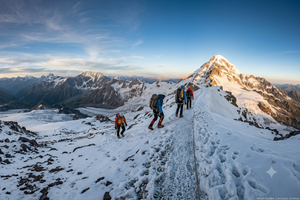
Hiking, trekking, mountaineering, climbing, ski touring and mountain biking all have something in common: the journey becomes more than simply moving from one place to another.
The route itself becomes part of the adventure.
In the mountains, it is not only the destination that matters. Weather, terrain, equipment, navigation, physical preparation and the ability to adapt to changing conditions all become part of the experience.
That is why people often remember not a particular hotel or restaurant, but a certain trail, mountain pass, sunrise at altitude or the moment when a spectacular view finally appeared after hours of walking.
Cycling Tourism and Traveling by Bike
The bicycle has long been much more than a means of transportation.
For some people, it is a way to move around the city. For others, it is a sport. And for another group, a bicycle is a way to explore entire regions.
Cycling tourism allows people to travel more slowly than by car but much faster than on foot. This creates a unique form of travel: you can cover significant distances while still staying close to the landscape.
Bikepacking has become an especially interesting part of this culture, turning a bicycle into a fully capable vehicle for multi-day self-supported journeys.
In this kind of travel, the road itself becomes part of the experience.
How Technology Is Changing Tourism
Travel has become easier thanks to technology.
A smartphone has replaced an entire bag of paper maps, guidebooks and timetables. GPS makes it possible to plan routes, online services help travelers find accommodation and transportation, and digital maps allow people to study a journey before even leaving home.
But in 2026, World Tourism Day has another particularly relevant theme.
This year's theme is "Digital Agenda and Artificial Intelligence to Redesign Tourism." It focuses on how digital technologies and artificial intelligence are changing the way people choose destinations, plan journeys and experience tourism.
AI can help create itineraries, recommend places based on personal interests, translate text, find transportation information or adjust a travel plan.
But this also creates an interesting challenge.
If everyone starts using the same algorithms and recommendations, tourist flows could become even more concentrated around a small number of already popular destinations.
Technology can therefore do more than help us discover the world. It can also influence which parts of the world we see.
Can Tourism Be Responsible?
Traveling frequently does not necessarily mean traveling responsibly.
This becomes especially visible in natural tourist destinations. A trail that was once relatively unknown can become extremely popular within just a few years.
Responsible tourism often begins with simple things: taking your waste with you, following local rules, avoiding damage to vegetation, respecting local traditions and supporting local businesses.
In many cases, it is also worth considering less crowded routes and destinations. This can help distribute tourist pressure while allowing travelers to discover places that are not found in every standard guidebook.
A journey should not leave more behind than memories.
Why Do We Travel?
There is no single correct answer.
Someone wants to see a new country.
Someone wants to challenge themselves on a difficult route.
Someone travels for mountains, the sea, forests or snow.
Someone is looking for new people and new experiences.
And someone simply wants to change their usual surroundings for a few days.
Sometimes travel is valuable precisely because it allows us to see familiar things from a different perspective.
Once we step outside our everyday routine, even an ordinary walk through an unfamiliar city can become an adventure.
Travel Stays With Us
One of the most interesting things about travel is that the journey continues even after we return home.
Photographs remain on our phones. Tickets end up among old documents. Route maps can stay saved for years.
But the most valuable part often exists only in memory.
It may be a particular smell in a mountain village, a sunrise above a ridge, the sound of the sea, a cup of coffee after a long hike or a chance conversation with someone you may never meet again.
That is why people often bring home more than photographs. They bring back small objects that remind them of an experience.
Jewelry can become one of those symbols - a small object that brings back memories of a particular place, route or passion.
In the Travel Jewelry catalog, we have gathered jewelry inspired by travel, mountains, outdoor activities and the interests of modern travelers.
World Tourism Day Is a Reason to Go Further
Perhaps the best way to celebrate World Tourism Day is to remember why we love traveling in the first place.
There is no need to plan a trip to another continent.
Sometimes it is enough to find a new route near home, climb a hill, walk along an unfamiliar trail or get on a bicycle and ride to the next town.
Tourism does not begin with a boarding pass.
It begins with curiosity.
With the desire to find out what is waiting around the next corner.
And perhaps that is what remains unchanged in travel regardless of new technologies, mobile applications or artificial intelligence: people still want to discover the world with their own eyes.
Happy World Tourism Day!
Sea to Summit: How Tim Macartney-Snape Walked from the Sea to the Summit of Everest
UIAA: History, Activities, Standards, Grading Systems and Its Role in Modern Mountaineering
Piolets d'Or - The Golden Ice Axe: History, Awards and Legendary Climbs
Edelweiss: The Legendary Mountain Flower That Never Fades from Memory