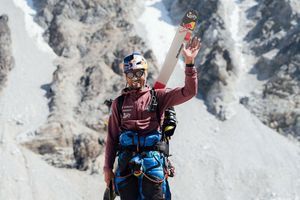
The Piolets d'Or, often translated as the "Golden Ice Axe", is one of the most prestigious awards in modern mountaineering. But unlike many sporting awards, it is not simply about reaching the highest summit or completing the most difficult route.
The Piolets d'Or recognizes how a climb was made - the style, commitment, exploration, technical difficulty, self-sufficiency and respect for the mountains.
That is what makes the award particularly important for modern alpinism.
What is the Piolets d'Or?
The Piolets d'Or is an international mountaineering award created to recognize outstanding alpine achievements.
The name comes from the French word piolet, meaning an ice axe. The ice axe is one of the fundamental tools of mountaineering and has become a natural symbol of exploration, climbing and the ability to move through terrain where there may be no obvious path.
The philosophy of the award goes much further than simply asking whether a climber reached the summit.
According to the official charter, the Piolets d'Or promotes progressive and ethical alpinism, with particular importance placed on climbing style.
In other words, the question is not only:
"Did you reach the summit?"
It is also:
"How did you get there?"
Read the official Piolets d'Or Charter

The history of the Piolets d'Or
The Piolets d'Or was created in the early 1990s through an initiative by French mountaineers Jean-Claude Marmier and François Marsigny.
The award was developed through cooperation between the Groupe de Haute Montagne (GHM) and Montagnes Magazine.
The first ceremony took place in 1992 in Autrans, France, during the International Mountain Film Festival.
The first jury included several prominent figures in international mountaineering, including Jean-Claude Marmier, Bernard Domenech, Andrzej Zawada, Franco Ribetti, Józef Nyka, Jean-Luc Amstutz and Yves Astier.
Initially, the award focused primarily on outstanding climbing achievements. Over the following decades, however, its philosophy developed considerably.
Style, commitment, exploration and ethics gradually became central to the selection process.
This evolution is important because it reflects a broader change in modern mountaineering - from the idea of simply conquering difficult summits toward the idea of finding better, cleaner and more responsible ways to climb them.
Explore the official Piolets d'Or history archive
What does the Piolets d'Or jury look at?
This is one of the most interesting aspects of the award.
The jury does not simply compare mountain heights, route grades or summit elevations.
The official charter establishes a much broader set of criteria.
Among them are:
-
Climbing style - how elegantly and efficiently the route was climbed.
-
Commitment and self-sufficiency - how independent the team was.
-
Spirit of exploration - whether the climb opened new terrain or demonstrated genuine exploration.
-
Technical ability - the difficulty and quality of the climbing.
-
Objective danger - the risks inherent in the chosen route.
-
Efficient use of resources - minimizing unnecessary equipment, infrastructure and environmental impact.
-
Transparency - providing an accurate account of the ascent.
-
Respect for the environment.
-
Respect for partners, local communities and other climbers.
-
Respect for future generations.
This means that a technically extraordinary climb can still fail to receive the main award if its style or other aspects conflict with the principles of the Piolets d'Or.
Why reaching the summit is not enough
One of the clearest examples is the 2022 ascent of Annapurna III by Ukrainian climbers Nikita Balabanov, Mikhail Fomin and Viacheslav Polezhaiko.
The team made a remarkable first ascent of the southeast ridge of Annapurna III, climbing a huge 2,950-meter route in difficult Himalayan conditions.
The climb was widely regarded as one of the most impressive Himalayan achievements of recent years.
However, the jury decided not to award it the main Piolet d'Or.
Instead, the team received a Special Jury Award.
The decision demonstrated one of the fundamental principles of the Piolets d'Or: an extraordinary climbing achievement and an award-winning ascent are not necessarily the same thing.
The jury also considered environmental and logistical aspects of the expedition, including helicopter access.
This is exactly what makes the Piolets d'Or different from a conventional competition.
What awards exist?
The Piolets d'Or is not organized like a traditional sports competition with a fixed ranking of first, second and third places.
Instead, there are several forms of recognition.
Piolet d'Or
The main award recognizes outstanding ascents that best represent the principles of modern, progressive and responsible alpinism.
Several teams can receive the award in the same year.
Special Jury Award
This recognizes an exceptional achievement that deserves special recognition, even when the ascent does not fully correspond to all the criteria for the main Piolet d'Or.
The 2022 Annapurna III ascent by the Ukrainian team is a particularly important example.
Special Mentions
The Piolets d'Or can also use special mentions to highlight important achievements or particular aspects of modern mountaineering.
One example is the Special Mention for Female Alpinism, introduced to promote and recognize women's achievements in mountaineering.
Lifetime Achievement Award
There is also a separate lifetime achievement distinction - the Piolet d'Or Lifetime Achievement, Walter Bonatti Award.
It recognizes outstanding careers in mountaineering rather than a single ascent.
The first recipient was legendary Italian climber Walter Bonatti, who received the award in 2009.
Since then, the distinction has been awarded to some of the most influential mountaineers in history, including Reinhold Messner, Doug Scott, Kurt Diemberger, Chris Bonington, Wojciech Kurtyka, Catherine Destivelle and others.
In 2026, the Lifetime Achievement Award is being presented to Peter Habeler.
Important dates in the history of the Piolets d'Or
A few dates are particularly important:
1992 - the first Piolets d'Or ceremony in Autrans, France.
2009 - the first Lifetime Achievement Award, presented to Walter Bonatti.
2016 - Ukrainian climbers Mikhail Fomin and Nikita Balabanov receive a Piolet d'Or for their first ascent of the north-northwest pillar of Talung.
2021 - the Piolets d'Or celebrates its 30th anniversary.
2022 - the Ukrainian Annapurna III expedition receives the Special Jury Award.
2026 - the Piolets d'Or returns to the Oisans region in France, with the ceremony and events scheduled for October 21-25.
Ukrainians and the Piolets d'Or
Ukraine has a particularly interesting place in the history of the award.
In 2016, Ukrainian climbers Mikhail Fomin and Nikita Balabanov received the Piolet d'Or for the first ascent of the north-northwest pillar of Talung, 7,348 meters, in Nepal.
The route was approximately 1,700 meters long and was climbed in alpine style over five bivouacs.
The ascent was named Daddy Magnum Force and involved extremely difficult mixed and technical climbing.
It became the first Piolet d'Or awarded to Ukrainian alpinists.
Read the official Piolets d'Or page about the Ukrainian Talung ascent
Six years later, another Ukrainian team made history on Annapurna III.
Nikita Balabanov, Mikhail Fomin and Viacheslav Polezhaiko completed the first ascent of the southeast ridge of Annapurna III, 7,555 meters.
The route, called Patience, was approximately 2,950 meters long and required 16 days to climb from base camp to the summit, followed by three more days descending previously unclimbed terrain.
Although the team did not receive the main Piolet d'Or, the Special Jury Award recognized the extraordinary nature of the achievement.

The most famous names associated with the Piolets d'Or
Over the years, the award has been connected with many of the greatest names in mountaineering.
Among them are:
-
Walter Bonatti
-
Reinhold Messner
-
Doug Scott
-
Chris Bonington
-
Wojciech Kurtyka
-
Catherine Destivelle
-
Kurt Diemberger
-
Krzysztof Wielicki
-
Jeff Lowe
-
Yasushi Yamanoi
-
Silvo Karo
British alpinist Paul Ramsden holds a particularly remarkable record - he is the only climber to have received the Piolet d'Or five times.
His awards came in 2003, 2013, 2016, 2017 and 2023.
What happens during the Piolets d'Or ceremony?
The Piolets d'Or is more than an awards ceremony.
It is part of a larger mountaineering event that brings together climbers, journalists, historians, photographers, filmmakers and mountain enthusiasts.
The program can include:
-
presentations of the awarded climbs;
-
climbing films;
-
lectures;
-
meetings with alpinists;
-
discussions about difficult and controversial ascents;
-
historical presentations;
-
exhibitions and informal meetings within the mountaineering community.
For example, during the 2016 event in La Grave, the awarded teams presented their ascents to the audience.
In 2019, the Piolets d'Or event in Lądek-Zdrój, Poland, attracted more than 2,000 spectators to the ceremony, while the wider festival welcomed thousands of individual visitors.
The event has therefore become an important meeting point for the international climbing community.
The Piolets d'Or in 2026
The 2026 edition will take place in Oisans, France, including Saint-Christophe-en-Oisans and La Bérarde, from October 21 to 25, 2026.
The international jury selected four outstanding ascents completed in 2025 for the main awards:
-
Ultar Sar, 7,388 m
-
Aikache Chhok, 6,673 m
-
Yerupajá Grande, 6,634 m
-
Jannu East, 7,460 m
The 2026 program also includes a special forum dedicated to the verification of mountaineering achievements.
The forum will bring together climbers, journalists and historians to discuss famous controversies surrounding ascents and possible future changes to the Piolets d'Or charter.
Why is the ice axe the symbol of the award?
The choice of the ice axe is not accidental.
For generations of climbers, the ice axe has been much more than a piece of equipment.
It can be used for climbing, balance, self-arrest, cutting steps, anchoring and moving safely through difficult terrain.
But symbolically, it represents something even simpler:
finding a way forward where there is no obvious path.
That is very close to the philosophy of the Piolets d'Or.
The award celebrates climbers who explore new terrain, accept uncertainty, make difficult decisions and create new possibilities for future generations of mountaineers.
ICE Pendant - a symbol inspired by mountaineering
The ice axe has also become an important symbol outside climbing itself.
Travel Jewelry created the ICE Pendant as a minimalist interpretation of this idea - a silver pendant combining an ice axe and a mountain.
It is not a replica of the Piolets d'Or award.
Instead, the connection is symbolic.
An ice axe can represent a particular ascent, a mountain experience, a difficult decision or simply a personal connection with the mountains.
For a climber, the symbol can carry a very different meaning from what it means to someone who simply loves hiking and mountains.
And perhaps that is what makes the ice axe such a powerful symbol - it is a simple tool, but it represents the ability to move forward when the route is uncertain.
Why does the Piolets d'Or matter?
The importance of the Piolets d'Or goes beyond the list of winners.
The award helps define what the climbing community considers valuable in modern alpinism.
It places emphasis not only on difficulty, but also on:
style, exploration, commitment, self-sufficiency, responsibility and respect for the mountain.
That philosophy has become increasingly relevant as mountaineering changes and some of the world's highest mountains become more accessible.
The Piolets d'Or reminds climbers that the most important achievement is not necessarily reaching the summit at any cost.
Sometimes, the most impressive achievement is finding a new route, climbing it in an elegant style, making good decisions under pressure and leaving as little trace as possible.
And that is why the Golden Ice Axe remains one of the most meaningful symbols in modern mountaineering.
Ama Dablam - The Most Beautiful Mountain in the Himalayas
The Climbing Carabiner: The Story of One of the Most Important Inventions in Mountaineering
Ski Mountaineering: History, Evolution and the Most Challenging Ski Descents