It is easy to imagine Antarctica as an endless white plain where people slowly drag sledges behind them. But this continent is more than a route to the South Pole. It has mountain ranges, steep glaciers, islands near the Antarctic Peninsula, and slopes where skis are not just a means of travel but part of a mountaineering ascent.
The history of skiing in Antarctica brings together two very different kinds of adventure. The first involves journeys lasting many weeks across an icy wilderness, where every kilometre depends on the weather, supplies, and endurance. The second involves mountain expeditions in which climbers reach summits and ski down routes that may still be almost unknown.

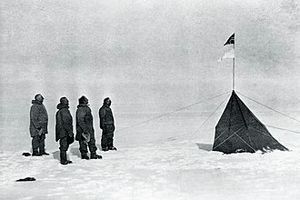
Roald Amundsen's team at the South Pole in December 1911. Skis were an important part of the Norwegian expedition's equipment.
Photo: Olav Bjaaland, 1911. Source and public-domain information: Wikimedia Commons.
Skis at the End of the World: Why They Became Essential
On snow and ice, skis distribute a person's weight, reduce sinking into soft snow, and make travel more efficient than walking. This was crucial for polar expeditions: teams covered great distances, transported equipment and food, and had to conserve their strength in conditions where even a small slowdown could affect the entire route.
Skis did not solve every problem. Sastrugi - hard, wind-shaped ridges of snow - made progress difficult, while crevasses required careful route selection. On steep slopes, skis could be useful for descents, but climbers sometimes had to take them off and continue uphill in crampons.
Skis should therefore be seen not as a magic solution but as one part of a larger system involving skills, sledges, navigation, supply planning, and the ability to assess snow conditions.
Amundsen, Scott, and the Race to the South Pole
By the early twentieth century, skiing had a long history in northern countries, but it remained a relatively unfamiliar tool for some British polar explorers. Roald Amundsen's expedition relied on Norwegian skiing experience and dog teams. For the journey to the Pole, the team prepared 20 pairs of wooden skis approximately 2.5 metres long, along with ski poles. Details are available in this account of equipment used by Amundsen's expedition.
Amundsen reached the South Pole on 14 December 1911. Robert Falcon Scott's British team arrived in January 1912. Scott's expedition also had skis: around 50 pairs were purchased, and Norwegian skier Tryggve Gran was invited to help the team learn skiing techniques. The skis of geologist Raymond Priestley are now held in the museum collection of Amgueddfa Cymru - Museum Wales. Their story illustrates how practical, yet experimental, the equipment of the time could be: skis from the Terra Nova expedition.
The difference between the two expeditions cannot be explained by skis alone. Route planning, dogs, load distribution, pace, team experience, and weather all played a role. Still, skis became one of the symbols of the Norwegian approach to polar travel: applying skills proven in snow and cold.
Skis as a Working Tool for Researchers
Skis remain important for fieldwork in Antarctica. They are used to travel between camps, tow sledges, transport equipment, and cover long stretches of glacier. On modern autonomous crossings, a traveller may pull a pulk sledge carrying a tent, stove, fuel, food, spare clothing, and other essentials.
This kind of travel is very different from recreational skiing. There are often no prepared tracks, and the surface can shift from hard crust to soft snow or sharp sastrugi. Even when the terrain looks flat, wind and surface features can conceal changes in elevation, crevasses, and sections where progress suddenly becomes much harder.
A field expedition depends on a steady routine: travelling, taking short breaks, checking the condition of people and equipment, setting up camp, preparing food, and planning the next day. In such a remote environment, a minor equipment failure can become a major problem.
Beyond the South Pole: Mountains and Islands of the Antarctic Peninsula
Antarctic ski expeditions can take very different forms. Some teams arrive by yacht, land on a remote shore, establish a camp, and head for nearby summits. The goal is not to cross the continent but to explore a mountain area, climb a new route, or ski down a slope that few people may have visited before.
A striking example took place in January 2024 on Liard Island, near the Antarctic Peninsula. British mountain guide Phil Wickens led a team to Mount Bridgman, the island's highest point. On 15 January, the team made the first known ascent of the summit, measured its height at approximately 1,410 metres, and skied back down the same route. This was not a journey to the Pole but a ski-mountaineering expedition. More details are available in the American Alpine Club report on Mount Bridgman.

A skier on the eastern slope of Mount Bridgman after the first known ascent in January 2024.
Photo: Phil Wickens. Source: American Alpine Journal. Check the terms for reusing the photograph before publication.
This is not the only kind of expedition of its type. On the Antarctic Peninsula and nearby islands, teams combine sea travel with mountaineering and ski descents. Weather affects not only comfort but also whether a landing, a safe ascent, and a return to the vessel are possible.
Skiing Down the Vinson Massif: Skis on the Continent's Highest Mountain
The Vinson Massif is Antarctica's highest mountain, rising to approximately 4,892 metres. In a 1998 report for the American Alpine Club, Slovenian climber Viki Groselj described his team's ascent and his own ski descent to base camp.
According to his report, the descent took four hours and covered about 2,900 metres of vertical drop. Part of the slope had an angle of approximately 30-40 degrees, with some sections even steeper. The team also made ski descents from several other peaks near base camp. The original account is available in the report on ascents in the Vinson Massif area.
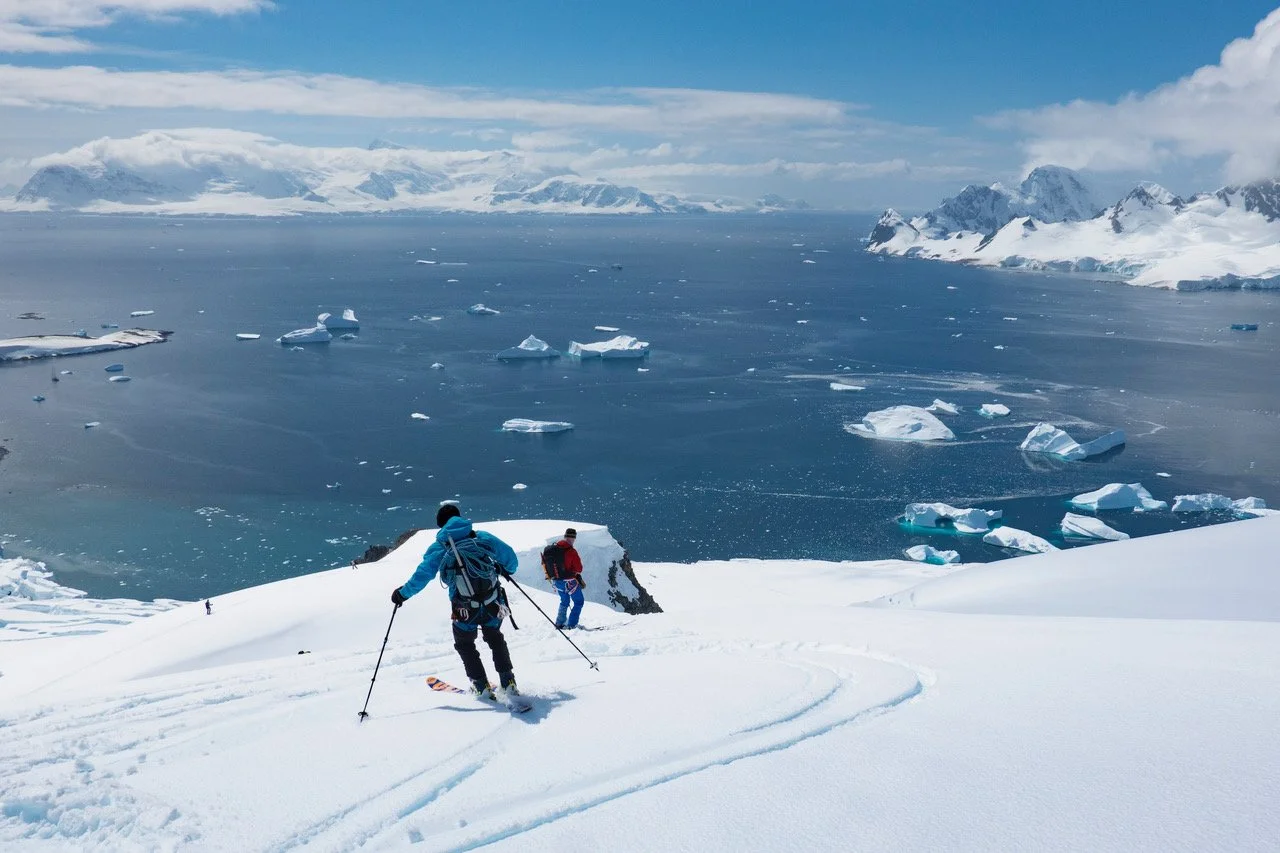
A ski descent from Mount Tennant on Rongé Island, with the sea and icebergs beyond the slope.
Photo source: Vinson of Antarctica & Amundsen, report on a ski expedition to the Antarctic Peninsula. Check permission terms before reusing the photograph.
This story shows that skiing down an Antarctic peak is more than a dramatic finale to an ascent. It requires suitable snow conditions, experience on challenging terrain, a sound understanding of the route, and the ability to make decisions at altitude. A snow-covered slope is not necessarily a safe one to ski.
From Team Crossings to Modern Autonomous Expeditions
In 1957-1958, the British Trans-Antarctic Expedition led by Vivian Fuchs, with New Zealander Edmund Hillary's involvement, crossed Antarctica via the South Pole. The expedition used motor vehicles, snow tractors, and other forms of transport, so it would be inaccurate to describe it as a crossing made entirely on skis. Nevertheless, it was a major milestone in the history of transcontinental travel.
Modern ski travellers choose different formats. Some rely on logistical teams that transport them to the starting point or provide supplies. Others aim to travel autonomously, pulling all their provisions themselves. Before describing an expedition as “solo,” “unsupported,” or “the first in history,” it is important to check what those terms mean in that particular case.
The goals also vary: reaching the South Pole, travelling from coast to coast, crossing the polar plateau, or exploring a mountain region. Distance is only one measure of achievement. The route, terrain, load, weather, support arrangements, and condition of the participants all matter.
Why a Ski Expedition in Antarctica Is So Difficult
The main challenge is not one extreme obstacle but the combination of demands that continue day after day.
- Cold and wind. Wind increases heat loss, makes travel harder, and can turn a stop into a dangerous situation.
- Terrain that is hard to read from a distance. Crevasses may be hidden by snow bridges, while sastrugi tire the legs and slow sledges.
- Altitude. Some routes cross the high polar plateau, where physical exertion can feel more demanding.
- Limited supplies. Food, fuel, and equipment must be calculated for the entire route, with reserves for delays.
- Isolation. Help may be far away, and bad weather can prevent evacuation for a period of time.
- Monotony and fatigue. Repetitive movement, lack of sleep, and persistent cold test attention and psychological resilience as well as physical strength.
Mountain expeditions add steep slopes, hard ice, rocky sections, and the need to switch between skis and mountaineering equipment. A successful team does more than keep moving forward - it knows when to stop or change the plan.
How a Modern Ski Expedition Is Organised
Preparation begins long before the first step on the snow. The team assesses the season, daylight hours, route, potential campsites, communications, and evacuation options. For an autonomous crossing, careful calculations of calories, fuel reserves, stove reliability, repair kits, and protection for equipment against the cold are especially important.
A pulk sledge can carry the main load, but its weight significantly changes the physical demands, especially on climbs and in soft snow. Clothing needs to work in layers: moisture management while moving, insulation during stops, and an outer barrier against wind and snow. Goggles, sun protection for the skin, navigation, and the ability to use emergency equipment are equally important.
This overview is not a guide for attempting an independent journey. Antarctic routes require specialist training, professional planning, appropriate permits, and a reliable safety system.
Will Skis Remain Important in the Future?
Aircraft, satellite communications, and modern vehicles have transformed Antarctic logistics, but they have not made skis obsolete. In many conditions, skis remain an efficient way to travel over snow, carry supplies, and explore areas far from permanent bases.
Skis also offer experiences that cannot be measured by records alone: reading the terrain carefully, working with the weather, trusting a team, and respecting the environment. In the mountains, they combine mountaineering with descent; on the polar plateau, they turn a long journey into a sequence of manageable daily tasks.
Conclusion: A Journey Measured in More Than Kilometres
From the wooden skis of Amundsen and Scott to modern expeditions on the islands of the Antarctic Peninsula, skis remain part of the story of humanity's drive to explore the unknown. They helped people cross the icy continent, work on glaciers, and ski down peaks whose routes were only recently documented.
Antarctica reminds us that adventure is not just about speed or reaching a summit. It is about preparation, perseverance, reading conditions, and respecting a place where nature sets the rules. For those inspired by skiing and travel, this connection between movement and discovery has a special meaning.
If skis mean more to you than equipment - if they represent freedom of movement and a love of the mountains - take a look at the Skis Pendant by Travel Jewelry, a piece of jewellery inspired by winter routes and adventure.
This article draws on historical museum collections and reports from polar and mountaineering expeditions. Statements about first ascents and descents are limited to what is documented in the available reports; they do not imply that every possible route or earlier attempt has been recorded.
Antarctic Research Stations and Life on the Ice: How Polar Teams Live and Work
Antarctica: From the Search for an Unknown Land to Discovering the World Beneath the Ice
Amundsen and Scott: The Race to the South Pole That Changed Antarctic History
Ski Descents from the Eight-Thousanders: The Story of Great Descents from the World's Highest Peaks
Ski and Snowboard Records: Speed, Height, Distance and Incredible Tricks
Ski Mountaineering: History, Evolution and the Most Challenging Ski Descents
Ski Travel: The History of Ski Touring, Ski Expeditions and Winter Journeys
The History of Skis: Evolution, Types, Technology and Skiing in Sport
Gift Ideas for a Skier: Practical and Meaningful Presents for Winter Enthusiasts