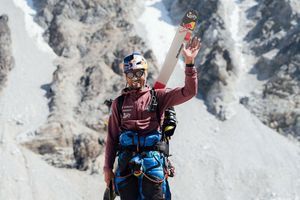
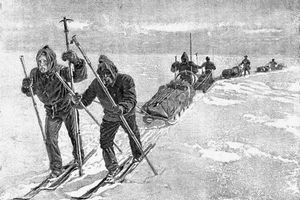
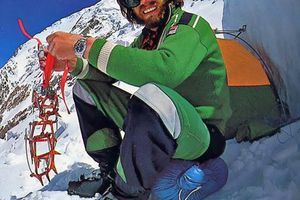
Today, mountaineering is much more than simply climbing to the top of a mountain.
For some, it means an alpine route in the Alps. For others, it is an expedition to an 8,000-meter peak, a technical wall, an ice route, or a multi-day ascent in an alpine style. Alongside traditional mountaineering, there are rock climbing, ice climbing, competitive climbing, and even professional rope access.
But once, it was much simpler.
People simply wanted to climb somewhere no one had been before.
That desire gradually gave rise to modern mountaineering. Over several centuries, it evolved from early exploratory ascents into a complex culture with its own disciplines, equipment, standards, professions, competitions, commercial expeditions, and records.
The history of mountaineering can be understood as the history of one question constantly changing:
What exactly makes a climb difficult?
When Mountains Stopped Being Just Obstacles
For most of human history, mountains were primarily part of the environment in which people lived and traveled.
People crossed them, hunted in them, grazed animals on their slopes, searched for resources, and eventually built roads through them. For local communities, mountains were part of everyday life. For much of Europe, however, high mountains remained remote, unfamiliar, and dangerous territory.
In the 18th century, this began to change.
European explorers and scientists became increasingly interested in the Alps. They studied geology, glaciers, plants, weather, and the height of the mountains.
And gradually, a new question emerged:
Could someone actually reach the summit?
This was a completely different motivation.
A mountain was no longer simply an obstacle or an object of scientific study. It became a goal in itself.
Mont Blanc and the Birth of Modern Mountaineering
One of the most important moments in this transformation involved Mont Blanc.
In 1760, the Genevan naturalist Horace-Bénédict de Saussure offered a reward to anyone who could find a route to the summit of the highest mountain in the Alps. Several attempts followed over the next decades.
On August 8, 1786, Jacques Balmat and Michel-Gabriel Paccard reached the summit of Mont Blanc. De Saussure himself climbed the mountain the following year.
Today, this ascent is considered one of the defining moments in the birth of modern mountaineering.
The equipment used by those early climbers is almost impossible to compare with modern gear. Balmat and Paccard had neither modern ice axes nor crampons. They used long wooden poles with metal tips to help them move through snow, glacier terrain, and crevassed areas. The history of Jacques Balmat's alpenstock
But the most important thing had already changed.
The summit had become the goal.
After Mont Blanc, the Alps were explored more systematically, local mountain guides became increasingly important, and climbing began to develop into a distinct culture.

The Golden Age of Mountaineering
The 19th century became a period of rapid development for mountaineering.
In 1857, the Alpine Club was founded in Britain - the world's first mountaineering club of its kind. Similar organizations soon appeared across Europe.
Mountaineers began systematically exploring the Alps, documenting routes, developing climbing techniques, and improving equipment.
One famous summit after another was climbed.
But the question itself was changing.
At first:
"Can we reach this summit?"
Then:
"Can we find another route?"
And eventually:
"Can we climb the hardest side of the mountain?"
The Matterhorn is a perfect example.
In 1865, a team led by Edward Whymper made the first successful ascent of the summit. But the descent ended in tragedy, with four members of the party losing their lives.
The ascent became one of the defining stories of 19th-century mountaineering.
By this point, reaching a summit was no longer simply a question of physical strength and endurance. Route selection, technique, equipment, weather, tactics, and decision-making had become essential parts of the challenge.
And another factor was about to change everything.
Technology.
How Equipment Changed Mountaineering
The early mountaineers were limited not only by their physical abilities, but also by their equipment.
Heavy leather boots, rough clothing, heavy ropes, primitive metal equipment, and the absence of modern protection systems made long and difficult routes much harder.
Gradually, this began to change.
Advances in metallurgy made it possible to produce stronger and lighter components. Steel was increasingly complemented or replaced in some applications by aluminum alloys and other modern materials. Carabiners, crampons, ice axes, and protection systems became more sophisticated while also becoming lighter.
The carabiner is a good example.
Early climbing carabiners were made of steel and could be relatively heavy. With the development of stronger aluminum alloys and more efficient designs, manufacturers could optimize them not only for strength, but also for weight, ergonomics, and specific uses.
We have already covered the history of this small but extremely important piece of equipment in our separate article about the climbing carabiner. The History of the Climbing Carabiner
But the technological revolution did not stop with metal equipment.
The Revolution in Clothing
The old principle of "the warmer, the better" gradually gave way to a much more sophisticated approach.
Clothing began to be designed as a layering system, with each layer serving a different purpose.
Synthetic fabrics made it possible to move moisture away from the body more effectively. Fleece became a lightweight insulating layer. Modern membranes provided protection from rain and wind while allowing water vapor to escape.
For example, modern synthetic fleece emerged in the early 1980s. Polartec dates the creation of its first PolarFleece to 1981, after which fleece quickly spread through outdoor clothing. Polartec fleece technology
Another major breakthrough was the development of waterproof-breathable membranes.
In 1969, Bob Gore discovered a method for creating expanded PTFE, the material that became the basis of GORE-TEX membranes. The first commercial products using the technology appeared in 1976. GORE-TEX technology and history
The result was a fundamentally different approach to outdoor clothing.
Not simply warm clothing, but functional clothing.
A base layer moves moisture away from the skin.
An insulating layer retains warmth.
An outer shell protects against wind and precipitation.
Later came softshell fabrics, modern insulation materials, lightweight membranes, and increasingly specialized textiles designed to balance protection, breathability, mobility, and weight.
Then Came the Race for Less Weight
Modern mountaineering also changed the way climbers think about equipment.
In the past, good equipment primarily meant strong equipment.
Today, another question is just as important:
How much weight can be removed without sacrificing the required strength and safety margin?
Lightweight tents, sleeping bags, backpacks, ropes, carabiners, crampons, and climbing tools have transformed what climbers can carry into the mountains.
A few hundred grams may not seem significant on their own. But when equipment has to be carried for many kilometers while gaining thousands of meters of elevation, every gram starts to matter.
This is why modern climbing equipment can seem almost paradoxical: it can be dramatically lighter than older equipment while still being designed to withstand extremely high loads.
From "Looks Strong" to Certified Equipment
Another fundamental change was the development of safety standards.
The UIAA began developing safety standards for mountaineering equipment in 1960, starting with ropes. The system later expanded to more than 25 categories of equipment, including helmets, harnesses, crampons, and other gear. The UIAA also works with the European standardization system CEN. UIAA Safety Standards
Modern equipment is no longer simply something that looks strong.
It can be tested, evaluated, and certified according to defined requirements.
This is one of the most important parts of the technological evolution of mountaineering.
Technology did not simply make equipment lighter. It made its characteristics measurable, testable, and more predictable.
And eventually, this technological progress helped climbers enter a world where the human body itself became the main limitation.
Altitude Becomes a New Challenge
While climbers were gradually tackling more difficult routes in the Alps, a completely different world was opening up in the Himalayas.
Here, the challenge was no longer only rock, ice, or steepness.
Altitude itself became the problem.
As altitude increases, atmospheric pressure decreases, and so does the partial pressure of oxygen available to the human body.
Climbers become exhausted more quickly, recovery becomes increasingly difficult, and prolonged exposure to high altitude puts enormous stress on the body.
Above roughly 8,000 meters, mountaineers refer to the area as the "death zone."
At these elevations, the human body cannot properly acclimatize. Time spent there needs to be minimized, and even a small mistake can quickly become fatal.
The 8,000-meter peaks therefore became a completely new frontier.
And the first answer to the question of whether humans could survive and reach such heights came not on Everest.
Annapurna - The First Summit Above 8,000 Meters
In 1950, a French expedition led by Maurice Herzog traveled to the Himalayas.
Their objective was Annapurna I.
The summit stands at 8,091 meters.
On June 3, 1950, Maurice Herzog and Louis Lachenal reached the summit.
It was the first confirmed ascent of a mountain higher than 8,000 meters. UIAA - Maurice Herzog and the first ascent of Annapurna
This was a monumental moment.
Until then, nobody knew whether a human could actually reach the summit of a mountain at such an altitude.
Annapurna provided the answer:
Yes, it was possible.
But the cost was extremely high. Herzog and Lachenal suffered severe frostbite during the expedition. Herzog eventually lost his fingers and toes. UIAA - Maurice Herzog and the first ascent of Annapurna
After Annapurna, the era of climbing the 8,000-meter peaks had begun.
And among all those mountains, one remained the ultimate objective.
The highest mountain on Earth.

Everest - The Highest Point on Earth
Everest had a special status even before anyone reached its summit.
It was the highest known mountain on Earth, and British expeditions spent decades trying to find a route to the top.
In 1924, George Mallory and Andrew Irvine disappeared high on the mountain during another attempt.
Whether they reached the summit before their deaths remains unknown.
Mallory's body was found in 1999, but no conclusive evidence has established that he and Irvine reached the summit.
On May 29, 1953, Edmund Hillary and Tenzing Norgay made the first confirmed ascent of Mount Everest. They reached the summit at approximately 11:30 in the morning after leaving their high-altitude camp. UIAA - Sir Edmund Hillary
Everest had been climbed.
But, as so often happens in mountaineering, success did not end the story.
It created new questions.
Could it be climbed without supplemental oxygen?
Could a different route be climbed?
Could it be climbed in winter?
Could it be climbed in a different style?
And eventually:
How fast could it be done?
El Capitan - When Height Was No Longer the Main Challenge
While climbers in the Himalayas were fighting altitude, another part of the climbing world was developing in a completely different direction.
In Yosemite Valley stands El Capitan - an enormous granite wall approximately 900 meters high.
Here, the summit itself was no longer the main challenge.
The wall was the challenge.
In 1958, Warren Harding's team completed the first ascent of The Nose. The climb took 47 days spread across 17 months of work on the route and became one of the defining achievements of the early big-wall era. National Park Service - The Nose on El Capitan
But the story did not end there.
Over the following decades, techniques, equipment, and ideas about climbing style continued to evolve. Routes that originally required extensive use of artificial protection and aid techniques gradually began to be climbed in increasingly free styles.
Once again, the definition of difficulty changed.
It was no longer enough simply to reach the top of the wall.
The question became:
How exactly can you climb it?

From One Mountaineering Tradition to Many Disciplines
By the late 20th century, it had become clear that mountaineering could no longer be described as a single activity.
A whole range of related disciplines had developed:
- traditional mountaineering;
- technical mountaineering;
- high-altitude mountaineering;
- rock climbing;
- ice climbing;
- big-wall climbing;
- sport climbing;
- ski mountaineering and others.
They shared a common foundation - movement over difficult terrain, altitude, ropes, equipment, and risk.
But their goals could be completely different.
For one climber, the summit was the main objective.
For another, it was the difficulty of a particular wall.
For someone else, it was speed.
For another, it was finding a new route that nobody had climbed before.
This is why the modern mountain world is better understood not as a single sport, but as a large family of related disciplines.
From Mountain Technique to a Profession: Industrial Rope Access
Mountaineering technology also began to move far beyond the mountains.
Rope skills and techniques for accessing vertical surfaces proved useful in places where conventional lifting equipment was difficult, expensive, or simply impossible to use.
This led to the development of industrial rope access.
One important stage in its professional development came in the United Kingdom in the late 1980s, when IRATA was established to address access and maintenance challenges in the offshore oil and gas industry. The system later expanded into construction, inspection, maintenance, and other high-access work. IRATA - About Us
The transformation was remarkable.
The rope that once helped climbers reach a mountain became a working tool.
Today, industrial rope access has its own training systems, standards, certification, and safety procedures.
Mountaineering had effectively given rise to a professional system that is now used far beyond the mountains.
Mountaineering and the Olympic Games
There is another surprising chapter in the history of mountaineering.
Mountaineering really was connected to the Olympic Games.
But it is important to understand exactly how.
This was not a modern competition where climbers started at the same time and raced to the summit. Olympic awards were given for outstanding mountaineering achievements.
The first such award was presented in 1924 to members of the British Everest expedition of 1922. The expedition had not reached the summit, but its achievement was recognized as an outstanding mountaineering accomplishment. Olympedia - Mountaineering at the Olympic Games
In 1932, German brothers Franz and Toni Schmid received an Olympic mountaineering award for the first ascent of the Matterhorn's north face.
In 1936, another award went to a Swiss expedition led by the Dürenfurths for Himalayan exploration and mountaineering achievements. Olympedia - Mountaineering at the 1936 Olympics
That was the last Olympic award for mountaineering.
Decades later, however, one of mountaineering's descendants would return to the Olympic stage.
From the Mountains to the Climbing Gym
Rock climbing gradually stopped being merely a way to train for mountain ascents.
Artificial climbing walls made it possible to create routes that could be repeated, compared, and used for organized competitions.
Modern competitive climbing developed around three main disciplines:
- lead;
- bouldering;
- speed.
Sport climbing made its Olympic debut at the Tokyo 2020 Games. At the time, the three disciplines were combined into one competition, with athletes competing in speed, bouldering, and lead. Olympics - Sport Climbing
At Paris 2024, the format changed. Speed became a separate event, while bouldering and lead were combined into another event. Olympics - Sport Climbing at Paris 2024
A discipline that had its roots in mountain climbing had developed into a fully independent Olympic sport.
The Rise of Commercial Mountaineering
Another major transformation came with the development of commercial expeditions.
Traditional expeditions required participants to have a huge range of skills.
They had to plan routes, organize logistics, work with ropes, understand weather, establish camps, assess risks, and make decisions far from civilization.
As commercial expeditions developed, professional operators and guides began taking responsibility for many of these tasks.
This became particularly visible on Everest.
Today, climbers can join an expedition where logistics, food, camps, high-altitude support, fixed ropes, and much of the technical organization are already arranged.
This has made major mountains accessible to far more people.
But it has also created an ongoing debate:
Where is the line between independent mountaineering and climbing as part of a commercial expedition?
For some climbers, reaching the summit is the most important thing.
For others, style matters just as much - autonomy, a small team, minimal external assistance, and self-sufficiency.
That is why modern mountaineering is concerned not only with where you climbed.
It also cares about how you climbed.

From Reaching the Summit to Racing the Clock
The history of mountaineering has passed through several stages.
First:
"Can we reach it?"
Then:
"Can we climb a harder route?"
Later:
"Can we do it in a better style?"
And modern mountaineering added another question:
"How fast can we do it?"
This marked the beginning of the era of speed ascents.
Records are now pursued on classic routes, huge walls, individual mountains, and entire mountain ranges.
The trend is particularly striking on the 8,000-meter peaks. Mountains that once required weeks-long expeditions can now become the setting for attempts measured in hours.
Speed has become another way to test the limits of human performance.
And it is a fitting conclusion to several centuries of evolution.
Once, people simply wanted to know whether the summit could be reached.
Now they want to reach it faster than anyone else.
What Has Remained the Same
Almost everything has changed over the centuries.
Equipment has become lighter.
Materials have become stronger.
Clothing has become more technical.
Routes have become harder.
Standards and certification have appeared.
Mountaineering has split into dozens of disciplines.
Professional guides, industrial rope access, commercial expeditions, and Olympic competitions have all emerged.
But something has remained unchanged.
The mountain is still there.
And people still look at it and wonder:
"Can I climb it?"
Perhaps that is why mountains continue to have such a powerful attraction.
Technology has allowed us to climb higher, move faster, and do things that once seemed impossible. But it has not removed the main reason people keep returning to the mountains.
The desire to explore.
To move.
To test yourself.
And to leave your own mark on the history of the mountains.
Mountains as Symbols
For modern people, a connection with the mountains does not necessarily mean constant expeditions.
Sometimes a small symbol is enough.
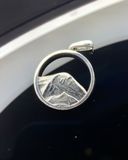
A summit that reminds you of a particular mountain.
An edelweiss - one of the best-known symbols of the Alps.
A carabiner that recalls climbing equipment, ropes, and trust in a climbing partner.
These symbols have also become part of Travel Jewelry's design language.
The collection includes pendants inspired by mountain peaks, a carabiner, edelweiss, and other jewelry inspired by mountaineering, travel, and mountain culture.
This is no longer equipment for climbing.
It is a way to keep a small part of that world close to you even when you are far from the mountains.
From Mont Blanc to Speed Records
The history of mountaineering began with a simple desire to reach a summit.
Mont Blanc showed that a mountain could become a goal in itself.
The Matterhorn demonstrated that the route to the summit could be as important as the summit itself.
Annapurna proved that humans could reach a mountain higher than 8,000 meters.
Everest became the ultimate symbol of reaching the highest point on Earth.
El Capitan showed that a huge vertical wall could be just as compelling a challenge as the highest mountain.
Mountaineering then evolved into many different disciplines. Its technologies moved beyond sport, while sport climbing eventually reached the Olympic Games.
Commercial expeditions made major mountains accessible to more people, while modern climbers continue to push the boundaries of difficulty and speed.
Yet beneath all these changes, one simple thing remains.
A person looks at a mountain and wants to know what lies beyond the limit.
That is where mountaineering began.
And that is why its story is far from over.
Edelweiss: The Legendary Mountain Flower That Never Fades from Memory
Mount Everest: History, First Ascents, Routes and Modern Mountaineering
Ski Mountaineering: History, Evolution and the Most Challenging Ski Descents
Piolets d'Or - The Golden Ice Axe: History, Awards and Legendary Climbs
UIAA: History, Activities, Standards, Grading Systems and Its Role in Modern Mountaineering