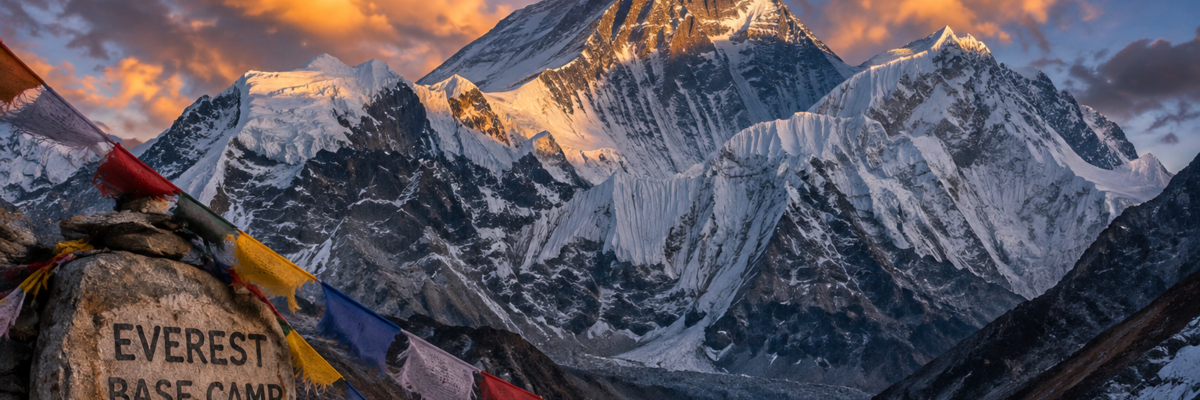
Mount Everest is the highest mountain on Earth above sea level. Its current official elevation is 8,848.86 meters (29,031.69 feet). The summit is located in the Himalayas, on the border between Nepal and China, within the Mahalangur Himal mountain range.
For millions of people, Everest has become a symbol of mountains, great adventures and mountaineering. But the story of this summit is much more than simply being the highest point on Earth.
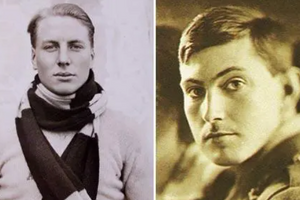
People attempted to reach the summit long before the successful expedition of 1953. Everest was the setting for the mysterious disappearance of George Mallory and Andrew Irvine, decades of exploration, dangerous expeditions and countless battles with altitude and weather.
Today, Everest remains one of the most famous mountains in the world. Modern technology, weather forecasting and expedition logistics have transformed mountaineering, but the mountain itself remains an extraordinary challenge.
In this article, we will explore the history of Everest, its different names, the first expeditions, the mystery of Mallory and Irvine, the first confirmed ascent, the main climbing routes, base camps, the role of Sherpa climbers, modern regulations and what climbing Everest is like today.
Table of Contents
-
Mount Everest - the highest mountain in the world
-
What is Mount Everest called?
-
How was Everest identified as the world's highest mountain?
-
The first expeditions to Mount Everest
-
George Mallory and the mystery of 1924
-
The first confirmed ascent in 1953
-
Everest after 1953
-
The two main routes to the summit
-
Everest Base Camp
-
The high-altitude camps of Everest
-
Acclimatization and the Death Zone
-
Why is Everest dangerous?
-
When is Everest climbing season?
-
How much does an Everest climbing permit cost?
-
Sherpas and modern Everest climbing
-
Everest today
-
The most famous tragedies on Everest
-
Everest Base Camp trekking vs. climbing Everest
-
Interesting facts about Mount Everest
-
Everest as a symbol
-
The Everest Pendant by Travel Jewelry
-
Related articles
Mount Everest - The Highest Mountain in the World
Mount Everest is located in the central Himalayas, in the Mahalangur Himal range. The international border between Nepal and China runs across the summit.
The current official elevation of Mount Everest is 8,848.86 meters (29,031.69 feet) above sea level.
This measurement was jointly announced by Nepal and China in 2020.
Everest is surrounded by several other Himalayan giants. Lhotse, the fourth-highest mountain in the world, stands nearby, along with Nuptse, Changtse and other major peaks.
On the Nepalese side, Everest lies within Sagarmatha National Park, established in 1976. The park covers much of the Khumbu region, home to the Sherpa people and the famous trekking and mountaineering routes leading toward Everest.
What Is Mount Everest Called?
Mount Everest has several names, each connected to the history and culture of the region.
Mount Everest
The name Mount Everest was officially adopted in the 19th century.
Before that, the mountain was known in British surveying records as Peak XV.
The name Everest was proposed in honor of George Everest, a Welsh surveyor who served as Surveyor General of India and was involved in the Great Trigonometrical Survey of India.
In 1865, Peak XV was officially named Mount Everest.
Sagarmatha
In Nepal, the mountain is known as Sagarmatha.
The name is particularly familiar because of Sagarmatha National Park, which surrounds the southern approach to Everest.
Qomolangma
On the Tibetan side, the mountain is known as Qomolangma, also commonly rendered in English as Chomolungma.
As a result, you may encounter three major names:
Mount Everest - Sagarmatha - Qomolangma / Chomolungma.
They all refer to the same mountain, but come from different linguistic and cultural traditions.
How Was Everest Identified as the World's Highest Mountain?
For the people living in the Himalayas, Everest was known long before European expeditions arrived in the region.
The question of which mountain was the highest on Earth, however, required precise scientific measurements.
A major role was played by the Great Trigonometrical Survey of India, which began in the early 19th century.
British surveyors gradually measured the elevations of Himalayan peaks. Peak XV was not initially regarded as an obvious candidate for being the highest mountain, but later calculations showed that its elevation exceeded that of the other measured peaks.
This was how Everest gradually became recognized by Western science as the highest mountain on Earth.
The First Expeditions to Mount Everest
Climbing Everest was considered almost impossible during the early 20th century.
One of the major difficulties was simply reaching the mountain. Nepal was largely closed to foreign expeditions at the time, so the earliest British expeditions approached Everest from the Tibetan side.
The 1921 Expedition
The first British expedition to Everest in 1921 was primarily an exploration mission.
Its goal was not simply to climb the mountain, but to determine whether a realistic route to the summit existed at all.
One of the expedition's most prominent members was George Leigh Mallory, who would later become one of the most famous climbers in Everest history.
The team explored the northern side of the mountain, searched for possible routes and collected information that became essential for later expeditions.
The 1922 Expedition
In 1922, the British returned to Everest with a more direct objective - to attempt to reach the summit.
The expedition climbed considerably higher than the 1921 team and became the first serious attempt to climb Everest.
The summit remained out of reach.
Nevertheless, the expedition provided valuable information about the route, altitude, weather and the effects of extreme elevation on the human body.
The next major attempt came in 1924.
And it created one of the greatest mysteries in mountaineering history.
George Mallory and the Mystery of 1924
George Leigh Mallory was one of the most famous British mountaineers of his generation.
He had participated in the 1921 Everest expedition, returned in 1922 and joined the mountain again in 1924.
During the final summit attempt in 1924, Mallory was accompanied by Andrew Irvine, a young climber and engineering student.
On June 8, 1924, Mallory and Irvine were seen high on the mountain's northern slopes, moving toward the summit.
They were never seen alive again.
One of the most famous questions in mountaineering history remains unanswered:
Did Mallory and Irvine reach the summit of Mount Everest in 1924?
This distinction is important. Climbers and historians can reconstruct parts of the expedition, analyze the route, equipment and weather conditions, but there is no conclusive evidence that they reached the summit.
In 1999, American climber Conrad Anker, as part of the Mallory & Irvine Research Expedition, discovered Mallory's body at approximately 8,200 meters.
The discovery provided additional information about Mallory's final expedition, but it did not solve the central mystery.
Andrew Irvine's body has never been found.
For this reason, it is more accurate to say that Mallory and Irvine may have reached the summit, rather than describing their ascent as an established fact.
1953 - The First Confirmed Ascent
After the unsuccessful expeditions of the 1920s, exploration of Everest continued.
In 1953, a British expedition led by John Hunt launched another attempt, this time from the southern side of the mountain.
Among the expedition members were New Zealand climber Edmund Hillary and Sherpa mountaineer Tenzing Norgay.
On May 26, the first summit pair, Tom Bourdillon and Charles Evans, reached the South Summit but were forced to turn around because of equipment problems and the late hour.
The next summit attempt was given to Hillary and Tenzing.
On May 28, together with their support team, they established their final high camp at approximately 8,500 meters.
On the morning of May 29, 1953, Hillary and Tenzing set out for the summit.
After several hours of climbing, they reached the highest point on Earth.
This became the first confirmed successful ascent of Mount Everest.
One of the most famous photographs in mountaineering history shows Tenzing Norgay standing on the summit. The photograph was taken by Edmund Hillary.
This is sometimes overlooked when the story of Everest is reduced to the phrase "Hillary climbed Everest."
In reality, the ascent was the result of a major expedition involving many people, while the final summit push was completed together by Edmund Hillary and Tenzing Norgay.
Everest After 1953
The first confirmed ascent did not mark the end of Everest's history.
Instead, it opened a new chapter in high-altitude mountaineering.
In 1960, a Chinese expedition reported the first ascent from the northern side.
In 1975, Japanese climber Junko Tabei became the first woman to reach the summit.
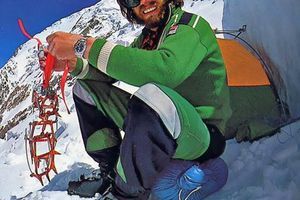
In 1978, Reinhold Messner and Peter Habeler completed the first confirmed ascent of Everest without supplemental oxygen.
In 1980, Messner completed the first successful solo ascent of Everest, also without supplemental oxygen.
These achievements demonstrated how different an ascent of the same mountain could be depending on the route, style and objectives of the climbers.
The Two Main Routes to the Summit
There are numerous routes on Mount Everest, but the vast majority of modern ascents use one of two main approaches:
-
the southern route through Nepal;
-
the northern route through China and Tibet.
The South Route Through Nepal
This is the route used by Hillary and Tenzing in 1953.
A typical progression is:
Lukla → Namche Bazaar → Dingboche → Lobuche → Everest Base Camp → Khumbu Icefall → Camp II → Camp III → South Col → Summit.
One of the most famous and dangerous sections of this route is the Khumbu Icefall, a huge moving glacier filled with crevasses, ice towers and unstable sections.
Because the glacier is constantly moving, the route through the icefall has to be prepared and maintained throughout the climbing season.
The North Route Through Tibet
From the Chinese side, the route passes through the North Col before continuing toward the summit along the Northeast Ridge.
Its challenges differ from those of the southern route.
There is no equivalent of the Khumbu Icefall on the same scale, but climbers face long, exposed sections at extreme altitude and technical challenges along the upper mountain.
The two routes therefore have different types of objective hazards. The southern route is particularly associated with the Khumbu Icefall, while the northern route includes long high-altitude sections leading toward the summit.
Everest Base Camp - What Is It?
Everest Base Camp is the main expedition base from which climbers begin the direct preparation for an ascent of the summit.
In fact, there are two major base camps:
-
the South Base Camp in Nepal;
-
the North Base Camp in Tibet.
The South Base Camp is located on the Khumbu Glacier. The North Base Camp is situated in the Rongbuk Glacier area.
Base Camp is much more than a place to sleep.
During the climbing season, it becomes a temporary high-altitude settlement where climbers and expedition staff eat, rest, acclimatize, prepare equipment and wait for suitable weather conditions.
At the same time, it is important to distinguish between an Everest Base Camp trek and an expedition to the summit of Mount Everest.
A trekker can travel to Everest Base Camp without attempting to climb the summit. The physical and technical requirements are completely different from those of an ascent to 8,848.86 meters.
We have covered the journey to Everest Base Camp in a separate article:
[Everest Base Camp Trek: Route, Highlights and What to Know]
The High-Altitude Camps of Everest
After reaching Base Camp, climbers do not immediately head for the summit.
The ascent is gradual.
On the southern route, the traditional camp system includes:
-
Base Camp;
-
Camp I;
-
Camp II;
-
Camp III;
-
South Col;
-
Summit.
The exact location and use of camps can vary depending on the season, route conditions and expedition strategy.
The main reason for this system is acclimatization.
The human body needs time to adapt to the decreasing availability of oxygen at higher elevations. Climbers therefore make multiple rotations up and down the mountain before attempting the summit.
The final summit push takes place after these acclimatization rotations and only when weather conditions are favorable.
Acclimatization and the Death Zone
Above approximately 8,000 meters (26,247 feet), climbers enter what mountaineers commonly call the Death Zone.
This is not an official geographical boundary, but a term used to describe elevations where the human body can no longer maintain normal physiological function for long periods.
For this reason, climbers try to minimize the amount of time they spend at these elevations.
At extreme altitude, the problem is not simply physical fatigue. Coordination, judgment and decision-making can deteriorate as oxygen availability decreases.
As a result, even a relatively simple movement above 8,000 meters can become a serious challenge.
Why Is Everest Dangerous?
Everest is not considered the most technically difficult mountain in the world.
There are peaks with much more difficult climbing routes.
What makes Everest unique is the combination of extreme altitude, severe weather, long expedition times and objective hazards.
Altitude
At 8,848.86 meters, the availability of oxygen is dramatically reduced.
Weather
Strong winds, extreme cold and rapidly changing weather can turn a manageable route into a life-threatening environment.
Khumbu Icefall
The glacier is constantly moving. Crevasses and ice formations can change throughout the climbing season.
Avalanches and Rockfall
Snow, ice and rock can fall unexpectedly on different parts of the mountain.
Exhaustion
Even highly trained climbers move much more slowly at extreme altitude.
Human Error
Above 8,000 meters, the consequences of even a relatively small mistake can be severe.
Modern equipment and technology have improved safety, but they cannot eliminate the fundamental risks of high-altitude climbing.
When Is Everest Climbing Season?
Nepal officially recognizes four mountaineering seasons:
-
spring - March to May;
-
summer - June to August;
-
autumn - September to November;
-
winter - December to February.
For Everest, however, spring is by far the most important climbing season.
The reason is the combination of weather patterns and short periods when winds and other conditions allow summit attempts.
Expeditions may spend weeks waiting for a suitable weather window.
This is one of the reasons an Everest expedition takes much longer than the final summit climb itself.
How Much Does an Everest Climbing Permit Cost?
The cost of climbing Everest changes over time, so current regulations should always be checked before planning an expedition.
Under Nepal's current regulations, effective from September 1, 2025, the royalty for a foreign climber attempting Everest by the standard route is:
-
US$15,000 in spring;
-
US$7,500 in autumn;
-
US$3,750 in winter and summer.
Different rates apply to other routes on Everest.
It is important to understand that the climbing permit is not the total cost of an Everest expedition.
An expedition also involves expenses for:
-
flights and transportation;
-
accommodation;
-
food;
-
guides;
-
Sherpas and other high-altitude workers;
-
climbing equipment;
-
supplemental oxygen;
-
insurance;
-
logistics;
-
communications;
-
high-altitude camps and support infrastructure.
Expeditions also have environmental and waste-management requirements, including a garbage deposit.
Therefore, it is misleading to describe Everest simply as having one fixed "climbing price." The actual cost depends heavily on the expedition format, level of support and services included.
Sherpas and Modern Everest Climbing
The history of Everest cannot be told without the Sherpa people.
Sherpas are an ethnic group historically associated with the mountainous regions of Nepal and Tibet. Many Sherpas have become highly experienced professional mountaineers and high-altitude workers.
Their role on Everest goes far beyond carrying equipment.
High-altitude workers help with:
-
route preparation;
-
fixing ropes;
-
establishing and maintaining camps;
-
transporting equipment and supplies;
-
expedition logistics;
-
supporting climbers during summit attempts.
Tenzing Norgay became the most famous Sherpa in history after reaching the summit of Everest with Edmund Hillary in 1953.
But his story represents only one part of the much larger contribution of Sherpa climbers and high-altitude workers to Himalayan mountaineering.
Everest Today
Modern Everest is very different from the mountain encountered by the first British expeditions.
Today's climbers have access to:
-
advanced weather forecasts;
-
satellite communications;
-
modern climbing equipment;
-
specialized high-altitude clothing;
-
GPS and navigation systems;
-
supplemental oxygen systems;
-
fixed ropes;
-
improved medical and logistical support.
At the same time, Everest has become much more accessible to commercial expeditions.
Since the 1990s, the number of commercial climbing operations has increased significantly. Today, numerous international expeditions operate on the mountain and share parts of the route infrastructure.
This has created new challenges:
-
congestion on popular sections;
-
pressure on mountain infrastructure;
-
waste and environmental problems;
-
dependence on high-altitude workers;
-
questions about the safety of commercial mountaineering.
Nepal has gradually introduced and updated regulations aimed at improving safety, managing tourism and addressing environmental issues around Everest.
The Most Famous Tragedies on Everest
The history of Everest is not only a history of successful ascents.
The mountain claimed the lives of climbers and high-altitude workers even during the earliest expeditions.
The disappearance of Mallory and Irvine in 1924 remains one of the most famous mysteries in mountaineering.
In 1996, a series of deaths during commercial expeditions attracted worldwide attention and raised major questions about safety, decision-making and commercial climbing on Everest.
In 2014, an avalanche in the Khumbu Icefall killed 16 Nepali high-altitude workers. It became one of the deadliest disasters in Everest's history and had a major impact on discussions about the risks faced by Sherpa workers.
In 2015, the earthquake in Nepal triggered an avalanche on Everest that struck the Base Camp.
These events highlight an important reality:
Modern equipment and technology have improved safety, but they have not made Everest safe.
Everest Base Camp Trekking vs. Climbing Everest
This is one of the most important distinctions to understand if you are interested in Everest.
Trekking to Everest Base Camp and climbing Mount Everest are two fundamentally different experiences.
Everest Base Camp Trek
The Everest Base Camp trek is a multi-day high-altitude journey through the Khumbu Valley.
The route passes through Sherpa villages, monasteries and spectacular mountain landscapes.
Although the trek reaches significant elevations, it does not require the technical mountaineering skills needed to climb Everest itself.
Climbing Mount Everest
Climbing Everest is a full-scale high-altitude mountaineering expedition.
It requires:
-
serious physical preparation;
-
high-altitude experience;
-
technical climbing skills;
-
acclimatization;
-
specialized equipment;
-
expedition logistics;
-
a climbing permit.
Someone who reaches Everest Base Camp has completed a demanding high-altitude trek, but they have not "almost climbed Everest."
The summit requires an entirely different level of preparation and commitment.
Interesting Facts About Mount Everest
1. Everest has several names
Mount Everest, Sagarmatha and Qomolangma are names for the same mountain, originating from different linguistic and cultural traditions.
2. Everest was once known as Peak XV
This was the designation used in British surveying records before the mountain was officially named Mount Everest.
3. Mallory died 29 years before the first confirmed ascent
His 1924 expedition remains one of the greatest mysteries in mountaineering history.
4. Mallory's body was found 75 years later
In 1999, an expedition led by Conrad Anker discovered Mallory's body high on the mountain.
5. The famous summit photograph shows Tenzing Norgay
The photograph was taken by Edmund Hillary on May 29, 1953.
6. Everest has two primary modern climbing routes
The southern route approaches from Nepal, while the northern route approaches from Tibet.
7. Parts of Everest are constantly moving
The Khumbu Icefall is a particularly famous example of a constantly changing high-altitude environment.
8. Base Camp becomes a temporary settlement
During climbing season, hundreds of people may live and work in the Everest Base Camp environment, supporting expeditions.
9. The official elevation is 8,848.86 meters
Nepal and China jointly announced this measurement in 2020.
10. Everest is not the most technically difficult mountain in the world
Its extraordinary challenge comes from the combination of extreme altitude, weather, expedition duration and objective hazards.
Everest as a Symbol
For a mountaineer, Everest is a real mountain - a route, an elevation, weather, acclimatization and a multi-week expedition.
For a traveler, Everest can be a symbol of the Himalayas.
And for someone who simply loves mountains, it is one of the most recognizable mountain images in the world.
Everest represents great journeys, long-term goals and those moments when a person finds themselves surrounded by mountains that exist on a completely different scale from everyday life.
That is why the image of Everest has long gone beyond mountaineering.
The Everest Pendant by Travel Jewelry
Everest has become one of the symbols of our mountain collection.
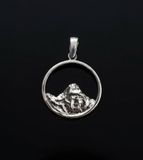
We created the Everest pendant in 925 sterling silver, featuring a stylized silhouette inspired by the world's highest mountain.
It is a piece of jewelry for people for whom mountains are more than just a place on a map.
The front features the silhouette of Everest, while the back is engraved with the name Everest and the height 8,848 m.
The pendant is 22 mm in diameter and weighs approximately 3.2 grams. Its surface features jewelry blackening that emphasizes the relief and details of the design.
It can become a personal reminder of a journey to the Himalayas, a gift for a mountaineer, or simply a small symbol of a love for mountains.
Discover the Everest Pendant →
Related Articles
If you are interested in Mount Everest, the Himalayas and mountaineering, you may also enjoy:
-
Everest Base Camp Trek - route, key points and what to expect from the journey to Everest Base Camp.
-
Ama Dablam - One of the Most Beautiful Mountains in the Himalayas.
-
What to Give a Mountaineer - Gift Ideas for Mountain Lovers.
Conclusion
Mount Everest became the world's most famous mountain not simply because of its height.
Its history is made up of decades of exploration, unsuccessful expeditions, the mystery of Mallory and Irvine, the historic ascent of Hillary and Tenzing, the achievements of Sherpa climbers and thousands of modern mountaineers.
Today, technology allows climbers to forecast weather more accurately, organize expeditions more efficiently and improve safety. But at 8,848.86 meters, Everest remains an extraordinary and dangerous environment.
For some people, it is a mountaineering goal.
For others, it is a dream of the Himalayas.
And for someone who simply loves mountains, it can be represented by a small symbol that keeps that connection close.
That symbol can be Everest.
Beyond the Limits: How Reinhold Messner Accomplished the First Solo Ascent of Everest Without Oxygen
Edelweiss: The Legendary Mountain Flower That Never Fades from Memory
The Climbing Carabiner: The Story of One of the Most Important Inventions in Mountaineering
Everest Base Camp Trek - One of the Greatest Adventures on Earth