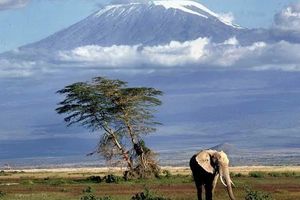
Kilimanjaro is often imagined as a solitary mountain rising above the African plains - its snow-covered summit, volcanic cones and routes leading to the highest point on the continent. Yet its lower slopes hold an entirely different world: dense gardens, coffee trees, banana groves, villages and water flowing through narrow channels between family plots. This is the story of the Chagga people, whose lives have been shaped over generations through an ongoing relationship with the mountain.
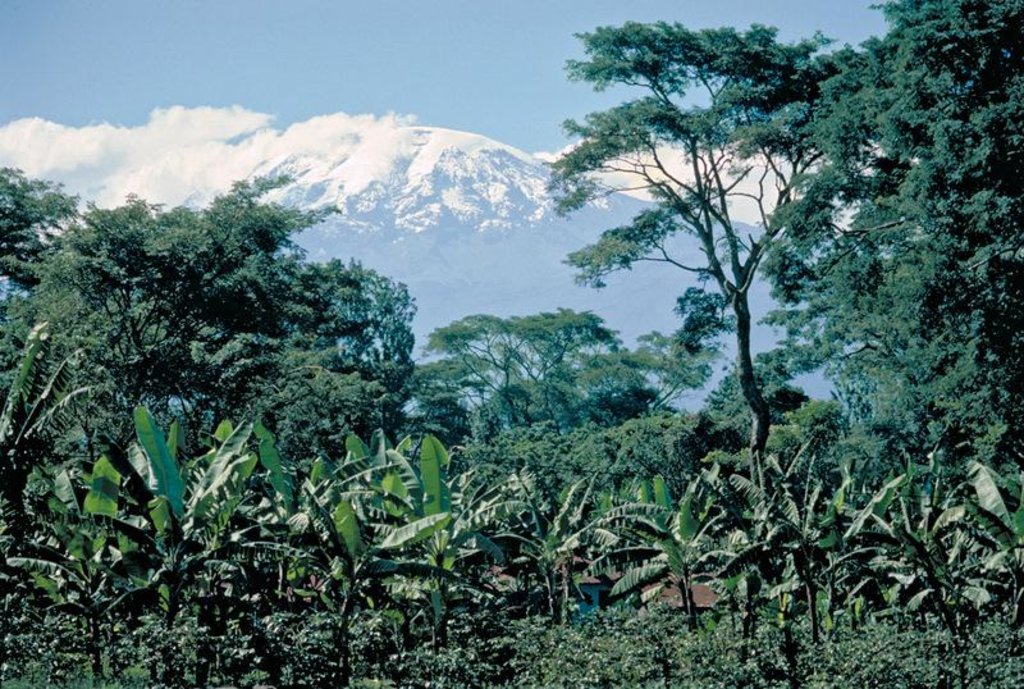
For the Chagga, the mountain was more than a landmark on the horizon. It provided water, fertile volcanic soils and a range of altitude zones with different temperatures and levels of moisture. People learned to work with these conditions, growing a variety of crops on relatively small plots and sustaining their households. In this story, nature is not a backdrop: it shapes the rhythm of work, the layout of settlements and the sense of belonging to a place.
1. The People of the Mountain
The Chagga (also known as Wachagga or Chaga) are one of Tanzania’s major ethnic communities. Their historical homeland lies mainly on the southern and eastern slopes of Mount Kilimanjaro, although Chagga people now live in other parts of the country and beyond. Their traditional language, Kichagga, has several regional varieties; the linguistic and cultural landscape of the mountain has never been entirely uniform.
It is difficult to assign an exact date to the emergence of the Chagga as a distinct community. Settlement in the region began long before European accounts of the nineteenth century, and local communities developed gradually through migration, marriage, trade, alliances and conflict. In the past, the slopes were home to numerous separate political territories and chiefdoms, each with its own leaders, kinship networks and rules governing access to land and water.
It is therefore misleading to imagine the Chagga as a single centralized kingdom with fixed borders that never changed. A broader shared identity took shape over time. Historian Matthew V. Bender shows how, during the 1940s and 1950s, the idea of a collective Chagga identity acquired new political significance amid disputes over natural resources and the authority of local rulers. The protection of land and water became one of the forces bringing communities together under a shared name.
2. Kihamba - The Garden That Sustains a Family

One of the most distinctive features of traditional Chagga life is the kihamba - a family plot that includes a home and a garden. It is much more than a vegetable patch beside a house: it is a carefully developed, multi-layered agroforestry system. Tall trees form the upper canopy and provide shade; banana plants grow below them; coffee shrubs, vegetables, root crops, spices and other useful plants occupy the lower layers. The exact mix varies with location, altitude, soil and each family’s needs.
This layered structure makes it possible to use the land at several levels. The plants do not simply compete for space; they can complement one another. Trees provide shade, fallen leaves return organic matter to the soil, and crop diversity reduces a household’s dependence on a single harvest. A garden may combine bananas, coffee, yams, taro, ginger, cassava, vegetables and fruit trees.
In the village of Shimbwe Juu, the kihamba system has been included in the FAO programme for Globally Important Agricultural Heritage Systems (GIAHS). According to FAO materials, the local agroforestry landscape contains more than 500 plant species. This figure describes a particular area, not every Chagga garden.
For a family, kihamba means more than food and income. The land connects generations: it is cultivated, inherited and becomes the setting for important family events. In the traditional understanding, it is a place of belonging - a space where ancestors are remembered and the future of children is imagined.

3. Water That Brought Communities Together

If the kihamba was the heart of the household, water was essential to its survival. Rainfall and mountain streams are unevenly distributed across Kilimanjaro’s slopes, and dry seasons made reliable access to water particularly important. Communities developed networks of channels that diverted water from streams and carried it to gardens and settlements.
These channels are known as mfongo. Some extended over considerable distances, following the contours of the slope and making use of the natural gradient. Water was directed to plots where it was needed for irrigation and everyday household use. Some systems also included small storage ponds known as nduwa, which helped communities cope with periods of low rainfall.
Building and maintaining the channels required not only knowledge of the terrain but also agreements among people. Communities had to decide who could use the water, when each plot would receive it, who was responsible for clearing the channel and who would repair damaged sections. Researchers describe these systems as complex social institutions based on collective work, local rules and the authority of elders and water-system leaders.
In some communities, specific channel managers organized water distribution and monitored compliance with the agreed rules. Water therefore did more than irrigate the land. It created interdependence between households, established rules for living together and sometimes became a source of disputes. The history of mfongo shows how closely engineering knowledge, social organization and the natural environment were connected.
According to FAO, one channel in Shimbwe Juu extends for approximately 17 kilometres along the mountain slope. This illustrates the scale of local infrastructure; it is not the length of every traditional channel. The combination of water networks and family gardens helped make intensive agriculture possible on the densely populated slopes.
4. Bananas, Coffee and Everyday Work

Bananas are one of the foundations of traditional Chagga food. Many varieties are grown, and they are used in more ways than simply eating the ripe fruit. Green bananas can form the basis of substantial meals, while fermented banana drinks are common in some areas. Beans, root crops, vegetables and livestock products are also important.
Coffee became an important cash crop later, particularly during the colonial economy of the late nineteenth and twentieth centuries. Its cultivation gradually changed the region’s economic relationships: harvests were sold at markets, and coffee income helped families pay for education, goods and other needs. At the same time, family gardens did not become merely coffee plantations - a mixed system of crops remained essential to everyday food supplies.
Work in the garden was shared among family members, although the division of tasks depended on the place, period and circumstances of each household. Ethnographic accounts describe different responsibilities for men and women, including the care of coffee, bananas, irrigation channels, vegetables, livestock and the home. These descriptions should not be treated as an unchanging rule for all Chagga people or as an exact portrait of today’s families. Today, women and men work in agriculture, education, trade, tourism, and the public and private sectors.
5. Home, Memory and a Sense of Belonging

The traditional Chagga landscape was made up of more than fields and irrigation channels. It included the house, trees, places for storing crops, paths between neighbouring plots and spaces connected with family memory. In the past, buildings were often made from locally available natural materials such as wood, grass, branches and clay. Over time, architecture changed: metal roofs, brick, concrete and modern layouts became increasingly common.
For many families, the meaning of land extended far beyond its economic value. A connection to the kihamba could also mean a connection to ancestors and clan history. Studies of contemporary memory practices describe particular places within family plots associated with lineage, rituals and the remembrance of the dead. Christianity and other changes have influenced religious life, but local forms of memory and symbolic connection to the land have not disappeared everywhere.
The Kichagga language also reflects this local diversity. Dialect differences exist between slopes and communities. Alongside Kichagga, Swahili - Tanzania’s national language - is widely used. For many people, modern identity brings together local heritage, national culture, education, urban life and global connections.
6. From Local Chiefdoms to Modern Tanzania
In the nineteenth century, the slopes of Kilimanjaro were home to numerous chiefdoms. They maintained trade links, formed alliances and sometimes fought one another. Their rulers were often known as mangi. Their authority was connected not only to military strength but also to control over land, water, trade and systems of mutual support.
European travellers and missionaries began describing the region more actively during the nineteenth century. Later, German and then British colonial rule changed local political structures, administrative boundaries and the economy. Coffee became an important cash crop; missionary schools and churches influenced education and religious life; and the colonial administration sought to reorganize traditional systems of authority.
Local communities, however, were not passive participants in these changes. They adapted, negotiated with the authorities, defended their rights to land and water, and rethought their shared identity. The history of the Chagga is therefore not a simple story of traditions disappearing under outside influence. It is a long process of negotiation, adaptation and the preservation of important ties to the home landscape.
7. Kilimanjaro Today: A Mountain That Is Still Home
Modern life on the slopes of Kilimanjaro is no longer limited to traditional gardens. Moshi and other towns in the region are connected to education, trade, transport and tourism. Some people work in towns or elsewhere in the country but maintain a connection with their family land. For others, the kihamba remains the basis of the household economy, a source of food and a place to pass on to the next generation.
This system faces new challenges: population growth, the division of inherited plots among descendants, changes in the coffee market, pressure on water resources and climate change. Young people do not always want to continue agricultural work, while maintaining traditional channels requires time, cooperation and agreements among water users. At the same time, the Chagga experience attracts the attention of researchers and conservationists as an example of how multi-layered farming can combine food production, biodiversity and soil conservation.
When travellers look up at Kilimanjaro from below, they may see one great mountain. But its slopes contain many different worlds - forests, farms, villages, coffee trees, banana gardens and water channels. The story of the Chagga reminds us that a mountain is not only a summit reached by a trail. It is also a home, where people have learned over generations to live with its water, soils and changing climate.
Keep the mountain close. For some, Kilimanjaro is a dream of a distant journey; for others, it is the experience of an ascent; for the people who live on its slopes, it is part of everyday life and family memory. At Travel Jewelry, we created the “Kilimanjaro” pendant in 925 sterling silver. Its design captures the silhouette of the African massif and can become a personal symbol of an encounter with the mountain or a reminder of a journey still to come. Discover the “Kilimanjaro” pendant.
Read also
- Mount Everest: History, First Ascents, Routes and Modern Mountaineering
- Everest Base Camp Trek - One of the Greatest Adventures on Earth
- Mount Kazbek: History, Legends, Climbing, and One of the Most Beautiful Peaks of the Caucasus
- The Highest Mountains in Ukraine: Hoverla, Brebeneskul, Pip Ivan and Other Peaks