Travel Jewelry · The Ukrainian mountain sports community
When a Ukrainian mountaineer sets out on a Himalayan route, a climber competes in a national championship, or a young athlete takes part in a speed-climbing event for the first time, a great deal of organisational work often stands behind the achievement. Part of that work is carried out by the Ukrainian Mountaineering and Climbing Federation (UMCF), known in Ukrainian as ФАіСУ. It brings together regional organisations, develops mountain sports, helps organise competitions, supports national teams and represents Ukraine in the international climbing and mountaineering community.
The UMCF is more than a sports federation. It has grown out of Ukraine's mountaineering tradition, passed through several political and institutional changes, expanded its range of disciplines and continues to operate in a country at war. This article looks at how the federation is organised, who leads it, what it does and which clubs and regional communities shape Ukrainian mountaineering and climbing.

What Is the UMCF?
The Ukrainian Mountaineering and Climbing Federation (UMCF) is a nationwide non-profit organisation coordinating the development of mountaineering and climbing in Ukraine. Its official website also lists dry tooling, ski mountaineering, skyrunning and other related mountain disciplines among its areas of activity.
The federation's Ukrainian name is Федерація альпінізму і скелелазіння України, commonly abbreviated as ФАіСУ. It is important not to confuse it with the Ukrainian Sport Tourism Federation: these are separate organisations with different statutory responsibilities. Sport tourism covers a broad range of hiking and expedition formats, while the UMCF focuses on mountaineering, climbing and related mountain sports.
In practical terms, the federation works with sporting rules and procedures, contributes to the national competition calendar, organises or coordinates Ukrainian championships and cups, supports coaching and judging structures, deals with mountaineering route classification and represents Ukrainian athletes within international sports organisations.
History: From Mountaineering Sections to a National Federation
Organised mountaineering in Ukraine is older than the modern UMCF. According to the Encyclopedia of Modern Ukraine, post-war mountaineering developed under the guidance of a mountaineering section and, from 1958, a mountaineering federation. The historical account names Anatolii Sytnykov, Volodymyr Monoharov and Volodymyr Shumykhin among the leaders of that period.
The modern federation dates its foundation to 15 April 1989 on its own website. The Encyclopedia of Modern Ukraine, however, describes the organisation of the Ukrainian Mountaineering and Climbing Federation in 1991 and its recognition as a national federation in 1999. Public registration records separately list 24 November 1997 as the date when the current non-governmental organisation was registered as a legal entity.
These dates should not be forced into a single timeline entry: they refer to different stages of institutional development - the beginning of the modern federation, the establishment of its national structure, the registration of the legal entity and the acquisition of national federation status. When asked for its foundation date, the federation itself uses 15 April 1989.
During the first decades of Ukraine's independence, the federation continued to bring together regional and city organisations, mountaineering clubs and sports groups. New disciplines gradually joined traditional mountaineering, while sport climbing developed as a distinct discipline with its own rules, coaching system and judging structure.
International Recognition and Partner Federations
The UMCF represents Ukraine in several international sports organisations. These include the UIAA, the International Climbing and Mountaineering Federation; World Climbing, the international governing body for sport climbing, formerly known as the IFSC; the International Ski Mountaineering Federation (ISMF); and the International Skyrunning Federation (ISF).
Membership connects Ukrainian athletes with international rules, calendars, championships and systems of sporting representation. The UMCF's membership in the UIAA dates back to 1991. Its full membership in the ISMF was approved in 2023. The ISF also lists the Ukrainian federation among its full members.
There has also been a recent name change worth knowing. On 10 December 2025, the IFSC announced its rebrand as World Climbing. Older UMCF documents and some federation pages may still use the abbreviation IFSC, while the current international name is World Climbing. This is the same international organisation under a new name, not a separate federation.
The official UMCF website publishes information about its leadership, committees, regional branches, documents and sporting disciplines. It is the best place to check current contacts and organisational updates.
How the Federation Is Organised
The UMCF has central governing bodies and a network of regional branches. Its website lists the Presidium, Supervisory Board, Veterans' Council, Anti-Doping Commission, Education and Methodology Commission, as well as regional branches in different parts of Ukraine.
Sporting work is organised primarily around two major areas: mountaineering and climbing. Each has its own committee, coaching council and judging structure. Within mountaineering, specialist commissions deal with route classification, ski mountaineering and skyrunning, amateur mountaineering and other areas. In climbing, separate working groups cover sport climbing, education and methodology, athletes' representation and ethics.
This structure is needed for more than running competitions. The federation supports the training of athletes, coaches and judges, maintains rankings, processes results, establishes selection criteria for national teams, updates sporting rules and considers matters related to mountaineering route classification.
UMCF Leadership
According to the leadership information published on the federation's official website, the UMCF is headed by Hanna Yasynska. Its vice-presidents are Serik Kazbekov and Hennadii Kopeika. Stanislav Kleshniov is also listed as a member of the Presidium, while Maryna Hnidan is named as the executive secretary.
Each sporting area has its own committee leadership. The latest published information on the mountaineering committee page names Hennadii Kopeika as its chair. The climbing committee is chaired by Olha Zakolodna. This distinction matters: the federation's president leads the organisation as a whole, while the specialist committees coordinate their respective sporting disciplines.
The composition of governing bodies can change following conferences and federation decisions. For practical matters, it is therefore best to consult the official Presidium and committee pages rather than rely on older publications.

Which Disciplines Does the Federation Develop?
The UMCF's remit is broader than traditional summit climbing. It covers several disciplines, each with its own techniques, equipment and competition formats.
Traditional and Technical Mountaineering
Traditional mountaineering involves climbing mountain peaks of different heights and levels of difficulty. Route selection, acclimatisation, teamwork, belaying skills, weather assessment and self-sufficiency are all essential. Technical mountaineering competitions test not only the ability to reach a summit, but also the team's command of technical skills on rock and mixed terrain.
Sport Climbing
Modern sport climbing has three main international disciplines: lead, bouldering and speed. In lead climbing, athletes try to climb as high as possible on a demanding route while protected by a rope from below. Bouldering involves short, technically complex problems on relatively low walls with protective mats. In speed climbing, athletes race on a standardised route, aiming for the fastest time.
Ice Climbing and Dry Tooling
Ice climbing involves moving on frozen formations with ice tools and crampons. Dry tooling uses similar techniques on rock, where athletes climb with tools and crampons. Both disciplines require specialised equipment, precise movement and a high level of technical skill.
Ski Mountaineering and Skyrunning
Ski mountaineering combines uphill travel on skis, sections completed on foot or with mountaineering equipment, and a downhill ski descent. In 2026, the discipline made its Olympic debut at the Milano Cortina Winter Games. Skyrunning is mountain running over demanding terrain, where elevation gain, technical trails and efficient movement in the mountains all matter.

National Championships, Cups and Sporting Events
One of the federation's most visible responsibilities is the national competition calendar. In sport climbing, Ukraine holds national championships and Ukrainian Cup events in speed, lead and bouldering. Some events are intended for adult athletes, while others are organised for youth, juniors and younger age groups. National championship results can also play a role in selecting athletes for the Ukrainian national team.
A good example is the Ukrainian School Climbing Championship, held in Kremenchuk in June 2025. The event featured speed and lead climbing and brought together 193 athletes from nine regions of Ukraine. It is a reminder that the federation's work is not limited to elite adult competitors: it also involves youth development and the next generation of athletes.
In December 2025, the final of the Ukrainian Bouldering Cup took place as part of the Boulder Space Anniversary event. This illustrates how the national sporting calendar can work with private climbing gyms, local organisers, route setters and partners. A competition is not just about athletes on the wall: it also depends on judges, coaches, route setters, volunteers and technical staff.
In mountaineering, the federation runs championships and cups in mountaineering technique, ski mountaineering and skyrunning. In 2026, the UMCF also announced a Cup for the Best Mountaineering Ascent of the Season. Teams affiliated with the federation can submit ascents of peaks above 2,000 metres in any mountain region of the world, provided they were completed without supplemental oxygen. Entries include an ascent report, route description and photographs. This is different from a climbing-gym competition: it evaluates an actual mountain ascent and its sporting significance.

Expeditions and Ukrainian Ascents
The UMCF's story is connected not only with sporting competitions but also with major mountain projects. Materials from the Kyiv branch of the federation mention national expeditions marking anniversaries of Ukraine's independence: an ascent of Manaslu in 2001 for the tenth anniversary and an ascent of Makalu in 2010 for the twentieth. These projects had both sporting and symbolic significance, bringing the Ukrainian flag to some of the world's major peaks.
Another landmark in modern Ukrainian mountaineering was the first ascent of the south-east ridge of Annapurna III in autumn 2021. The route was climbed by Mykhailo Fomin, Mykyta Balabanov and Viacheslav Polezhaiko. The team received a Special Mention from the jury of the 2022 Piolets d'Or, one of the most respected international mountaineering awards. The UMCF Mountaineering Committee's report describes the ascent as one of the outstanding achievements of Ukrainian alpine-style mountaineering.
It is important to make a distinction: not every expedition undertaken by Ukrainian mountaineers is automatically an expedition organised by the federation. Some projects are initiated by the athletes themselves, by clubs or by independent teams. The UMCF's role may involve sporting representation, coordination, support or recording an achievement within the national sporting context. This distinction allows us to celebrate Ukrainian achievements without attributing organisational work to the wrong people.

The UMCF During Russia's Full-Scale War Against Ukraine
Since February 2022, the work of the federation and the entire Ukrainian mountain community has changed profoundly. The Mountaineering Committee's report for 2020-2023 states that no mountaineering competitions were held in 2022, while the pandemic and Russia's full-scale invasion restricted sporting events and international travel.
The same report notes that many mountaineers joined the Armed Forces of Ukraine or territorial defence units, and that dozens of athletes were killed. In January 2023, Oleksandr Zakolodnyi was killed near Bakhmut. He was chair of the UMCF Mountaineering Committee, a mountaineer and a serviceman. His death was a profound loss for the Ukrainian mountain community.
Despite these circumstances, the federation continued working on rules, route classification and the development of new disciplines. National competitions in ski mountaineering, skyrunning and mountaineering technique resumed in 2023. This part of the story shows that the federation is not an abstract administrative structure: it is made up of people - coaches, judges, athletes and clubs - many of whom continue their work under extraordinarily difficult conditions.
Mountaineering Clubs and Regional Communities in Ukraine
The UMCF is not just a central office. Its work relies on regional branches, local federations, clubs, training sections and climbing gyms. The federation publishes a list of regional branches that includes Kyiv and a number of Ukrainian regions, among them Dnipropetrovsk, Donetsk, Lviv, Odesa and Kharkiv. A regional UMCF branch and an independent mountaineering club are not necessarily the same organisation: sometimes they work alongside one another or within a shared local structure.
Kharkiv Regional Mountaineering Club
The Kharkiv Regional Mountaineering Club is one of the best-known historic centres of Ukrainian mountaineering. It runs a mountaineering school for beginners and houses an exhibition dedicated to the nearly century-long history of Kharkiv climbers. The Kharkiv regional mountaineering and climbing federation also works from the club, helping organise sporting events, develop local teams and support the regional community.
Extrem Mountain Club, Lviv
The Lviv-based Extrem Mountain Club was founded in 1992. It is a non-profit public organisation and a regional UMCF branch. The club brings together mountaineers and climbers from the Lviv region, runs an annual mountaineering school, organises training on natural rock and holds mountain training camps in the Tatras, the Alps, the Caucasus and the Pamirs.
Kyiv and Other Regional Centres
Kyiv has a UMCF branch as well as a city federation that organises training sections, courses and local competitions. Active regional communities can also be found in Dnipro, Odesa, Ivano-Frankivsk, Vinnytsia, Kropyvnytskyi and other cities. Their strengths and specialisations differ: some have a particularly strong tradition in traditional mountaineering, while others focus on sport climbing, youth programmes, mountaineering technique or mountain running.
It would be inaccurate to label a few clubs as "the largest" without current, comparable membership figures. These examples instead illustrate the diversity of Ukraine's mountain community and its regional foundations.

Interesting Facts About the UMCF
- The federation's official foundation date is 15 April 1989, although organised mountaineering in Ukraine has a much longer history.
- The UMCF represents Ukraine in several international organisations: the UIAA, World Climbing (formerly IFSC), ISMF and ISF.
- Ski mountaineering became an Olympic sport at the 2026 Winter Games in Milano Cortina.
- National climbing competitions include young athletes: the 2025 school championship brought together 193 participants from nine Ukrainian regions.
- The federation works on mountaineering route classification and supports the training of coaches and judges.
- In 2026, the UMCF introduced a Cup for the Best Mountaineering Ascent of the Season, recognising real mountain ascents rather than results on artificial walls alone.
The UMCF Is More Than a Competition Calendar
The Ukrainian Mountaineering and Climbing Federation brings together different worlds: from classic expeditions to the great mountains to short bouldering problems in a gym, from ice climbing to ski mountaineering and skyrunning. Its work includes many less visible processes - rules, rankings, coach and judge education, regional coordination, route documentation and representing Ukraine internationally.
Every championship depends on organisers and volunteers. Every expedition depends on a team, preparation and support. Every club is built around people who pass their experience on to the next generation. Together, this network forms Ukraine's mountaineering and climbing community.
The UMCF should therefore be seen as more than an organisation that approves sporting rules. It is one of the institutions through which Ukraine's mountain culture maintains continuity, develops new disciplines and remains part of the international community.
Ice Pendant - A Mountain and an Ice Axe
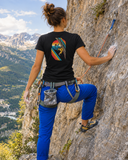
An ice axe is one of the most recognisable symbols of mountaineering. It evokes technical routes, movement on snow and ice, trust in equipment and responsibility within a climbing team. The Ice pendant by Travel Jewelry combines the silhouette of a mountain with an ice axe - a small symbol of belonging to the world of high places and mountain ascents.
Read Also
- Ski Mountaineering: History and Development
- What to Gift a Rock Climber: 20 Thoughtful Gift Ideas They'll Actually Use
- The Climbing Carabiner: History and Evolution
- Climbing Shoes: History and Evolution
- Mount Everest: History, First Ascents and Routes
- Types of Skis and Skiing Disciplines
- History of Skis
- Mount Kazbek: History and Climbing
- Everest Base Camp Trek
- What to Gift a Rock Climber
- 15 Gift Ideas for Climbers