It is difficult to imagine modern mountaineering without a carabiner.
This small piece of metal has become such a familiar part of climbing equipment that most climbers rarely stop to think about how profoundly it changed the way people move in the mountains. Carabiners make it possible to build anchors, manage ropes efficiently, organize belays, and safely negotiate technical terrain.
But it was not always this way.
Before the beginning of the 20th century, climbers relied almost entirely on ropes, knots, and pitons. The introduction of the carabiner marked a turning point that forever changed the evolution of mountaineering.
How Was the Carabiner Invented?
The modern climbing carabiner has surprisingly practical origins.
Its ancestors were spring-loaded metal hooks used by firefighters, soldiers, and industrial workers in the late 19th century. These devices allowed equipment and safety lines to be attached quickly and securely.
The simple concept of a metal hook with a spring-loaded gate eventually caught the attention of climbers in Central Europe, who were searching for faster and safer ways to work with ropes on increasingly difficult routes.
That simple idea became the foundation of the modern climbing carabiner.
The First Climbing Carabiners
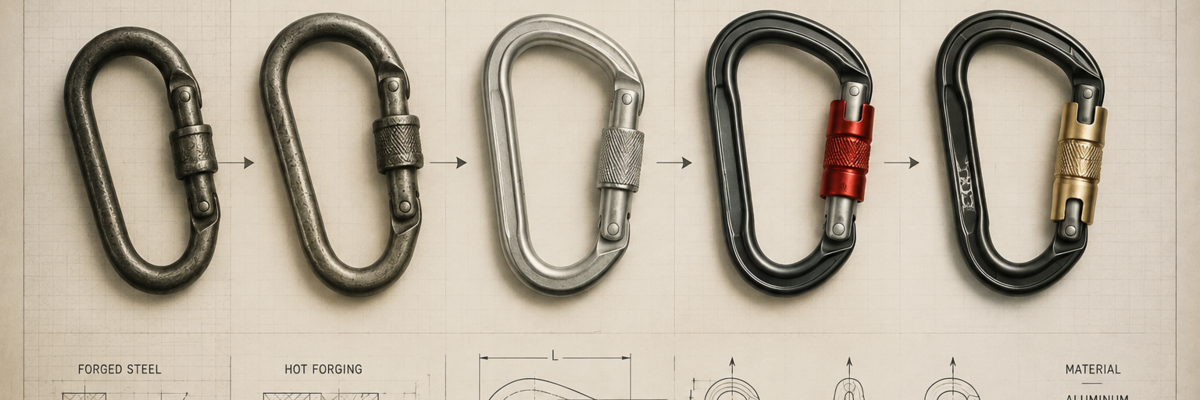
In the early 1900s, Austrian and German climbers began using the first steel carabiners.
These early models were heavy, hand-forged, and very different from today's refined designs. Even so, they dramatically simplified rope management and reduced the time required to build protection systems on the mountain.
It quickly became clear that the carabiner was far more than just another piece of equipment - it was an invention that would redefine technical climbing.
A Revolution in Mountaineering
During the 1920s and 1930s, carabiners became increasingly common on difficult Alpine routes.
They allowed climbers to:
- build belays more quickly;
- move more efficiently on vertical terrain;
- create stronger anchor systems;
- climb technical routes with greater confidence and safety.
Many mountaineering historians consider the carabiner one of the key innovations that made modern technical climbing possible.
From Steel to Aluminum Alloys
The first climbing carabiners were made entirely from steel.
While incredibly strong, they were also heavy.
After World War II, manufacturers began producing carabiners from high-strength aluminum alloys. This dramatically reduced weight while maintaining excellent durability and strength.
These lighter designs soon became the industry standard and remain the foundation of modern climbing equipment.
Why Is a Carabiner Shaped Like That?
At first glance, the shape of a climbing carabiner may appear simple.
In reality, every curve has a purpose.
The familiar D-shaped geometry directs most of the load onto the strongest part of the frame - the major axis. This allows the carabiner to achieve exceptional strength while keeping weight to a minimum.
Although materials, locking systems, and manufacturing methods have evolved dramatically over the decades, the basic geometry has remained remarkably consistent because of its efficiency.
The Main Types of Climbing Carabiners
As climbing developed, manufacturers designed different carabiner shapes for different applications.
The most common types include:
- D-shaped - versatile, all-purpose models.
- Offset D - similar to the classic D shape but with a larger gate opening.
- HMS (Pear) - designed primarily for belaying and rappelling.
- Oval - symmetrical models often used in rescue systems, aid climbing, and industrial rope access.
Each design is optimized for a specific purpose while sharing the same fundamental principle: creating a fast, secure connection.
Why Are Carabiners Marked with kN?
Every certified climbing carabiner is marked with numbers followed by kN.
This stands for kilonewtons, the international unit used to measure force.
These markings indicate the loads the carabiner can withstand during standardized laboratory testing under different loading directions.
Certified climbing carabiners are tested according to internationally recognized UIAA and EN safety standards, ensuring they meet strict performance and reliability requirements.
The Engineering Race: How Manufacturers Improved the Carabiner
During the second half of the 20th century, climbing equipment manufacturers entered an era of rapid innovation.
Their goal was to make carabiners:
- lighter;
- stronger;
- easier to handle;
- more reliable while wearing gloves;
- less likely to snag on ropes or gear.
Companies such as DMM, Petzl, Black Diamond, CAMP, and many others introduced major improvements, including hot-forged construction, Keylock noses, wiregate technology, advanced locking mechanisms, and highly specialized designs for different climbing disciplines.
Even today, manufacturers continue refining materials, ergonomics, and construction techniques to make climbing equipment safer and more efficient.
When Carabiners Were Considered "Unfair"
Interestingly, the introduction of carabiners was not universally welcomed.
In the early 20th century, some climbers believed that using carabiners made climbing too easy. They argued that "true" mountaineering should rely almost entirely on ropes, knots, and minimal equipment.
History proved otherwise.
Carabiners did not make mountains easier.
They made climbing significantly safer.
Within just a few decades, they became an essential part of mountaineering equipment throughout the world.
Interesting Facts About Climbing Carabiners
- The first climbing carabiners were made entirely from steel.
- Modern aluminum carabiners often weigh several times less than their early predecessors.
- A single climbing carabiner can withstand loads of several dozen kilonewtons.
- Specialized carabiners exist for mountaineering, rock climbing, rescue operations, industrial rope access, and caving.
- The Keylock system greatly reduces the chance of snagging on ropes, slings, or other equipment.
- Millions of climbing carabiners are manufactured every year for climbers around the world.
The "Carabiner" Silver Pendant by Travel Jewelry
For people who love the mountains, a carabiner is much more than a piece of equipment.
That idea inspired us to create our Carabiner silver pendant.
Rather than simply recreating the shape of an iconic climbing tool, we wanted to capture everything it represents - reliability, mutual trust, and a lifelong passion for the mountains.
Conclusion
Some pieces of equipment make climbing more comfortable.
Others make modern mountaineering possible.
The carabiner belongs firmly in the second category.
Small and simple in appearance, it has become one of the enduring symbols of the mountains, trust, and safety.
Related Articles
If you enjoy learning about mountaineering history and climbing equipment, you may also like: